
Amblyopia Explained: Vision Development, Patching Therapy, and Treatment Options
 Jul, 7 2026
Imagine looking at the world through a slightly foggy window in one eye while the other sees everything crystal clear. Most people wouldn't notice because their brain automatically ignores the blurry image. But for children with Amblyopia, also known as lazy eye, this suppression becomes permanent if left untreated. It is not just an eye problem; it is a wiring issue in the brain. This condition affects roughly 2% to 4% of children worldwide, making it the leading cause of preventable vision loss in kids. The good news? When caught early, it is highly treatable. The challenge lies in understanding how vision develops and sticking to treatments that feel tedious to a child.
How Vision Develops and Why Amblyopia Occurs
To understand amblyopia, you have to look beyond the eyeball. Vision starts in the retina but finishes in the visual cortex of the brain. During the first seven years of life, the brain is like a sponge, rapidly building neural pathways based on what the eyes see. This is called the critical period of visual development. If both eyes send clear, aligned images, the brain learns to merge them into a single 3D picture (binocular vision). If one eye sends a blurry or misaligned signal, the brain gets confused. To avoid double vision or constant blur, it simply shuts off the input from the weaker eye. Over time, the connections between that eye and the brain weaken, leading to reduced best-corrected visual acuity (BCVA).
This isn't a structural defect in the eye itself. The eye looks healthy under an exam light. The problem is neurological. Dr. Abed Namavari, a specialist at Colorado Eye Clinic, notes that intervention before age five yields the best results because the brain is most plastic during those years. However, recent studies show that older children-and even some adults-can still benefit from treatment, challenging the old belief that nothing could be done after age eight.
The Three Main Types of Amblyopia
Amblyopia doesn't happen randomly. It usually stems from one of three specific causes. Identifying which type your child has dictates the treatment plan.
- Strabismic Amblyopia: This accounts for about 50% of cases. It occurs when the eyes are misaligned-one turns in, out, up, or down. Because the eyes point in different directions, the brain receives two conflicting images. To stop seeing double, the brain suppresses the image from the deviating eye. This is often visible to parents as a "crossed eye" or "wall eye."
- Anisometropic Amblyopia: Making up roughly 30% of cases, this happens when there is a significant difference in refractive error between the two eyes. For example, one eye might be perfectly normal, while the other is highly nearsighted or farsighted. The brain prefers the sharp image from the stronger eye and ignores the chronically blurry one. Since the eyes appear straight, parents rarely notice until a school screening catches it.
- Deprivation Amblyopia: This is the rarest (10-15%) but most serious form. A physical blockage prevents light from entering the eye entirely. Causes include congenital cataracts, ptosis (droopy eyelid), or corneal scarring. Without immediate medical or surgical removal of the obstruction, permanent vision loss can occur rapidly.
Risk factors include premature birth, low birth weight (under 2,500 grams), and family history. If amblyopia runs in your family, your child’s risk increases by 30-40%. Regular pediatric eye exams are non-negotiable for these groups.
Patching Therapy: The Gold Standard
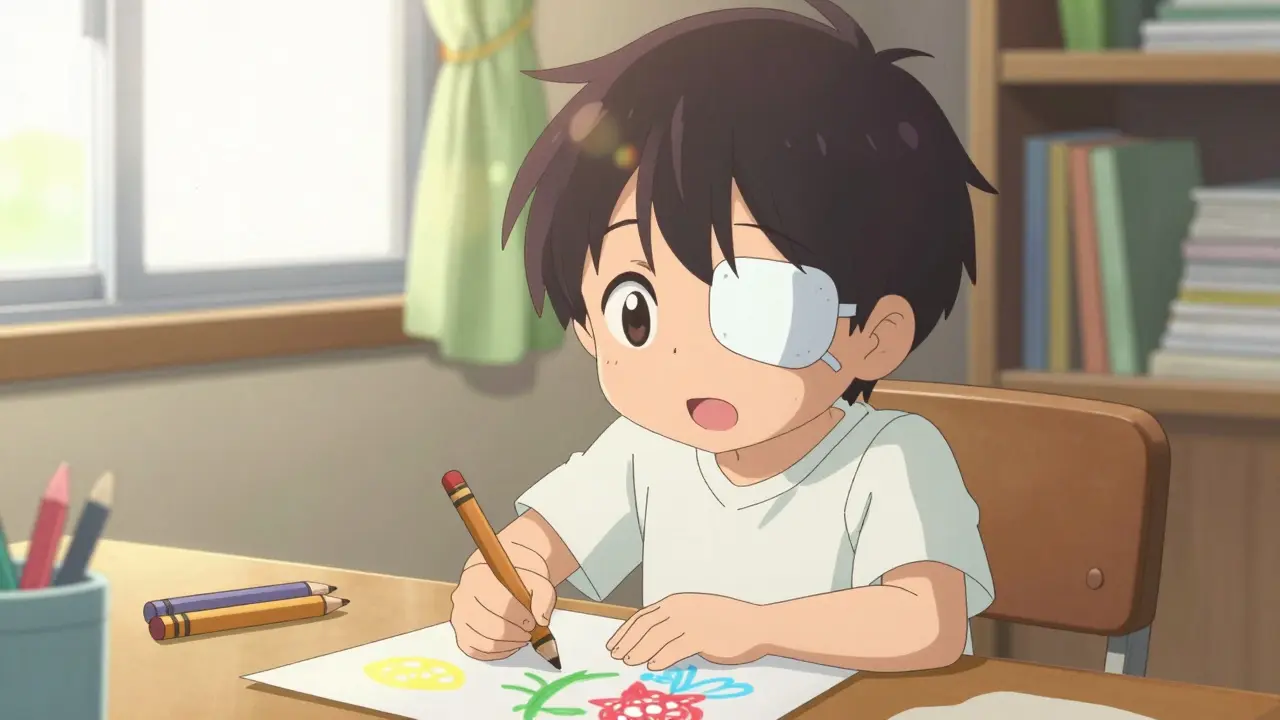
When doctors talk about treating lazy eye, they are mostly talking about forcing the brain to use the weak eye. The most common method is patching therapy, also known as occlusion therapy. You cover the strong eye with an adhesive patch, compelling the brain to process signals from the amblyopic eye. It sounds simple, but consistency is key.
| Severity Level | Daily Patching Time | Typical Duration |
|---|---|---|
| Mild (20/30 - 20/40) | 1-2 hours | 3-6 months |
| Moderate (20/50 - 20/100) | 2-4 hours | 6-12 months |
| Severe (< 20/200) | 6+ hours | 12+ months |
The landmark Amblyopia Treatment Study (ATS) revealed a crucial insight: more is not always better. For moderate amblyopia, two hours of daily patching produced the same visual gains as six hours. This reduces the burden on families and improves compliance. However, the ATS also showed that only 40-60% of children adhere strictly to the schedule. Why? Patches itch, they peel off, and kids face social stigma at school.
To combat this, experts recommend integrating patching into enjoyable activities. Reading, drawing, or playing video games with the strong eye covered makes the time fly. Digital apps like 'LazyEye Tracker' help parents log hours, turning it into a game with rewards. Consistency beats intensity. Two hours every day is far more effective than ten hours once a week.
Alternatives to Patching
If patching fails due to skin irritation, poor compliance, or social resistance, several alternatives exist. These methods aim to penalize the strong eye without a visible patch.
- Atropine Penalization: Doctors prescribe 1% atropine sulfate drops for the strong eye. Atropine temporarily paralyzes the eye's focusing muscle, blurring near vision. The child naturally starts using the amblyopic eye for reading and close work. The Pediatric Eye Disease Investigator Group (PEDIG) found atropine equally effective as patching for moderate cases, with 79% of children achieving 20/30 vision or better after six months. Newer protocols allow weekend-only dosing for maintenance, improving quality of life.
- Bangerter Filters: These are opaque stickers applied directly to the glasses lens over the strong eye. They diffuse light rather than blocking it completely, mimicking the effect of patching but looking less obvious. Studies show 60-70% efficacy, particularly useful for older children who refuse patches.
- Vision Therapy: While patching forces the eye open, vision therapy trains the brain to process the image. It involves supervised exercises for focusing, tracking, and binocular coordination. Data from Fox Eye Care Group suggests adding vision therapy to patching can improve stereopsis (depth perception) by 15-20% compared to patching alone. Sessions typically last 45-60 minutes, two to three times a week for several months.
Navigating Compliance and Social Challenges
The biggest hurdle in amblyopia treatment is not the medicine; it is the behavior. Thirty-five percent of parents discontinue treatment early due to child resistance or social embarrassment. How do you handle a seven-year-old who refuses to wear a patch at recess?
Communication is vital. Explain to teachers and friends that the patch helps the eye get stronger, similar to a cast for a broken arm. Some clinics organize "patching parties" where multiple children wear patches together, reducing isolation. At home, establish a routine. Patching during homework or screen time ensures the child is engaged, making the time pass quickly. Never punish a child for removing the patch; instead, investigate why it was uncomfortable. Skin allergies to adhesive are common; switching to silicone-based patches or paper tape can solve this.
Parental education drastically changes outcomes. When parents understand the neuroplasticity behind the treatment-that they are literally rewiring their child's brain-adherence rates jump from 45% to 89%, according to data from Colorado Eye Clinic. You are not just covering an eye; you are saving their future depth perception and career options.
Emerging Treatments and Future Outlook
Science is moving fast. For decades, we believed adult brains were too rigid to fix amblyopia. Now, evidence suggests otherwise. Intensive perceptual learning protocols are showing modest improvements in adults. More exciting are digital therapeutics. FDA-cleared platforms like AmblyoPlay use gamified exercises that adapt to the child's performance. Real-world data from European clinics shows 75% compliance with these apps, significantly higher than traditional patching.
Research into Transcranial Random Noise Stimulation (tRNS) is also promising. In phase 2 trials, combining tRNS with patching resulted in 40% greater visual acuity improvement than patching alone. While these technologies are emerging, the core principle remains unchanged: early detection saves sight. The American Academy of Pediatrics recommends comprehensive vision screening before age three. Don't wait for school screenings. If you suspect an eye turn, squinting, or head tilting, see a pediatric ophthalmologist immediately.
Frequently Asked Questions
Can amblyopia be cured in adults?
While treatment is most effective in childhood, adults can still experience modest improvements. Recent studies show that intensive perceptual learning and specialized vision therapy can enhance visual acuity and contrast sensitivity in adults, though complete normalization is rare compared to childhood outcomes.
How long does patching therapy take to work?
Most children require 6 to 12 months of consistent treatment. Progress is monitored every 4-8 weeks. Mild cases may improve in 3-6 months, while severe cases can take longer. The key is consistency; irregular patching delays results significantly.
Is atropine penalization safer than patching?
Both are safe and effective. Atropine avoids the social stigma and skin irritation of patches but may cause light sensitivity and blurred near vision in the treated eye. It is equally effective for moderate amblyopia and is often preferred for children who resist wearing a patch.
What causes strabismic amblyopia?
It is caused by eye misalignment (strabismus). When eyes point in different directions, the brain receives conflicting images. To avoid double vision, the brain suppresses the signal from the deviating eye, leading to weakened neural connections and reduced vision in that eye.
Do I need surgery for amblyopia?
Surgery is not used to treat amblyopia itself but may be necessary to correct the underlying strabismus (eye misalignment) or deprivation (like cataracts). After surgery, patching or atropine is still required to strengthen the vision in the weaker eye. Surgery aligns the eyes; patching fixes the brain's processing.
Can my child play sports with a patch?
Yes, but caution is advised. Patching eliminates depth perception, which is critical for catching balls or navigating obstacles. Avoid contact sports or activities with high injury risk while patched. Encourage patching during quiet activities like reading or drawing instead.
Why does my child tilt their head?
Head tilting is often a compensatory mechanism for strabismus or significant astigmatism. The child tilts their head to align their eyes or reduce blur. If you notice frequent head tilting, seek an eye exam immediately, as it may indicate uncorrected vision issues or amblyopia.