
Benign Prostatic Hyperplasia and Decongestants: What You Need to Know About Urinary Retention Risk
 Jan, 11 2026
BPH Decongestant Risk Checker
This tool helps you understand the risks of common cold and allergy medications for men with Benign Prostatic Hyperplasia (BPH). Based on clinical studies, certain decongestants can cause sudden urinary retention - a medical emergency.
Check Your Decongestant Risk
Risk Assessment
Select a medication to see the risk level.
If you’re a man over 50 and you’ve been told you have an enlarged prostate, you’ve probably heard about the frustrating symptoms: slow stream, frequent nighttime trips to the bathroom, or that feeling your bladder never fully empties. But here’s something most people don’t warn you about-taking a common cold or allergy medicine could suddenly turn those mild annoyances into a medical emergency.
Why Decongestants Are Dangerous for Men with BPH
Benign Prostatic Hyperplasia, or BPH, is not cancer. It’s just the prostate getting bigger with age. By the time most men hit 60, about half of them have it. By 85, it’s nearly everyone. That’s normal. But normal doesn’t mean harmless. The enlarged prostate squeezes the urethra-the tube that carries urine out of your body. That’s why urination gets harder. Now add decongestants into the mix. Most over-the-counter cold medicines, like Sudafed, contain pseudoephedrine. This ingredient is designed to shrink swollen nasal passages by tightening blood vessels. But it doesn’t stop there. It also tightens smooth muscle in your prostate and bladder neck. Think of it like turning a hose nozzle tighter. Your bladder is trying to push urine out, but now the exit is pinched even more. A 2021 study in the Journal of Urology found that men with BPH who took pseudoephedrine were 2.8 times more likely to develop acute urinary retention-meaning they couldn’t urinate at all. That’s not a small risk. That’s a hospital visit waiting to happen.How Pseudoephedrine Works Inside Your Body
Your prostate isn’t just soft tissue. About half of its enlarged mass is made up of smooth muscle, packed with alpha-1 receptors. These receptors are like tiny locks. When pseudoephedrine hits them, it’s like turning the key. The muscles clamp down. Urethral resistance increases by 35-40%, according to urodynamic studies. That’s not a guess. That’s measured data. Pseudoephedrine doesn’t wear off quickly. Its half-life is 12 to 16 hours. That means even if you take one 30mg tablet at 8 a.m., your body is still processing it at midnight. Symptoms can last up to 24 hours. One man in a 2022 Massachusetts General Hospital trial saw his maximum urinary flow drop by 27% after just one dose. He didn’t feel dizzy or jittery. He just couldn’t pee. And that’s exactly how it often starts-quietly, painfully, unexpectedly.Not All Decongestants Are the Same
If you’re thinking, “I’ll just pick something else,” you need to know the differences. Phenylephrine, found in many “pseudoephedrine-free” cold remedies, is often marketed as safer. But it’s not. It still activates those same alpha receptors. It’s just a little weaker-still raising urethral resistance by 15-20%. It’s not a safe alternative. It’s a false promise. Nasal sprays like oxymetazoline (Afrin) are different. They’re absorbed locally. Less enters your bloodstream. That means less impact on your prostate. Studies show the risk of urinary retention with these sprays is only 1.25 times higher than baseline. That’s close enough to neutral to be considered low-risk-especially if you use them for no more than three days. But here’s the catch: many men don’t realize they’re taking decongestants. They’re hidden in multi-symptom cold tablets, sinus pills, and even some allergy formulas. Always check the active ingredients. Look for pseudoephedrine, phenylephrine, or ephedrine. If you see any of those, walk away.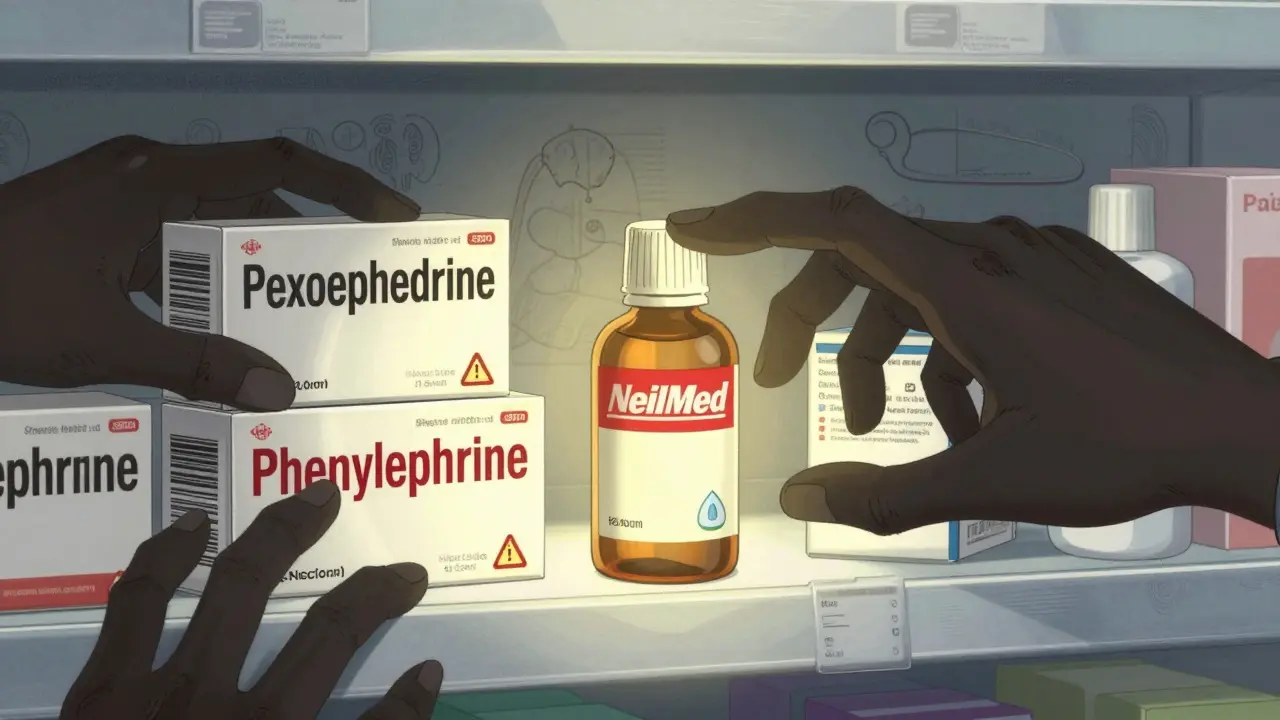
Who’s at Highest Risk?
Age isn’t just a number here. Men over 70 with moderate to severe BPH symptoms (IPSS score above 12) are in the danger zone. A 2016 NIH study found that 51.8% of men in that group developed subclinical urinary dysfunction after taking pseudoephedrine. That means their bladder didn’t empty properly-even if they didn’t feel completely blocked. Compare that to men under 50: only 17.3% showed any change. So if you’re 45 and have mild symptoms, your risk is low. But if you’re 65 and you’ve been told your prostate is enlarged, you’re not just “a little off.” You’re in a high-risk group. The American Urological Association and the European Association of Urology both say: avoid systemic decongestants entirely if you have BPH. The FDA now requires warning labels on pseudoephedrine packaging. But here’s the problem: most men never read them. A 2023 FDA survey showed that only 63% of men over 50 even knew about the risk-up from 28% in 2021. Progress, yes. But still too many people are flying blind.What to Use Instead
You don’t have to suffer through congestion. There are safer options. Saline nasal irrigation-using a neti pot or NeilMed Sinus Rinse-is the gold standard. A 2022 Cochrane Review found it helped 68% of users clear congestion without a single urinary side effect. It’s cheap, simple, and effective. Many users on Amazon and health forums say it’s the only thing that worked for them. Intranasal corticosteroids like fluticasone (Flonase) are another top choice. They reduce swelling inside the nose over time. No effect on the prostate. One study showed 72% effectiveness. You need to use them daily for a few days to feel the full benefit, but once they work, they work well. Antihistamines are tricky. First-gen ones like diphenhydramine (Benadryl) are dangerous-they have anticholinergic effects that relax the bladder muscle, making it harder to empty. That’s another path to retention. Stick to second-gen options like loratadine (Claritin) or cetirizine (Zyrtec). They don’t affect the bladder and carry minimal risk (odds ratio of 1.35).What to Do If You’ve Already Taken a Decongestant
If you’ve taken pseudoephedrine and now feel like you can’t pee, don’t wait. Don’t drink more water. Don’t try to “push harder.” That’s when things get dangerous. Acute urinary retention is a medical emergency. Your bladder is overdistended. It can get damaged. You may need a catheter for 48-72 hours. A 2021 study showed 70% of men who developed retention after decongestants required catheterization. If you’re unsure, try this: go to the bathroom and try to urinate. If you can’t, or if your stream is barely a trickle after 12-24 hours, go to urgent care. Don’t wait until you’re in pain. Don’t hope it’ll pass. It might not.
How to Protect Yourself Going Forward
The best defense is prevention. Here’s what works:- Always tell your pharmacist you have BPH when buying cold medicine. They’re trained to catch this.
- Read labels. If it says “for sinus congestion” or “decongestant,” assume it’s risky.
- Use saline rinses first. Give them a few days before turning to meds.
- If you must use a decongestant, talk to your urologist. They might prescribe tamsulosin (Flomax) ahead of time. A 2022 Cleveland Clinic study showed combining tamsulosin with pseudoephedrine reduced retention risk by 85%.
- Never take decongestants for more than two days in a row. The “48-hour rule” isn’t just advice-it’s a safety line.
Real Stories, Real Consequences
On Reddit, a user named u/BPH_Warrior wrote: “I took one 30mg Sudafed tablet. Within 6 hours, I couldn’t pee. I felt my bladder swell. I sat there for 12 hours, terrified. Ended up in the ER with a catheter. I didn’t even feel sick-I just had a stuffy nose.” Another man on the Prostate Cancer Foundation forum said, “I’ve been on Flomax for years. Thought I was safe. Took a cold pill. Couldn’t pee for 18 hours. They had to catheterize me. I’ve never been so scared.” But there’s hope. The same forums are full of people who switched to saline rinses and now say they haven’t had a urinary issue since. One user wrote: “I used to rely on Sudafed. Now I use NeilMed every night. My nose is clear. My bladder is fine. Best decision I ever made.”What’s Changing in the Medical World
The tide is turning. The American Geriatrics Society now lists pseudoephedrine as a “potentially inappropriate medication” for men over 65 with BPH. The European Medicines Agency is considering restricting sales to older men. Urology practices across the U.S. now routinely screen patients for decongestant use during check-ups. A new drug, PF-06943303, is in late-stage trials. It blocks only the specific receptor in the bladder-not the ones in the nose. Early results show 92% success in preventing retention. It’s not available yet, but it’s coming. The message is clear: we’re moving beyond “just take a pill.” We’re moving toward smarter, safer choices. And that starts with you knowing the risk.Can I take Sudafed if I have an enlarged prostate?
No. Sudafed contains pseudoephedrine, which significantly increases the risk of acute urinary retention in men with benign prostatic hyperplasia (BPH). Studies show a 2.8-fold higher chance of being unable to urinate after taking it. Even one dose can trigger a medical emergency. Avoid it entirely if you have BPH symptoms.
Is phenylephrine safer than pseudoephedrine for BPH?
Not really. Phenylephrine is a weaker alpha-agonist, but it still tightens prostate and bladder neck muscles. It increases urethral resistance by 15-20%, which can worsen urinary symptoms. It’s not a safe alternative. Many “pseudoephedrine-free” products still carry the same risk.
What’s the safest way to treat a stuffy nose with BPH?
Start with saline nasal irrigation (like NeilMed Sinus Rinse), which works for 68% of users with zero urinary side effects. If that’s not enough, try an intranasal corticosteroid like fluticasone (Flonase). These reduce nasal swelling without affecting the prostate. Avoid oral decongestants entirely.
Can I take Claritin or Zyrtec if I have BPH?
Yes. Loratadine (Claritin) and cetirizine (Zyrtec) are second-generation antihistamines with minimal impact on the bladder. They carry a very low risk (odds ratio of 1.35) compared to first-gen antihistamines like Benadryl, which can cause urinary retention by relaxing the bladder muscle. Stick to Claritin or Zyrtec for allergies.
How long does pseudoephedrine affect urination?
Pseudoephedrine has a half-life of 12-16 hours, meaning it stays active in your system for up to 24 hours after a single dose. Urinary symptoms like weak stream or difficulty starting urination can persist during this time. Even if you feel fine, your bladder may still be under pressure.
Should I stop my BPH medication if I need a decongestant?
Never stop your BPH medication without talking to your doctor. If you must take a decongestant, your urologist may recommend starting tamsulosin (Flomax) 72 hours before use. One study showed this combination reduced urinary retention risk by 85%. But the best approach is to avoid decongestants altogether.
Katherine Carlock
January 13, 2026 AT 09:06I took Sudafed last winter thinking it was harmless-turns out I couldn’t pee for 14 hours. Ended up in the ER with a catheter. No joke. My bladder felt like a water balloon about to pop. I didn’t even feel sick, just super uncomfortable. Now I use a neti pot every night. Best decision ever. 🙏
Sona Chandra
January 15, 2026 AT 05:59Why are men so lazy they can't just drink tea or steam their face? Instead they pop pills like candy and then cry when their body says NO. This isn't rocket science. Stop being weak and use your nose, not your pharmacy. 🤦♀️
Jennifer Phelps
January 16, 2026 AT 21:38So phenylephrine is bad too but nasal sprays are okay wait so if I use Afrin for three days is that safe or do I need to count hours and what about those combo cold meds that say 'decongestant' but don't list the ingredient oh god I think I took one last week
Lelia Battle
January 17, 2026 AT 13:37It's fascinating how medicine has become a series of unintended consequences. We treat one system-respiratory-with a systemic agent, and inadvertently disrupt another-urinary-because of shared receptor biology. The body is not a collection of isolated parts. Yet we prescribe and self-medicate as if it were. This isn't just about decongestants-it's about our relationship with pharmaceutical convenience versus physiological wisdom. We've outsourced our bodily awareness to the label on the bottle.
Rinky Tandon
January 17, 2026 AT 23:40Let me be crystal clear for the uneducated masses-pseudoephedrine is a prostate assassin. It's not a 'risk'-it's a biochemical betrayal. You think your nose is the only thing that matters? Your bladder is a sacred organ. When you take that chemical sledgehammer, you're not just inconveniencing yourself-you're inviting acute urinary retention, catheters, ER visits, and psychological trauma. This isn't a suggestion. It's a biological imperative. Stop being naive. Read the damn label. Or suffer the consequences like the rest of us did.
Ben Kono
January 18, 2026 AT 18:19I took Sudafed once for a cold and spent the night in the ER. No pain. No warning. Just couldn't pee. Like my bladder got a lock on it. Now I check every single pill. Even the 'natural' ones. Don't be me.
Cassie Widders
January 19, 2026 AT 23:58I'm 68 and have had BPH for years. I never knew decongestants were this dangerous. I thought it was just about drinking less coffee. Saline rinse changed my life. No more midnight panic. Just a little pot and warm water. So simple. Why didn't anyone tell me sooner?
Konika Choudhury
January 21, 2026 AT 13:32Why do Americans always need a pill for everything? In India we use turmeric steam and ginger tea. No hospital visits. No catheters. Just old wisdom. This is why your healthcare costs are insane. You buy convenience instead of health. Learn from us.
Darryl Perry
January 23, 2026 AT 11:06Study says 2.8x risk. So? That's not a guarantee. My uncle took Sudafed for 10 years and never had an issue. Don't scare people with statistics. Use common sense. If you're fine, you're fine.
jordan shiyangeni
January 23, 2026 AT 12:10It's not merely irresponsible-it's criminally negligent that pharmaceutical companies are allowed to market pseudoephedrine as a 'safe' decongestant without explicit, visually prominent, and legally enforceable warnings targeted directly at men over 50 with BPH. The FDA's current labeling is a joke. It's buried in fine print, written in passive voice, and lacks any emotional urgency. This isn't a 'potential risk.' It's a preventable medical catastrophe that occurs in thousands of men annually. The absence of mandatory, FDA-regulated, high-contrast, bold-faced warnings on every bottle constitutes institutional malpractice. Someone needs to sue. Someone needs to be held accountable. And until then, every man over 50 should treat any decongestant like a loaded gun.
Abner San Diego
January 25, 2026 AT 03:12Look I get it. But half the people reading this are gonna ignore it anyway. My cousin took Flonase and still ended up catheterized. Turns out he was also on an antidepressant. So maybe it's not just decongestants. Maybe it's the combo. Maybe we need more studies. Maybe we're just overreacting. I don't know. I just know my bladder's fine and I still take Sudafed. So there.
Monica Puglia
January 25, 2026 AT 06:17Just switched to NeilMed after my ER trip last year. No more panic. No more 'can I even pee?' moments. 🌿 Also started drinking more water and cutting out caffeine after 4pm. Life is so much calmer now. If you're reading this and have BPH-please, try the rinse. It's free, natural, and doesn't require a prescription. You've got nothing to lose except anxiety. 💙