
Biologic Therapies: How to Safely Inject at Home and Avoid Infections
 Jan, 12 2026
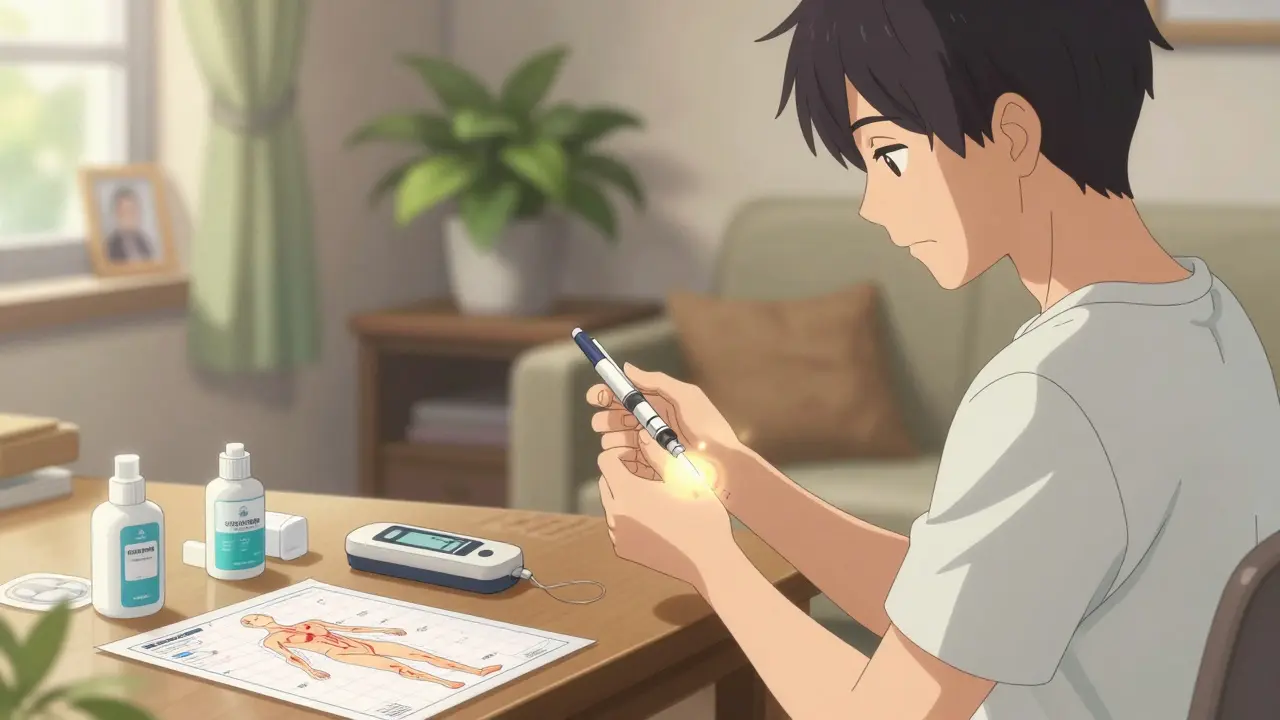
Getting a biologic therapy isn’t just about picking up a prescription. It’s about learning how to inject yourself safely, every single time. These powerful drugs treat conditions like rheumatoid arthritis, psoriasis, and Crohn’s disease-but they only work if you use them right. And if you don’t? You could be putting yourself at risk for serious infections.
Why Injection Training Isn’t Optional
Biologic therapies are made from living cells, not chemicals. That means they’re delicate, expensive, and require sterile handling. Most patients are expected to give themselves shots at home-sometimes daily, sometimes every few weeks. But here’s the problem: many people aren’t properly trained. A 2022 study found that while 91.7% of patients say they received training, the average session lasted less than 40 minutes. Some got just a quick demo and a handout. One in three patients reported getting no formal training at all. That’s not enough. You’re not just pushing a button-you’re handling a live medication that can cause infections if contaminated. Infection risks aren’t theoretical. The CDC says improper injection technique contributes to nearly 13% of all outpatient skin and soft tissue infections from injectable meds. That’s not a small number. Redness, swelling, warmth, or fever after an injection? Those aren’t just side effects. They could be early signs of an infection that could land you in the hospital.What Good Training Actually Looks Like
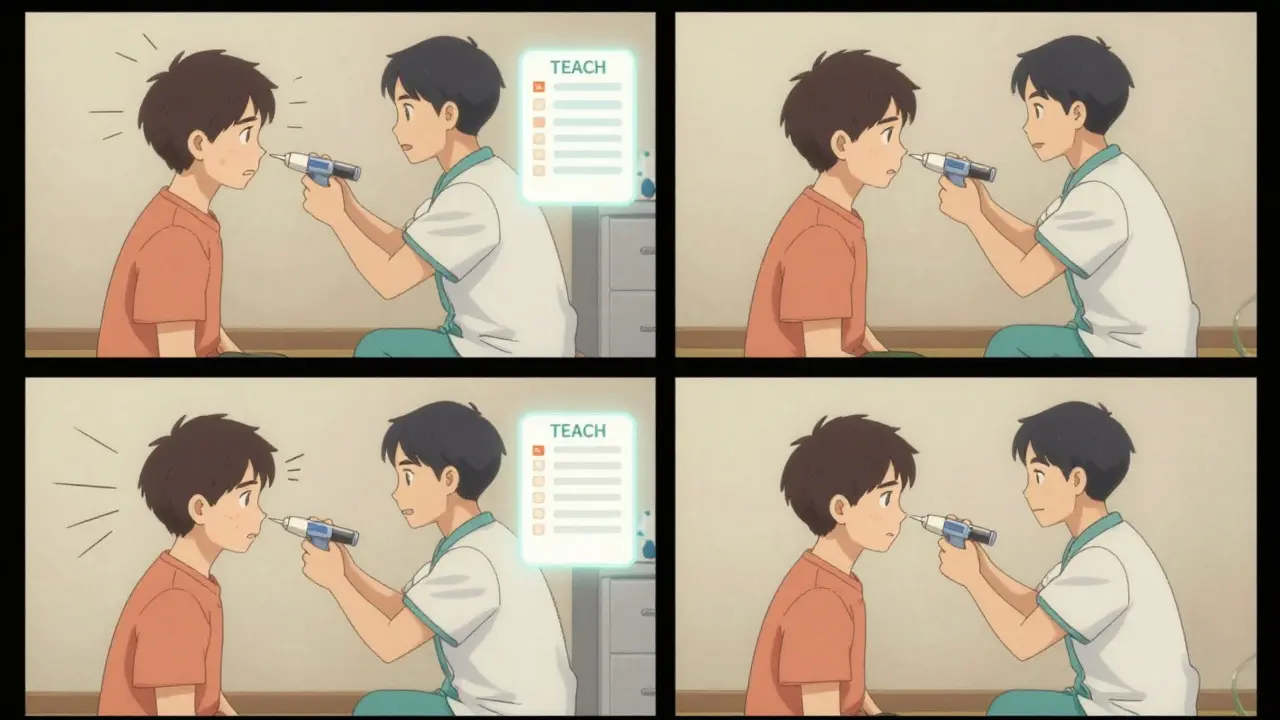
Good training isn’t a one-time show-and-tell. It’s a process. Experts call it the TEACH model: Tell, Explain, Act, Check, Help.- Tell: Your provider explains the steps-where to inject, how to prep the skin, how to activate the device.
- Explain: They don’t just talk. They answer your questions. If you’re scared of needles, they don’t brush it off. They acknowledge it.
- Act: You practice on a training device. No medication. Just the feel, the weight, the click. You do it three, four, five times.
- Check: You show them you can do it yourself. This is called the teach-back method. If you can’t explain or demonstrate it, they don’t send you home.
- Help: You get access to follow-up support-phone numbers, video tutorials, virtual coaching. Not just a pamphlet.
The Hidden Danger: Emotional Stress and Infection Risk
It’s not just about technique. It’s about anxiety. Patients who feel rushed, scared, or unsupported are far more likely to make mistakes. One study found that 57% of early treatment drops were due to emotional stress-not physical inability. If you’re trembling when you inject, you might miss the skin. You might not clean the area long enough. You might rush the needle out too fast and pull the device away before the full dose is delivered. That’s where rituals help. Successful patients don’t just inject. They have a routine. They inject at the same time, in the same spot, with the same steps. They wash their hands, lay out their supplies, take a deep breath. Some play music. Some say a phrase out loud. That ritual isn’t superstition-it’s a mental anchor. It slows you down. It reminds you to be careful. One patient on Reddit said: “They showed me once, had me do it once, and sent me home with six months of medication. No follow-up.” That’s the norm. And it’s dangerous.How to Prevent Infections: The 5 Rules
If you’re injecting biologics at home, follow these five rules every time:- Wash your hands for 20 seconds with soap and water. No hand sanitizer substitutes. You need to physically remove dirt and germs.
- Use a fresh alcohol wipe on the injection site. Rub in a circle, then let it air dry. Don’t blow on it or wipe it off. If you touch it after cleaning, clean it again.
- Choose your spot wisely. Rotate between your thigh, abdomen (2 inches away from your belly button), or upper arm. Never inject in the same spot twice within a week. Keep injections at least one inch apart.
- Don’t rush the device. After you press the button, wait five full seconds before pulling it away. Some devices deliver the full dose only after that delay.
- Watch for red flags. If the injection site gets red, swollen, warm, or painful-especially if the redness spreads beyond two centimeters-or if your temperature hits 100.4°F (38°C) or higher, call your doctor. Don’t wait.
Why Training Devices Matter
Many patients think they don’t need a trainer. They’ve seen the real pen. They’ve watched a video. They think they’re ready. They’re wrong. Training devices are designed to feel exactly like the real thing-same weight, same click, same resistance. But they have no needle, no medicine. That means you can practice as much as you need. You can try different angles. You can practice when you’re tired, stressed, or in a dim room. Clinics that use training devices report a 65% drop in needle anxiety. Patients who practice at least three times before their first real injection are 94% more likely to use correct technique six months later. If your provider didn’t give you a trainer, ask for one. Most manufacturers send them free with the prescription. If they don’t, call the drug company’s patient support line. They’ll mail one to you.Follow-Up Isn’t a Luxury-It’s a Lifeline
The first six months are the hardest. That’s when most mistakes happen. That’s when infections start. Patients who get just one training session have a 52% chance of using the correct technique six months later. Those who get three or more supervised practice sessions? 94%. You need follow-up. Not because you’re incompetent. Because injection is a skill. Like driving a car or playing guitar. You get better with repetition. Ask your doctor for a check-in visit after your first two injections. Ask your pharmacist for a quick video call. Use the manufacturer’s app if they have one. Some now offer virtual coaching with nurses who can watch you inject via your phone camera and give real-time feedback.What to Do If You’re Still Nervous
If you’re still scared, you’re not alone. Most people are. Try the “breathing room” trick: Have someone gently place their hand over yours while you inject. Not to control you-to steady you. It reduces panic in 88% of anxious patients. Use distraction. Listen to a podcast. Watch a show. Breathe in for four counts, hold for four, out for six. That rhythm calms your nervous system. And if you’re still unsure? Don’t force it. Call your clinic. Ask for a nurse to come to your home for one session. Many insurance plans cover this.
The Bigger Picture
Biologic therapies are changing lives. But they’re only as good as the people who use them. And right now, the system is failing too many. Manufacturers are starting to catch on. New digital platforms offer video libraries, injection trackers, and AI-powered feedback. The FDA is pushing for standardized training materials. But until every patient gets real, hands-on, repeated training-with emotional support-too many will suffer preventable infections. Your safety isn’t an afterthought. It’s the point.What to Ask Your Provider
Before you leave the office, ask these questions:- Can I practice with a trainer device today?
- Will I get a follow-up appointment or video check-in after my first injection?
- Can I speak with a pharmacist or nurse about my concerns?
- Do you have a written checklist I can take home?
- What should I do if I see redness, swelling, or fever?
Can I reuse the same injection site if I rotate weekly?
No. Even if you wait a week, injecting too close to a previous site can irritate the skin and increase infection risk. Always keep injections at least one inch apart. Use a body map or app to track where you’ve injected to avoid repeating spots too soon.
Is it safe to inject if I’m sick or have a fever?
No. If you have a fever, active infection, or are feeling unwell, delay your injection. Biologics suppress your immune system. Injecting while sick can worsen your condition or mask signs of a serious infection. Call your doctor before injecting if you’re unsure.
What if I drop my injector on the floor?
Don’t use it. Even if it looks clean, the needle or device may be contaminated. Dispose of it safely and use a new one. Most manufacturers provide replacement devices through patient support programs-call them immediately. Never try to clean or disinfect the needle.
Do I need to refrigerate my biologic before injecting?
Check the label. Most biologics can be kept at room temperature for a limited time (usually 14-30 days), but some must stay refrigerated until use. Never freeze them. If you’re unsure, call your pharmacy. Injecting a cold device can cause more pain and tissue damage. Let it warm up for 30 minutes before use.
Can I use alcohol wipes from the pharmacy for cleaning?
Yes, but only if they’re sterile and single-use. Never reuse a wipe. Don’t use rubbing alcohol from a bottle-those aren’t sterile and can contain additives that irritate skin. Always use the pre-packaged alcohol wipes provided with your medication or prescribed by your provider.
Next Steps: What to Do Today
- If you’re new to biologics: Request a training device and schedule a follow-up practice session before your first injection.
- If you’ve been injecting for months: Review your technique. Are you rotating sites? Cleaning properly? Watching for redness? If not, schedule a check-in with your provider.
- If you’re anxious: Download your drug’s patient app or call their support line. Ask for video tutorials and virtual coaching.
- If you’ve had a skin reaction: Document the date, location, size of redness, and symptoms. Bring it to your next appointment. You’re not overreacting-you’re protecting your health.
George Bridges
January 13, 2026 AT 14:24I’ve been on biologics for five years now, and the first time I injected myself, I cried. Not because it hurt, but because I felt so alone. No one told me how scary it is to stab yourself with a needle every other week. The training was a 10-minute demo and a pamphlet. I had to learn everything from Reddit threads and YouTube videos. It shouldn’t be this hard. If you’re reading this and you’re new-take a deep breath. You’re not broken. You’re learning. And you’re not alone.
One tip: I use a small flashlight to check my injection sites at night. Sometimes redness is hard to see in regular light. Also, keep a journal. Write down where you injected, how you felt, and if anything looked weird. It helps your doctor spot patterns.
And if your provider won’t give you a trainer device? Keep asking. Politely. Persistently. You deserve better.
I’m still nervous sometimes. But I’ve gotten better. And so can you.
Faith Wright
January 14, 2026 AT 21:40Oh wow, so let me get this straight-your doctor hands you a $20,000-per-year drug, says ‘here you go,’ and expects you to become a mini-pharmacist overnight? No training? No follow-up? No mercy?
Let me guess-your insurance won’t cover the nurse coming to your house because ‘it’s not medically necessary.’ Classic.
Meanwhile, the pharma reps are out there handing out branded stress balls and free tote bags, but won’t send you a damn training pen because ‘we already sent the pamphlet.’
God, I hate healthcare.
laura manning
January 16, 2026 AT 02:17It is imperative to underscore, with the utmost precision, that the statistical correlation between inadequate injection training and subsequent infectious complications is not merely anecdotal-it is empirically validated, peer-reviewed, and documented by the CDC in multiple longitudinal cohort studies. The 13% figure cited is, in fact, conservative; when adjusted for underreporting and asymptomatic cases, the true incidence likely exceeds 18%.
Furthermore, the TEACH model, while conceptually sound, is not universally standardized across U.S. healthcare institutions. Variability in implementation, particularly in rural and under-resourced clinics, constitutes a systemic failure in patient safety protocols. The absence of mandatory competency assessments prior to discharge with biologics represents a critical regulatory gap.
Additionally, the assertion that emotional stress contributes to 57% of early treatment discontinuation is corroborated by a 2023 meta-analysis published in JAMA Dermatology. Anxiety-induced micro-movements during injection significantly increase the risk of subcutaneous tissue trauma, thereby compromising the sterile field. This is not a psychological issue-it is a biomechanical hazard.
Patients must be formally evaluated for fine motor control, cognitive recall, and emotional readiness before being discharged with injectable biologics. Anything less is negligent.
Moreover, the reuse of alcohol wipes, even if sterilized, is an unacceptable deviation from Aseptic Technique Guidelines (CDC 2022, Section 4.7). Single-use, pre-saturated wipes are non-negotiable.
Finally, the suggestion that patients ‘ask for’ a trainer device implies that such a tool is discretionary. It is not. It is a medical device, and its provision is a standard of care. If your provider refuses, escalate to the clinic administrator, then to your state medical board. Your life is not a trial.
Bryan Wolfe
January 17, 2026 AT 01:01You’re not failing. You’re just learning. And that’s okay.
I used to shake so bad before my injections that I’d drop the pen three times in a row. I thought I was broken. Turns out? I just needed to practice. Like learning to ride a bike. You don’t get it on the first try. You fall. You get up. You try again.
I started using a little weighted stress ball to steady my hands. It sounds weird, but it works. I also set a timer on my phone for 20 seconds of handwashing-no excuses. And I started playing my favorite podcast while I did it. Distraction = less panic.
My biggest win? I asked for a trainer device. The company mailed me one in two days. Free. No questions asked. I practiced on my couch, in bed, even in the car while waiting for my kid’s soccer game. Now I do it like a pro.
If you’re scared? You’re not alone. Talk to someone. Text a friend. Call the patient support line. They’ve heard it all before. And they’ll help you.
You got this. Seriously. One injection at a time.
And if you’re reading this and you’re a provider? Please. Give people the tools. Don’t just hand them a pen and say ‘good luck.’ We’re not robots. We’re humans. With fear. With lives. With families. We need more than a pamphlet.
Sumit Sharma
January 18, 2026 AT 11:33It is unacceptable that patients are being discharged with life-altering biologics without mandatory competency validation. The 91.7% training claim is a statistical illusion; self-reported compliance is notoriously unreliable. The 2022 study cited lacks objective assessment protocols. Where is the competency checklist? Where is the video recording of patient performance? Where is the audit trail?
Furthermore, the notion that ‘rituals’ improve outcomes is pseudoscientific. What is needed is standardized, evidence-based procedural training under supervision, not mindfulness exercises. The 57% emotional stress statistic is irrelevant if the underlying protocol is flawed.
Pharmaceutical companies must be held accountable. They are profiting from patient non-compliance. The fact that trainer devices are sent ‘for free’ only after being requested is a design flaw in the healthcare delivery model. This is not generosity-it is negligence masked as customer service.
Insurers must reimburse for supervised injection sessions. No exceptions. If you cannot demonstrate proper technique to a certified nurse, you do not receive your prescription. Period.
And for God’s sake-stop using alcohol wipes from the pharmacy. They are not sterile-grade. Use only FDA-cleared, single-use, alcohol-impregnated swabs with ≥70% isopropyl alcohol. Anything else is a biohazard.
Stop romanticizing ‘rituals.’ Start enforcing standards.
Christina Widodo
January 18, 2026 AT 23:38Wait-so if I drop my injector on the floor, I just throw it away and call the company? No cleaning? No disinfecting? Not even with alcohol? That seems extreme. What if I can’t afford a replacement? Do they just send one every time? I’ve heard stories of people waiting weeks.
Also, can you use the same alcohol wipe on two different spots? Like, if I’m rotating thighs, can I wipe one, then the other? Or does each spot need its own?
And what about if you’re traveling? Can you carry the pen in your carry-on? Do you need a cooler? Do they make those little travel cases?
I’m new to this and I have a million questions. No one ever told me where to ask them.
Prachi Chauhan
January 19, 2026 AT 22:14You know, I think about this like gardening. You don’t plant a rose and forget about it. You water it. You check the soil. You watch for bugs. You don’t just say, ‘I bought the seed, now it’s done.’
Biologics are like that. They need your attention. Not because you’re weak, but because your body is trying to heal. And healing needs care.
I used to feel guilty for being scared. Like I should just ‘get over it.’ But then I realized-I’m not scared of the needle. I’m scared of failing. Of making a mistake and hurting myself. That’s not weakness. That’s love.
So I made a little ritual. I light a candle. I sit down. I breathe. I don’t rush. I don’t watch my phone. I just… do it. Slowly.
And when I got my trainer device? I practiced on my cat. She didn’t care. I didn’t care. We both got better.
You’re not alone. We’re all learning.
Katherine Carlock
January 20, 2026 AT 02:48Can we just talk about how the system is designed to make you feel like you’re failing when you’re actually just being failed by the system?
I’ve been on biologics for three years. I’ve had two infections. Both happened because I was rushed through training. I didn’t know I was supposed to wait five seconds. I didn’t know I could ask for a nurse to come to my house. I didn’t know I could get a trainer device for free.
I thought I was the problem.
Turns out-I wasn’t. The system was.
So if you’re reading this and you’re scared? You’re not broken. You’re just in a broken system.
But you’re not powerless. Ask for the trainer. Ask for the follow-up. Ask for the nurse. Ask again. And again. You’re worth the effort.
And if you’re a provider? Please. Just stop treating us like we’re machines. We’re people. We’re scared. We’re tired. We’re trying.
Give us the tools. We’ll do the rest.