
Dose-Related vs Non-Dose-Related Side Effects: What You Need to Know in Pharmacology
 Dec, 28 2025
Side Effect Type Calculator
Understand Your Side Effect
This tool estimates whether a side effect you're experiencing is more likely dose-related or non-dose-related based on key pharmacological principles.
Analysis
Enter your information and click Calculate to see your side effect assessment.
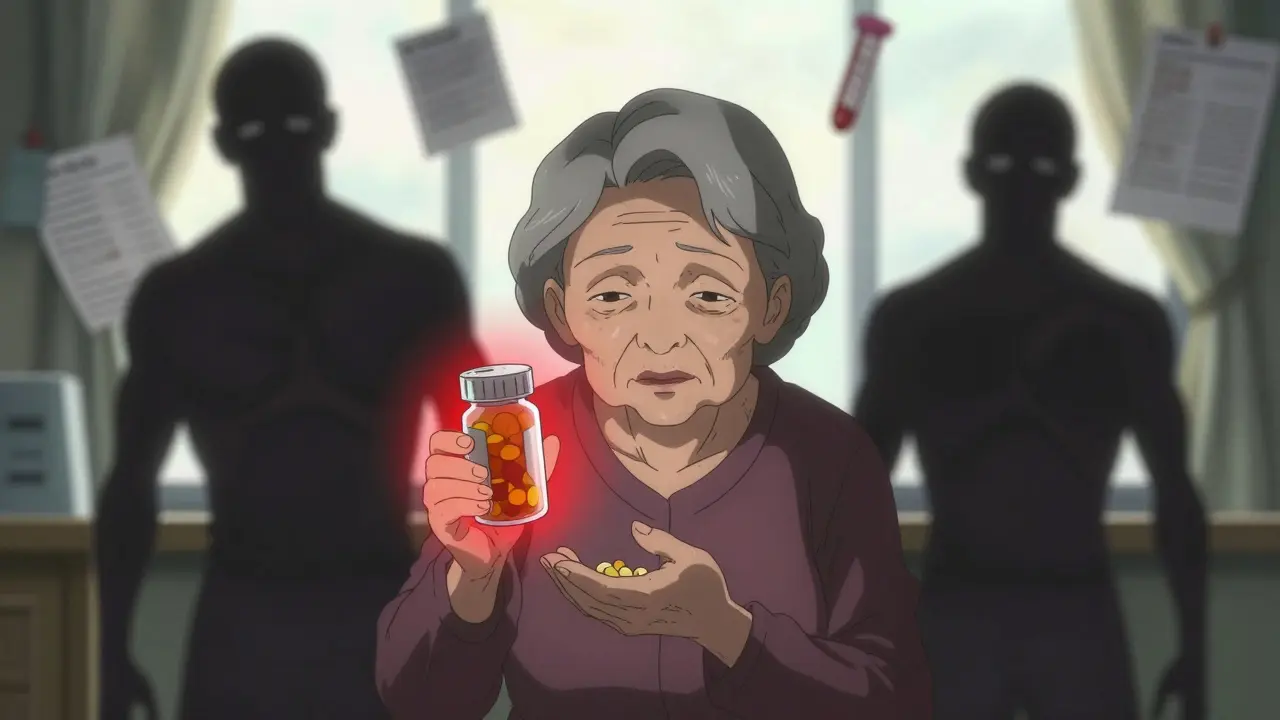
When you take a pill, you expect it to help. But sometimes, it causes harm. Not all side effects are the same. Some happen because you took too much. Others strike out of nowhere-even with a tiny dose. Understanding the difference between dose-related and non-dose-related side effects isn’t just for doctors. It’s critical for anyone on medication, especially older adults or those taking multiple drugs.
What Are Dose-Related Side Effects?
Dose-related side effects, also called Type A reactions, are predictable. They’re basically an extension of the drug’s intended effect-just turned up too high. If a blood pressure pill lowers your pressure, too much of it can drop it too far. If insulin lowers blood sugar, too much can cause a dangerous low. These reactions follow the law of mass action: more drug = stronger effect. Simple. Direct. Avoidable.
They make up 70 to 80% of all adverse drug reactions. And they’re the reason so many older adults end up in the ER. Think about warfarin, a blood thinner. If your INR climbs above 4.0, you’re at serious risk of bleeding. Or lithium, used for bipolar disorder. At 0.6 to 1.0 mmol/L, it works. At 1.2 mmol/L or higher, you get tremors, confusion, even seizures. These drugs have what’s called a narrow therapeutic index-meaning the line between helpful and harmful is razor-thin.
These reactions often happen because of things you can control: kidney or liver problems slowing down drug clearance, other meds interfering (like clarithromycin boosting statin levels by 5 to 10 times), or just aging. Your body processes drugs differently after 65. Diazepam, for example, clears 30 to 40% slower in older adults. That’s why dose adjustments aren’t optional-they’re lifesaving.
What Are Non-Dose-Related Side Effects?
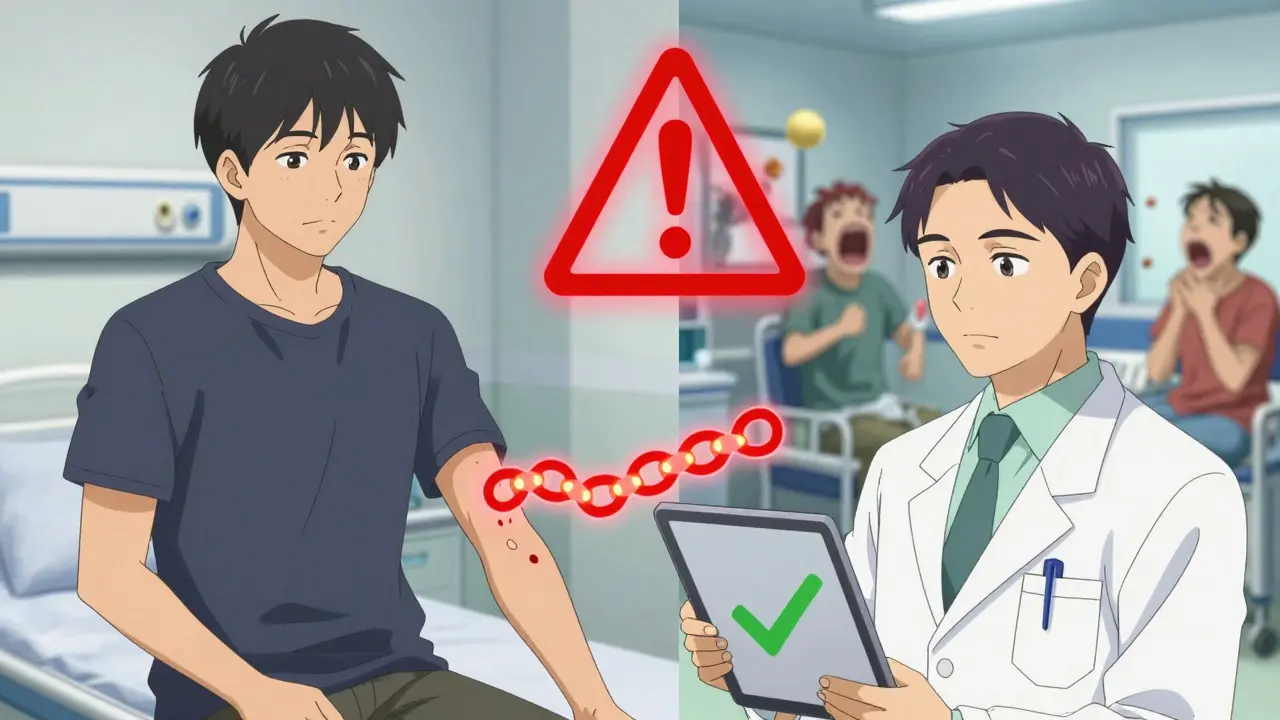
Non-dose-related side effects, or Type B reactions, are the opposite. They’re unpredictable, rare, and often terrifying. You might take one pill-and your skin starts peeling. Or you break out in hives, your throat swells, and you can’t breathe. These aren’t about how much you took. They’re about who you are.
These reactions are usually immune-driven. Your body mistakes the drug for an invader. Anaphylaxis from penicillin? That’s Type B. Stevens-Johnson syndrome from lamotrigine? Type B. Drug-induced liver injury from amoxicillin-clavulanate? Also Type B. They don’t follow the rules of pharmacology. You can’t predict them by looking at the dose. But you can sometimes predict them by looking at your genes.
For example, if you’re of Asian descent and carry the HLA-B*15:02 gene, taking carbamazepine can trigger a life-threatening skin reaction. That’s why doctors test for it before prescribing. The test costs around $215. It’s not cheap, but it’s cheaper than a hospital stay-or a funeral. Similarly, people with HLA-B*57:01 should never take abacavir for HIV. The risk of a severe allergic reaction drops from 5% to less than 1% with screening.
Why the Confusion? Are Non-Dose-Related Reactions Really Not Dose-Dependent?
Here’s where things get tricky. Some experts argue that no reaction is truly non-dose-related. Even anaphylaxis has a threshold. But that threshold varies wildly between people. For one person, one pill triggers a reaction. For another, it takes ten. So in population studies, it looks random. But in your body, it might be very specific.
Researchers like Aronson and Ferner explain this with four reasons: (1) the reaction might not be real-maybe it’s a coincidence; (2) your body is hypersensitive, so even the smallest dose hits the max effect; (3) people are just wildly different in how they respond; and (4) we’re bad at measuring exact doses or effects. That last one matters. Did you take 500 mg or 520 mg? Did you eat before? Are you dehydrated? These tiny differences can make a Type B reaction seem like it came from nowhere.
So while we call them non-dose-related, it’s more accurate to say they’re individually unpredictable. They’re not magic. They’re just complex.
Which Type Is More Dangerous?
Dose-related reactions are common. Non-dose-related ones are rare. But here’s the twist: the rare ones kill more often.
Type A reactions cause 70 to 80% of all adverse drug reactions, but their death rate is under 1%. Type B reactions make up only 15 to 20% of cases, yet they’re responsible for 70 to 80% of hospitalizations due to serious reactions-and their mortality rate is 5 to 10%. That’s why drugs with Type B risks often get black box warnings from the FDA. These are the strongest safety alerts a drug can carry.
And it’s not just about death. Type B reactions drive most drug lawsuits. If a patient develops a rare skin reaction, the manufacturer gets sued-even if the dose was perfect. Type A reactions? They’re often blamed on prescribing errors, monitoring failures, or patient non-compliance. So while Type A costs the system more in total (about $130 billion a year in the U.S.), Type B drives the legal and reputational fallout.
How Do Doctors Handle Each Type?
Management couldn’t be more different.
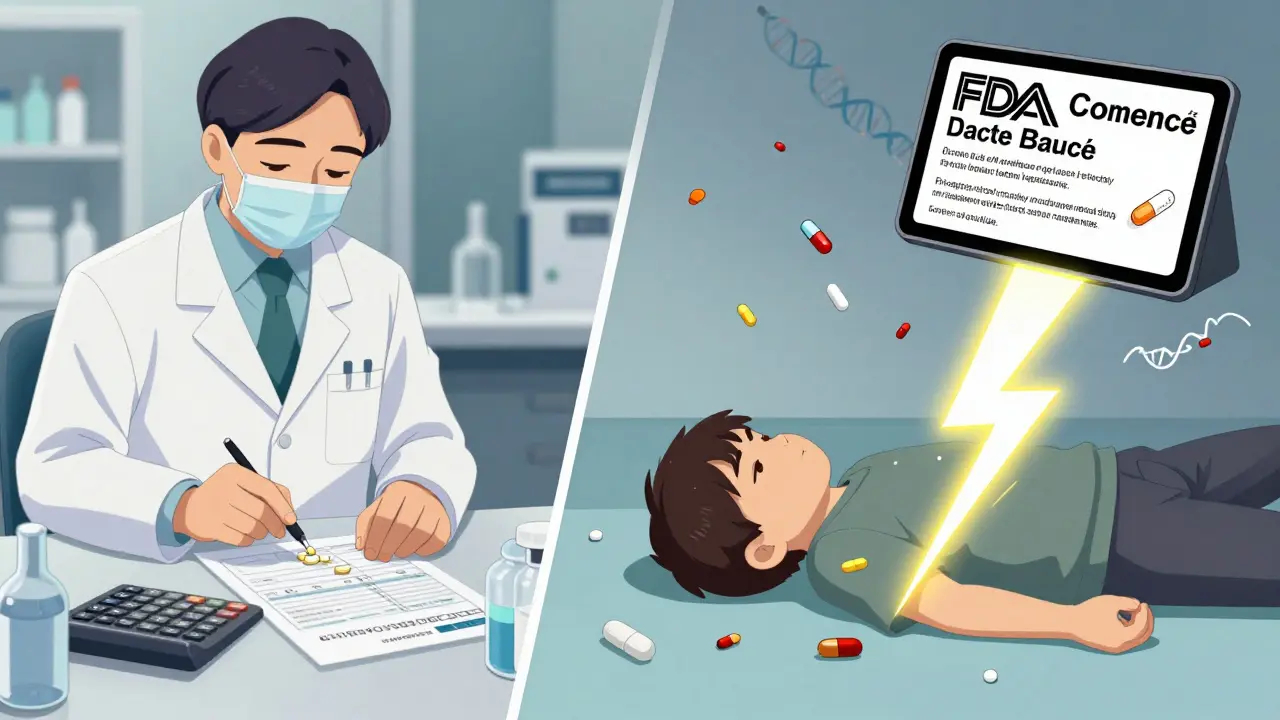
For Type A reactions, the goal is to find the right dose. That means therapeutic drug monitoring. For drugs like vancomycin, phenytoin, or digoxin, doctors check blood levels regularly. If your level is too high, they lower the dose. If you have kidney disease, they cut the dose by half. If you start a new med that interacts with your current one, they adjust. It’s science. It’s routine. It’s manageable.
For Type B reactions? There’s no dose adjustment that helps. Once it happens, you stop the drug-forever. And you avoid all similar drugs. If you had a reaction to penicillin, you won’t take amoxicillin. If you had Stevens-Johnson from carbamazepine, you won’t take oxcarbazepine. Some people even carry epinephrine auto-injectors. One patient on Inspire.com said her epinephrine pen cost $500-and she carries it everywhere. That’s the cost of unpredictability.
Prevention is key. Skin tests for penicillin allergy have a 50 to 70% positive predictive value. Graded challenges (giving tiny doses under supervision) work 80 to 90% of the time for low-risk patients. And genetic screening? It’s becoming standard. HLA-B*57:01 testing before abacavir use is now routine in the U.S. and Europe. The FDA has included pharmacogenomic info in 311 drug labels-and 28 of them require genetic testing before use.
What’s Changing in Pharmacology?
The future is personalization. The global pharmacogenomics market is projected to hit nearly $18 billion by 2030. Why? Because we’re learning how to use genetics to prevent both types of reactions.
For Type A, we’re using genes to fine-tune doses. The CYP2C9 and VKORC1 genes affect how your body handles warfarin. With genetic testing, doctors can start you on the right dose from day one-cutting the risk of bleeding by up to 40%. For Type B, we’re using genes to avoid disasters. HLA-B*15:02 screening in Southeast Asia has reduced carbamazepine-induced SJS by over 90%.
Machine learning is helping too. Algorithms analyzing electronic health records can predict Type A reactions with 82% accuracy. But for Type B? Only 63%. That gap tells us something important: we’re getting better at managing predictable harm. But unpredictable harm? That’s still the wild frontier.
Regulators are catching up. The FDA’s 2024 draft guidance supports software that helps doctors calculate individualized doses based on age, weight, kidney function, and genetics. The EMA now distinguishes between ‘dose-independent’ and ‘dose-unrelated’ reactions, acknowledging that thresholds exist-even if they’re hidden.
What does this mean for you? If you’re on long-term medication, ask: Could this be dose-related? Should I get tested? Is there a safer alternative? Don’t assume all side effects are normal. Some are avoidable. Some are genetic. And knowing the difference might save your life.
Are all side effects caused by taking too much medicine?
No. While many side effects happen because the dose is too high (dose-related), others occur even at normal doses because of your body’s unique response. These are called non-dose-related reactions and are often immune-based, like severe rashes or anaphylaxis. They’re not about quantity-they’re about individual biology.
Can a non-dose-related reaction happen on the first dose?
Yes. While some Type B reactions require prior exposure to trigger sensitization (like penicillin allergies), others can occur on the first dose if you’re genetically predisposed. For example, someone with the HLA-B*15:02 gene can develop Stevens-Johnson syndrome after their very first dose of carbamazepine. That’s why genetic screening is now recommended before starting certain drugs.
Why are dose-related reactions more common in older adults?
As we age, our kidneys and liver slow down, meaning drugs stay in the body longer. For example, diazepam clears 30-40% slower in people over 65. Also, older adults often take multiple medications, increasing the risk of drug interactions that boost drug levels. This makes dose-related reactions like low blood pressure, low blood sugar, or bleeding much more likely if doses aren’t adjusted.
Is there a way to prevent non-dose-related side effects?
Yes, in some cases. Genetic testing can identify people at high risk before they take a drug. For example, testing for HLA-B*57:01 before prescribing abacavir prevents life-threatening allergic reactions in 99.9% of cases. Skin tests and graded challenges can also help safely rule out allergies. But for many Type B reactions, prevention is still limited-so awareness and early reporting of symptoms are crucial.
Do all drugs have both types of side effects?
Most drugs can cause both, but it depends on how they work. Drugs with narrow therapeutic windows-like warfarin, lithium, or digoxin-are more likely to cause dose-related effects. Immune-triggering drugs-like penicillin, sulfonamides, or anticonvulsants-are more likely to cause non-dose-related reactions. Some drugs, like chemotherapy agents, can trigger both types at the same time.
Should I ask my doctor for genetic testing before starting a new medication?
If you’re being prescribed a drug with known pharmacogenomic risks-like abacavir, carbamazepine, or warfarin-yes. The FDA lists 28 drugs that require or recommend genetic testing. Even if it’s not required, if you’ve had unexplained reactions to medications before, or if you have a family history of severe drug reactions, it’s worth discussing. The test costs $150-$300 and can prevent life-threatening reactions.
Janette Martens
December 29, 2025 AT 18:39Marie-Pierre Gonzalez
December 31, 2025 AT 02:37Louis Paré
January 1, 2026 AT 01:31Celia McTighe
January 1, 2026 AT 04:00Ryan Touhill
January 2, 2026 AT 06:51Teresa Marzo Lostalé
January 2, 2026 AT 21:38ANA MARIE VALENZUELA
January 3, 2026 AT 19:24Bradly Draper
January 4, 2026 AT 03:07Gran Badshah
January 4, 2026 AT 07:02Ellen-Cathryn Nash
January 6, 2026 AT 06:01Samantha Hobbs
January 7, 2026 AT 05:00Nicole Beasley
January 9, 2026 AT 04:59