
Fall Prevention Strategies for Sedating Medications in Older Adults
 Mar, 13 2026
Medication Fall Risk Calculator
Select Your Medications
Identify fall-risk medications you take. Each sedating medication adds to your fall risk. The CDC estimates each additional sedating medication increases fall risk by 20%.
Your Fall Risk Assessment
Every year, over 36 million older adults in the U.S. fall - and for many, the cause isn’t slippery floors or poor lighting. It’s the very medications they take to sleep, calm nerves, or manage pain. Sedating drugs like benzodiazepines, antidepressants, and opioids don’t just make people drowsy - they rob balance, slow reaction time, and blur judgment. The result? A higher chance of breaking a hip, spending weeks in the hospital, or worse. But here’s the good news: fall prevention isn’t just about handrails and non-slip mats. It starts with a clear look at what’s in the medicine cabinet.
What Makes a Medication a Fall Risk?
Not all drugs are created equal when it comes to fall risk. The term FRIDs - Fall Risk Increasing Drugs - covers a long list of common prescriptions. These include:- Benzodiazepines (like diazepam or lorazepam) for anxiety or insomnia
- Antidepressants, especially tricyclics and SSRIs with sedating effects
- Opioids for chronic pain
- Antipsychotics used for dementia-related agitation
- Muscle relaxants like baclofen - which has the highest fall risk in its class
- Antihypertensives that cause sudden drops in blood pressure
- Sedative-hypnotics for sleep
It’s not just the drug itself - it’s the combination. Taking three or more of these at once? That’s polypharmacy, and it triples your fall risk. A 78-year-old on a sleep aid, a painkiller, and an antidepressant isn’t just managing three conditions - they’re stacking three risks. One study found that each additional sedating medication increases fall risk by 20%. That’s not a small bump. That’s a cliff.
The STEADI-Rx Model: How Pharmacists Are Changing the Game
In 2019, the CDC launched STEADI-Rx - a simple, practical tool designed for community pharmacies. It’s not fancy. It doesn’t need high-tech gear. It just needs a pharmacist who asks the right questions.Here’s how it works in three steps:
- Screen - Ask: "Have you fallen in the past year? Do you feel unsteady when standing?" A simple yes to any of these flags a high-risk patient.
- Assess - Pull up the full medication list. Look for FRIDs. Check doses. Ask if the patient still needs all of them.
- Intervene - Work with the doctor to replace risky drugs with safer alternatives. Or reduce the dose. Or stop one altogether.
What’s powerful about STEADI-Rx is that it’s built for real life. Pharmacists use a Provider Consult Form to clearly explain their concerns - not just say "this drug is bad." They answer three key questions: What’s the problem? What’s the alternative? And what should the doctor do next? In 75% of cases, the fix wasn’t removing the drug - it was switching to a less sedating one. For example, replacing a long-acting benzodiazepine with non-drug sleep therapy like CBT-I (Cognitive Behavioral Therapy for Insomnia) cut nighttime falls to zero in one patient’s case.
Medication Review Alone Isn’t Enough - But It’s the Foundation
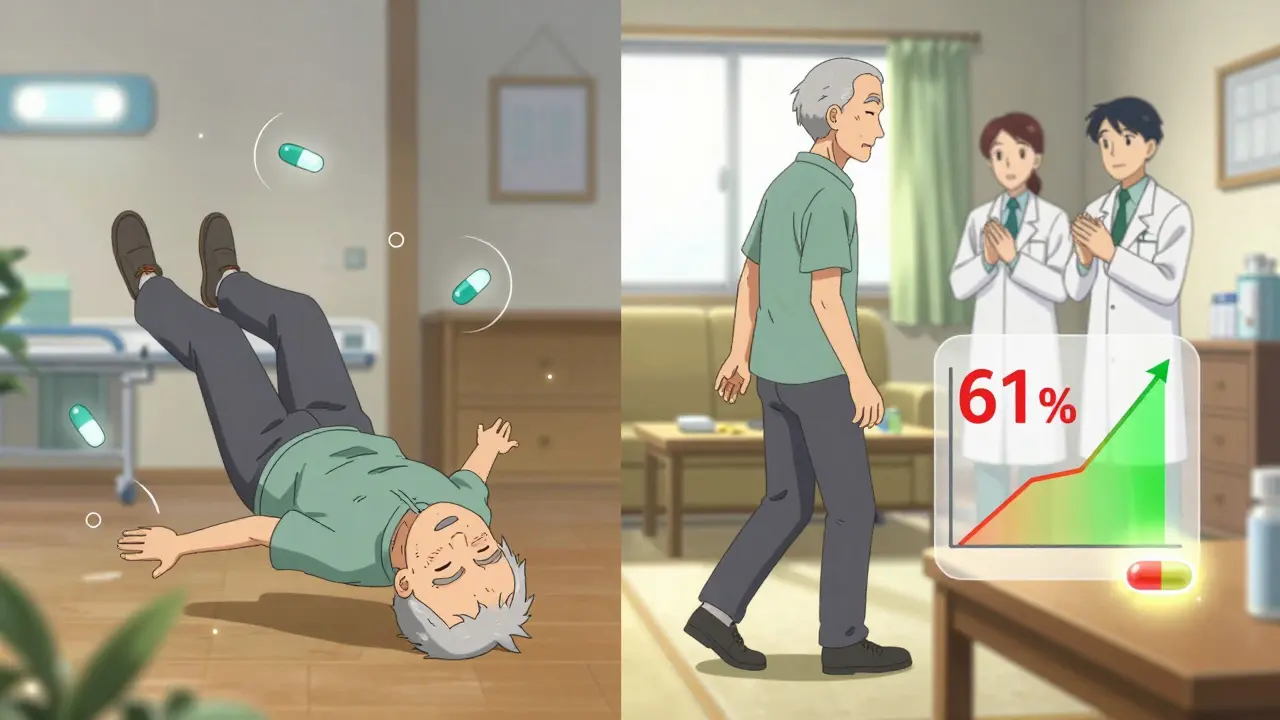
You can’t fix a fall risk problem by just doing physical therapy or installing grab bars if the person is still taking a daily dose of a sedating antidepressant. That’s why medication review is the first step - not the last.Research shows that when medication review is paired with exercise, the results explode. A Cochrane review found that exercise programs - even just 30 minutes, three times a week - reduced falls by 15% to 29%. Add in balance training, strength work, and gait correction, and you cut fracture risk by 61%. But here’s the kicker: those gains vanish if the patient is still on a medication that makes them dizzy.
Think of it like this: You wouldn’t send someone with a broken leg to physical therapy without setting the bone first. Medication review is the setting. Exercise is the healing.

What About Vitamin D? Does It Help?
You’ve probably heard that vitamin D helps prevent falls. And yes, the American Academy of Family Physicians recommends 1,000 IU daily for older adults. But the evidence is mixed. The U.S. Preventive Services Task Force says 800 IU might help. A major Cochrane review found no clear benefit. So what’s the truth?The answer: Vitamin D only helps if you’re deficient. If you’re already getting enough sunlight or eating fortified foods, extra pills won’t make you steadier. But if you’re low - and many older adults are - then supplementing can make a real difference. It’s not a magic bullet, but it’s a low-cost, low-risk tool worth checking.
Why Do People Resist Changing Their Medications?
It’s not that patients are stubborn. It’s that they’re scared. One 2021 survey found that 63% of older adults didn’t want to stop a sedating medication because they feared worse insomnia, anxiety, or pain. They didn’t realize the drug itself was causing their falls.One Reddit user shared how switching from diazepam to CBT-I ended their nightly falls. But another user wrote: "My doctor refused to take me off my sleeping pill. Said I’d have a seizure." That fear isn’t irrational - withdrawal from some sedatives can be dangerous. That’s why deprescribing must be done slowly, with monitoring, and with clear communication.
Doctors and pharmacists need to explain: "We’re not taking away your comfort. We’re replacing a risk with a safer option." That’s why the STEADI-Rx model includes patient education. It’s not just about changing prescriptions - it’s about changing minds.
What’s Holding Back Better Care?
Despite all the evidence, many clinics still don’t do routine medication reviews. Why?- Time - A full review takes 20-30 minutes. Most primary care visits last 15.
- Reimbursement - Insurance often doesn’t pay pharmacists for medication reviews.
- Resistance - Some doctors don’t trust pharmacists to suggest changes.
- Lack of tools - EHRs don’t always flag high-risk combinations.
But change is coming. In 2023, the CDC expanded STEADI-Rx to include specific deprescribing guides for benzodiazepines. Over 1,200 pharmacists are now certified as Geriatric Pharmacotherapy Specialists. And Medicare now requires long-term care facilities to assess fall risk - including medication use.
The future? AI tools that flag dangerous drug combos before they’re prescribed. Pharmacists with prescribing authority to make small changes without waiting for a doctor’s note. And better payment models that reward prevention, not just treatment.
What You Can Do Right Now
If you or someone you care for is over 65 and taking any of these medications:- Ask the pharmacist: "Are any of these drugs linked to falls?"
- Ask the doctor: "Can we try lowering the dose or switching to something less sedating?"
- Start simple balance exercises - stand on one foot while brushing your teeth, or walk heel-to-toe in a hallway.
- Get your vitamin D level checked - it’s cheap, and it might help.
Don’t wait for a fall to happen. A single conversation about medication can prevent months of pain, rehab, and isolation. It’s not about giving up drugs. It’s about choosing safer ones - and taking back control.
Which medications are most likely to cause falls in older adults?
The most common fall-risk medications include benzodiazepines (like diazepam), antidepressants (especially tricyclics), opioids (like oxycodone), antipsychotics (like quetiapine), muscle relaxants (especially baclofen), and sedative-hypnotics (like zolpidem). These drugs cause dizziness, slowed reflexes, confusion, or low blood pressure - all of which increase fall risk. The CDC’s STEADI-Rx tool lists these as Fall Risk Increasing Drugs (FRIDs).
Can stopping a sedating medication really prevent falls?
Yes - and often dramatically. One study showed that medication review and deprescribing could prevent over 42,000 medically treated falls each year in the U.S. alone. For example, switching from a long-acting benzodiazepine to non-drug therapy for insomnia reduced nighttime falls from 2-3 per month to zero in a single patient. The key is doing it safely: tapering slowly, monitoring symptoms, and replacing the drug with a safer alternative when possible.
Is exercise more effective than changing medications for fall prevention?
Neither works as well alone as they do together. Exercise programs that include balance, strength, and gait training reduce falls by 15-29% and fractures by 61%. But if the person is still taking a sedating medication, those gains are lost. Medication review removes the root cause - while exercise rebuilds physical stability. The best results come from combining both.
How can a pharmacist help with fall prevention?
Pharmacists are trained to spot dangerous drug combinations and identify medications that increase fall risk. Through programs like STEADI-Rx, they screen patients, review full medication lists, and work directly with doctors to switch to safer alternatives. In 75% of cases, the fix was replacing a high-risk drug with a lower-risk one - not just stopping it. Pharmacists also educate patients on risks and help manage withdrawal safely.
Why don’t more doctors review medications for fall risk?
Time and reimbursement are the biggest barriers. Most primary care visits are only 15 minutes - not enough for a full med review. Insurance often doesn’t pay for pharmacist-led medication management. Some doctors also worry about patient resistance or withdrawal risks. But as awareness grows and tools like STEADI-Rx become standard, more clinics are starting to integrate these reviews into routine care.
Rex Regum
March 14, 2026 AT 05:01Let me get this straight - we’re blaming drugs for falls but ignoring that older people are just frail as hell? I’ve seen 80-year-olds try to climb stairs with a walker and a half-gallon of milk. No pill is the real problem here - it’s that society stopped teaching people how to move safely decades ago. We medicate the symptom instead of fixing the culture of laziness.
Rosemary Chude-Sokei
March 15, 2026 AT 12:20Thank you for this thorough and clinically grounded overview. The STEADI-Rx framework represents one of the most pragmatic, evidence-based interventions we’ve seen in geriatric pharmacotherapy. What stands out is its scalability - pharmacists, as frontline providers, are uniquely positioned to initiate deprescribing conversations without requiring physician approval in every instance. The data on reducing polypharmacy-related falls is not just statistically significant - it’s life-saving.
Ali Hughey
March 15, 2026 AT 16:27⚠️⚠️⚠️ THIS IS A BIG PHARMA COVER-UP! ⚠️⚠️⚠️
They don’t want you to know that the FDA approved 87% of these sedating drugs in 2012-2016 after secret meetings with Big Pharma lobbyists!
And guess what? The CDC’s STEADI-Rx? It’s funded by the same companies that make these drugs! They ‘replace’ them with other branded meds - it’s a shell game!
My uncle died after they took his diazepam and gave him ‘safer’ antidepressants - he went into a coma for 11 days. No one told us the withdrawal could cause seizures. They’re gaslighting us.
And vitamin D? HA! They say it doesn’t help - but my cousin’s cat got more vitamin D than he did, and the cat’s still alive. 🐱💀
They’re silencing the truth. I’ve filed FOIA requests. You’re being lied to. Don’t trust anyone. Not even your pharmacist. 🔍💊🩸
Alex MC
March 16, 2026 AT 13:09This is such an important conversation. I’ve watched my dad go from ‘I need this to sleep’ to ‘I didn’t realize I was falling because of the pill’ - and it changed everything.
Switching from zolpidem to CBT-I wasn’t easy, but after three months, he hasn’t had a single tumble. No more ER visits. No more fear of the bathroom at night.
And honestly? He sleeps better now. Not because of a pill - because his brain learned how to rest again.
Small changes, big impact. You don’t need a miracle. Just a thoughtful review.
rakesh sabharwal
March 18, 2026 AT 02:07The underlying epistemological framework of STEADI-Rx, while ostensibly evidence-based, remains ontologically reductionist - it operationalizes fall risk as a pharmacological variable while neglecting the sociopolitical determinants of geriatric frailty. One cannot disaggregate polypharmacy from structural neglect: Medicare’s reimbursement architecture, the commodification of chronic care, and the neoliberal erosion of long-term support systems are the true etiologies here.
Pharmacists are not agents of liberation - they are bureaucratic intermediaries in a system that pathologizes aging as a pharmacological problem.
Exercise? Vitamin D? These are palliative distractions from the systemic collapse of elder care infrastructure. We are treating symptoms while the foundation crumbles.
Aaron Leib
March 18, 2026 AT 13:01Just wanted to say - this post made me pause and think about my grandma. She’s 86, on three of these meds, and I never connected the dots.
She’s been stumbling around the house for months, and we thought it was just ‘getting old.’
But now I’m scheduling a med review with her pharmacist next week. No drama. No panic. Just a quiet, smart conversation.
Small steps. Big difference. Thanks for the nudge.
Kathy Leslie
March 20, 2026 AT 07:11I love how you said it’s not about giving up drugs - it’s about choosing safer ones.
My mom was terrified to stop her lorazepam. She said she’d be ‘a mess’ without it.
But after switching to melatonin and a nightly stretch routine? She’s calmer. More alert. And hasn’t tripped over the rug since.
It’s not magic. It’s just better choices.
Amisha Patel
March 20, 2026 AT 12:10This is so helpful. I’ve been wondering if my grandfather’s dizziness is from his blood pressure meds or just aging.
Could you clarify - when you say antihypertensives increase fall risk, is it only certain types? Like beta-blockers vs. ACE inhibitors?
And is there a recommended time of day to take them to reduce dizziness?
Elsa Rodriguez
March 21, 2026 AT 04:13I’m not saying this to be dramatic - but I’ve seen this before.
My aunt took 7 pills a day. One was for sleep. One for anxiety. One for pain. One for blood pressure. One for cholesterol. One for… I don’t even remember. And one was just ‘because her doctor said so.’
She fell. Broke her hip. Went to rehab. Came home. Didn’t recognize us. Then she died six months later.
They called it ‘natural causes.’
It wasn’t. It was a slow, silent poisoning by prescriptions.
Don’t wait until it’s too late.
Check. Her. Meds.
Serena Petrie
March 22, 2026 AT 03:17Stop the meds. Start walking. Done.
Buddy Nataatmadja
March 23, 2026 AT 06:20Interesting how this mirrors what’s happening in Indonesia - we’ve got the same drugs, same issues. But here, elders often take traditional herbs alongside pills. No one checks for interactions. No one even asks.
Maybe the real solution isn’t just replacing drugs - it’s building systems that actually talk to each other. Pharmacist, doctor, family, patient. All in the same room.
Simple. But rare.