
Generic Manufacturer Profitability: Business Models and Sustainability
 Feb, 24 2026
Generic drugs are the backbone of affordable healthcare. They make up 90% of prescriptions filled in the U.S., yet cost only 10% of what brand-name drugs do. That sounds like a win-until you look at the manufacturers trying to keep their doors open. In 2025, the U.S. generic drug market brought in $35 billion in revenue, down 6.1% from five years earlier. Meanwhile, companies like Teva lost $174.6 million despite $3.79 billion in sales. On the other hand, Viatris (formerly Mylan) managed a 4.3% profit margin. What’s the difference? It’s not luck. It’s business model.
Commodity Generics: The Race to the Bottom
For decades, generic manufacturers made money by churning out simple pills-like metformin or lisinopril-after brand patents expired. Easy to copy. Easy to make. But here’s the catch: when 20 companies can make the same 10mg tablet, the only thing left to compete on is price. And that’s where things break.
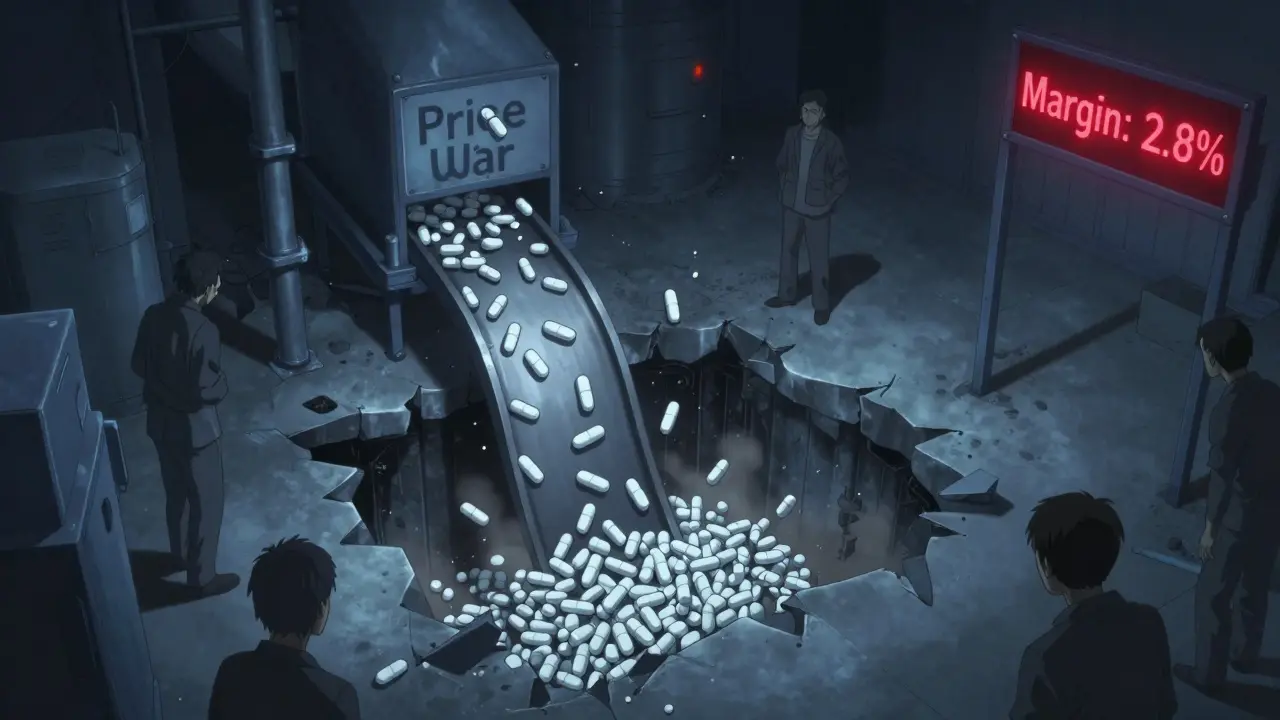
Some generic drugs now sell for less than $0.01 per pill. Gross margins? Often below 30%. That’s a far cry from the 50-60% margins seen 15 years ago. The result? Manufacturers walk away. A 2024 McKinsey analysis found that 65% of new companies focusing only on these commodity drugs fail within two years. Why? The cost to get FDA approval for one drug (an ANDA) is $2.6 million. Add $100 million for a cGMP-compliant facility, and you’re already in the red before you make your first pill.
And it’s not just cost. The system is rigged. Pharmacy benefit managers (PBMs) negotiate bulk discounts, but the savings rarely reach the manufacturer. Instead, they get squeezed between insurers, PBMs, and retailers. Meanwhile, brand companies pay generics to delay entry-known as "pay for delay"-a practice that cost the U.S. healthcare system $45 billion over 10 years, according to Blue Cross Blue Shield. When profit margins are this thin, even a single delay can sink a product line.
Complex Generics: The High-Risk, Higher-Reward Path
Not all generics are created equal. Some drugs are hard to copy. Think inhalers with precise dosing, injectables with unstable ingredients, or combination pills that need exact ratios. These are called complex generics. They require advanced formulation science, specialized equipment, and deep regulatory expertise.
These aren’t just harder to make-they’re harder to compete with. Only a handful of manufacturers can produce them. That means fewer players, higher prices, and margins that hover around 40-50%. Companies like Teva and Viatris are shifting resources here. Teva spent $998 million on R&D in 2024, mostly targeting complex generics for neurological and autoimmune conditions. Their drug Austedo XR for movement disorders? It’s now a top revenue driver. Why? Because there’s no cheap alternative.
Complex generics aren’t easy. It takes years to develop, and FDA approval can take twice as long. But the payoff is worth it. When you’re the only one who can make a drug like lenalidomide for multiple myeloma, you’re not bidding against 19 other companies-you’re setting the price.

Contract Manufacturing: Making Other People’s Drugs
Another path out of the profitability trap? Stop trying to sell your own drugs. Start making them for others.
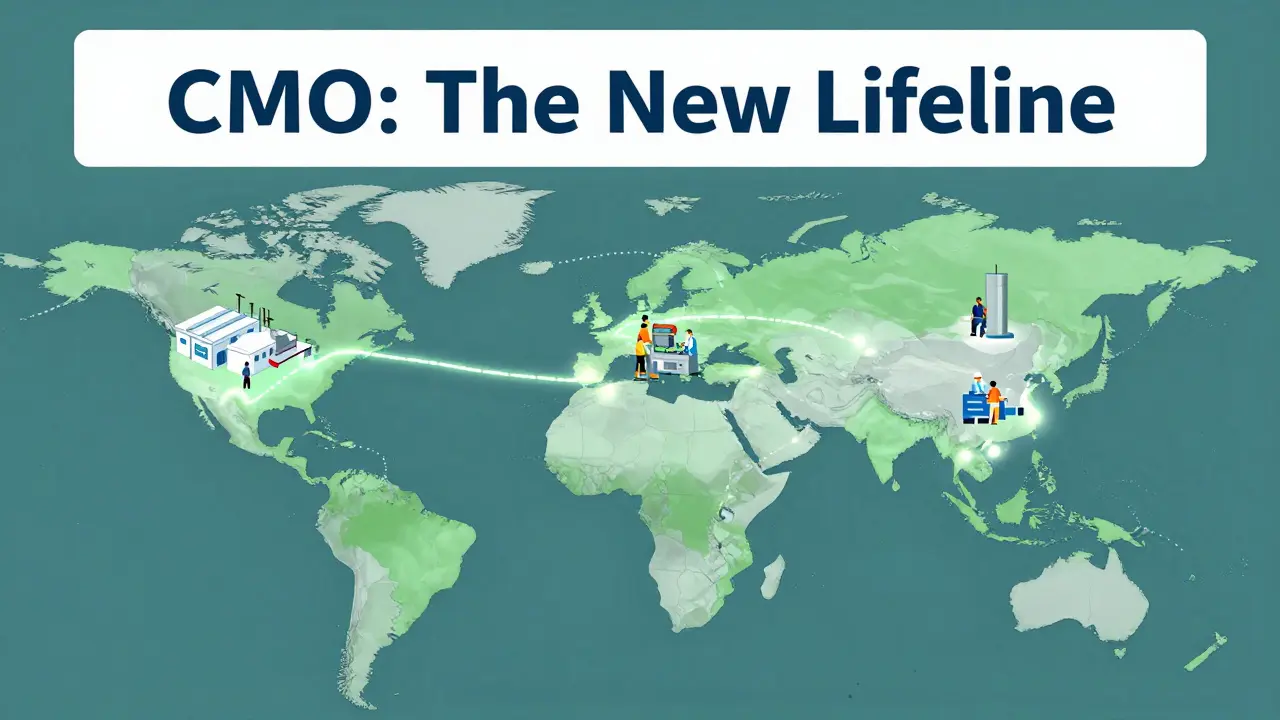
The contract manufacturing organization (CMO) segment is projected to grow from $56.53 billion in 2025 to $90.95 billion by 2030. That’s nearly a 60% increase in just five years. Companies like Egis Pharmaceuticals in Hungary launched "Egis Pharma Services" in 2023 to offer API (active pharmaceutical ingredient) development and manufacturing to global brands and generics alike.
This model works because it removes the risk of market competition. You’re not competing on price-you’re competing on reliability, quality, and speed. A CMO doesn’t care if 100 companies sell the same drug. They just need to make it right, on time, and under strict cGMP rules. And that’s a service worth paying for. Big pharma companies outsource production to cut costs and avoid facility investments. Generic companies use CMOs to scale without building their own plants.
For smaller manufacturers, this is a lifeline. You don’t need $100 million in infrastructure. You just need a skilled team and a clean facility. The margins aren’t glamorous, but they’re stable. And in a market where most generic makers are bleeding cash, stability is gold.
Why Sustainability Is a Myth-Unless You Adapt
There’s a dangerous myth in this industry: that generics will always be profitable because demand is endless. It’s not true. The U.S. market is shrinking. The FDA approved 16,000 generic drugs, and most are in a death spiral of price cuts. But globally, the picture is different. By 2033, the total generics market is expected to hit $600 billion. Why? Because countries like India, Brazil, and South Africa are ramping up production-and they’re not playing by U.S. pricing rules.
Europe maintains higher reimbursement rates. Emerging markets are willing to pay more for quality. And biosimilars-the generic version of biologic drugs-are about to explode. Over 50 blockbuster biologics will lose patent protection between 2025 and 2033. That’s a $100+ billion opportunity.
But here’s the hard truth: if you’re still making simple pills in a U.S. market dominated by PBMs and price wars, you’re not sustainable. You’re surviving. And survival isn’t a strategy. It’s a countdown.
Who’s Winning? And What Can You Learn?
Look at Teva. They stopped being just a generic company. They invested in complex generics, biosimilars, and even proprietary delivery systems. Their 2024 revenue grew 4%-the first time in years. Viatris? They sold off their biosimilars unit and their OTC business to focus on core generics with real margins. Both companies survived by letting go of what didn’t work.
Meanwhile, new players are skipping the U.S. entirely. Indian manufacturers like Dr. Reddy’s and Sun Pharma are building global supply chains. They’re making complex generics for Europe and Latin America. They’re partnering with CMOs. They’re not fighting the U.S. price war-they’re avoiding it.
The lesson? You can’t win by doing the same thing better. You have to do something different.
The Real Cost of Cheap Drugs
Dr. Aaron Kesselheim from Harvard put it bluntly: "The relentless price competition in generics has created a market failure where essential medicines face shortages because manufacturers cannot profitably produce them." We praise generics for saving $408 billion in 2022-but who’s paying the real price? The workers in the factory. The communities that lose jobs. The patients who can’t get their medication because no one’s making it anymore.
Healthcare systems need affordable drugs. But they also need reliable supply. You can’t have one without the other. If the business model doesn’t allow for profit, it doesn’t allow for sustainability. And if there’s no sustainability, there’s no future.
Why are generic drug margins so low?
Margins are low because of intense competition. Once a brand drug’s patent expires, dozens of manufacturers can make the same pill. With no differentiation, price becomes the only way to win. This drives prices down until margins fall below 30%. Add in FDA approval costs of $2.6 million per drug and facility investments over $100 million, and many companies can’t break even.
What’s the difference between commodity and complex generics?
Commodity generics are simple, off-patent pills like ibuprofen or metformin-easy to copy and made by hundreds of companies. Complex generics involve hard-to-formulate drugs like inhalers, injectables, or combination products. These require advanced science, specialized equipment, and longer approval times. Fewer companies can make them, so competition is lower and margins are higher-often 40-50%.
Can contract manufacturing save generic manufacturers?
Yes, for many. Contract manufacturing (CMO) lets companies produce drugs for others without owning the brand or facing market competition. Instead of fighting over price, they compete on quality and efficiency. This model is growing fast-projected to hit $90.95 billion by 2030. For smaller manufacturers, it’s a way to stay in business without massive upfront investments.
Why are U.S. generic manufacturers struggling more than others?
The U.S. has a unique system dominated by pharmacy benefit managers (PBMs) who negotiate bulk discounts. These discounts don’t go to manufacturers-they go to insurers and retailers. Meanwhile, Europe and emerging markets have different pricing rules that allow for better margins. India and China, for example, produce generics at scale with lower labor and regulatory costs, giving them a global advantage.
What role do biosimilars play in the future of generics?
Biosimilars are the next big wave. They’re generic versions of complex biologic drugs-like Humira or Enbrel-that cost tens of thousands per year. Over 50 of these drugs will lose patent protection between 2025 and 2033. Making biosimilars requires advanced technology and regulatory expertise, so only a few manufacturers can do it. That means higher margins and less competition. Companies investing in biosimilars now are positioning themselves for the next decade of growth.
Generic drugs aren’t going away. But the old way of making them is. The future belongs to those who stop chasing pennies on pills and start building value-through complexity, partnerships, and global strategy. The system needs affordable medicine. But it also needs manufacturers who can survive long enough to keep making it.
Jacob Carthy
February 24, 2026 AT 21:10Let me get this straight-U.S. taxpayers pay $400 billion a year for healthcare and we’re mad because some guy in Ohio can’t make a profit selling 10mg tablets for a penny? Grow up. The system is broken not because generics are cheap but because PBMs and insurers are skimming the cream while farmers in Telangana feed the world with pills. This isn’t a crisis-it’s justice.
Joseph Cantu
February 26, 2026 AT 08:33You think this is about drugs? Nah. This is about control. The same people who own the banks own the PBMs who own the pharmacies who own the FDA contractors. They want generics to fail so they can push you back into $12,000 insulin. And they’re winning. I’ve seen it. My cousin’s mom died because her metformin ran out. No one cared. No one ever does. Until it’s your name on the death certificate.
Lisandra Lautert
February 28, 2026 AT 03:22Complex generics aren’t a solution. They’re a loophole.
Cory L
February 28, 2026 AT 11:49Bro. I work in pharma logistics. I’ve seen the factories. The ones making complex generics? They’re humming. The ones churning out metformin? Dead. Empty. The real winners aren’t the ones making pills-they’re the ones making the machines that make the pills. And yeah, the Indian guys? They’re not just making drugs. They’re building supply chains that’ll outlast us. We’re still arguing over who gets the last penny. They’re already building the next factory.
Bhaskar Anand
March 2, 2026 AT 02:55USA thinks it owns innovation but the truth is India makes 20% of all global generics and 40% of all APIs. We don’t need your patents. We don’t need your PBMs. We don’t need your $2.6 million approval fees. We have engineers. We have labor. We have discipline. And you? You’re still crying about margins while we’re shipping to 150 countries. Your system is a museum. Ours is a launchpad.
William James
March 2, 2026 AT 16:39There’s a quiet truth here: we don’t value health-we value price tags. We cheer when a pill costs a penny but we don’t ask who’s making it, or if they can eat, or if they’ll still be there next year. Sustainability isn’t about profit margins-it’s about dignity. Can a person who makes 10,000 pills an hour afford insulin? If the answer is no, then we’re not saving lives-we’re just moving the cost around.
David McKie
March 4, 2026 AT 08:54Let’s be brutally honest: the U.S. generic market isn’t dying. It’s being murdered. Systematically. By regulators who sleep while PBMs loot. By politicians who take campaign cash from insurers. By consumers who think $0.01 per pill is a victory. It’s not. It’s a funeral. And the pallbearers? They’re wearing suits with Goldman Sachs logos.
Anil bhardwaj
March 4, 2026 AT 21:57CMO model is smart. Less risk. More stability. In India we’ve been doing this for decades. Make for others. Don’t fight for shelf space. You don’t need to be the brand. Just be the best maker. Simple. Clean. Reliable. No drama. No price wars. Just work. And people pay for that. Always have. Always will.
lela izzani
March 6, 2026 AT 05:33I’ve worked in rural clinics. When the metformin runs out, patients don’t ask why. They just stop taking it. And then their diabetes gets worse. And then they end up in the ER. And then the system spends $12,000 to fix what could’ve been prevented for $20. We’re not saving money-we’re just delaying the cost. And that’s not smart. It’s cruel.
Southern Indiana Paleontology Institute
March 7, 2026 AT 21:17Why are we even talking about this? The answer is simple. We need more factories. More workers. More American made pills. Not some Indian guy in a garage. We need to bring this back. Build it here. Pay people decent. Stop outsourcing our health. That’s the real solution. Not some fancy complex nonsense. Just good old American manufacturing.