
How to Address Stigma When Discussing Mental Health Medications
 Jul, 9 2026
Imagine sitting across from your doctor. You’ve finally worked up the courage to admit that your anxiety is making it impossible to sleep or focus. The doctor listens, nods, and then suggests a medication. It’s a standard, evidence-based recommendation for millions of people. But instead of relief, you feel a wave of shame. You worry they’ll think you’re weak, addicted, or 'crazy.'
You are not alone in feeling this way. This specific type of shame-medication-related stigma-is one of the biggest barriers to effective mental healthcare today. According to the Substance Abuse and Mental Health Services Administration (SAMHSA), about 56% of adults with mental illness did not receive treatment in 2022. For 32% of those people, the fear of judgment around taking medication was the primary reason they stayed away from help.
This isn’t just about general prejudice against mental illness. It’s a specific discomfort with the idea of using pills to treat brain chemistry. Many people confuse psychiatric medications with recreational drugs, fearing addiction or loss of control. In reality, these medications are strictly regulated tools, much like insulin for diabetes or statins for cholesterol. Overcoming this stigma requires a shift in how we talk about treatment, both as patients and as healthcare providers.
Understanding the Roots of Medication Stigma
To fix the problem, we first need to understand why it exists. Mental health medication stigma often stems from misinformation and cultural beliefs. A 2021 study published in Academic Psychiatry found that 22% of primary care physicians admitted to holding negative attitudes toward patients requesting psychiatric medications. Yes, even doctors can be part of the problem.
Common myths fuel this stigma:
- The 'Addiction' Myth: People assume all psychotropic medications are addictive. While some classes carry risks, most antidepressants and mood stabilizers are not physically addictive in the way opioids or benzodiazepines can be.
- The 'Weakness' Myth: Taking medication is seen as a failure of willpower. In truth, it’s an acknowledgment that biology plays a role in mental health, just as it does in physical health.
- The 'Danger' Myth: Research by Corrigan et al. (2012) showed that 52% of people believe individuals on psychiatric meds are more dangerous. Statistics show homicide rates among medicated patients are identical to the general population.
Cultural background also plays a huge role. A 2020 study in the American Journal of Public Health noted that Asian American communities had 47% lower rates of antidepressant adherence compared to White Americans, largely due to cultural beliefs that stigmatize external medical interventions for emotional issues.
Why Language Matters More Than You Think
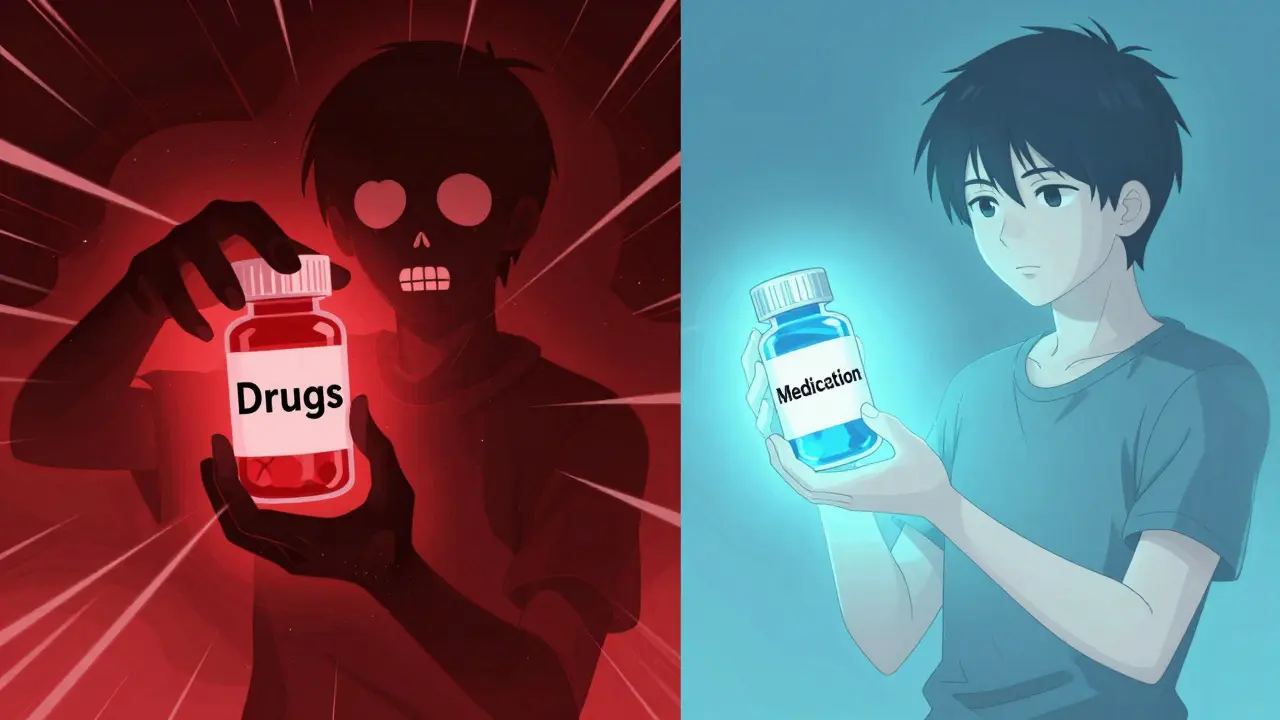
Words have power. The language we use shapes our perception of reality. The National Institute of Mental Health (NIMH) has conducted extensive research on how terminology affects patient attitudes. They found that using stigmatizing terms like 'drugs,' 'pills,' or 'meds' increases negative attitudes by 41% in focus groups.
Consider the difference between saying "I’m on drugs" versus "I’m taking medication for my health." The first sounds illicit; the second sounds clinical and responsible. The American Psychiatric Association (APA) emphasizes this in their 2022 communication guidelines, noting that replacing loaded terms with neutral ones reduces patient shame by 27%.
If you are a healthcare provider, pay attention to your script. If you are a patient, pay attention to your self-talk. Normalizing the vocabulary is the first step in normalizing the treatment.
A Framework for Providers: The Three-Step Approach
For clinicians, addressing stigma isn’t just about prescribing; it’s about communicating. The Mayo Clinic recommends a simple, three-step framework to discuss medications without triggering defensiveness or shame.
- Normalize: Start by validating the commonality of the treatment. Say something like, "Many people take medication for mental health conditions, just as others do for high blood pressure or asthma." This removes the sense of being 'othered.'
- Educate: Explain the mechanism simply. "This medication helps balance brain chemistry, similar to how insulin helps regulate blood sugar." Avoid overly technical jargon that can alienate patients.
- Personalize: Connect the treatment to the patient’s goals. "For many, this medication reduces anxiety enough to function better at work or enjoy time with family." Focus on quality of life, not just symptom suppression.
This approach shifts the conversation from 'fixing a broken person' to 'optimizing health.' It treats the mind with the same respect as the body.
Practical Strategies for Patients and Families
If you are the one taking medication, or supporting someone who is, here are practical ways to handle stigma in daily life.
Reframe the Narrative
Stop apologizing for your treatment. On Reddit’s r/mentalhealth community, users reported that normalizing statements like "I take medication for my brain health just like others take it for heart conditions" reduced negative reactions from friends and family by approximately 60%. Own your health journey.
Use the 'Two-Question Approach'
If you are hesitant to start medication, ask yourself (or ask your provider):
- "How do I feel about taking medication for my condition?"
- "What specific concerns do I have about these medications?"
A 2023 study in General Hospital Psychiatry found that patients who explicitly voiced their concerns had 33% higher adherence rates. Silence breeds fear; dialogue breeds understanding.
Leverage Digital Tools
Technology can help bridge the gap. SAMHSA’s 'Medication Conversation Starter' app, downloaded over 150,000 times since 2021, provides scripted responses for common stigmatizing comments. Having a pre-planned response can boost confidence when discussing meds with employers or skeptical relatives.
The Role of Education and Contact
Misinformation thrives in the dark. Light it up with facts. Educational interventions that correct misconceptions about efficacy have demonstrated a 34% reduction in stigma-related beliefs, according to a 2021 NCBI meta-analysis.
However, numbers alone aren’t always enough. Human connection is powerful. Contact-based interventions, where individuals share personal experiences with medication treatment, are particularly effective. A randomized controlled trial tracking over 700 students (da Conceição et al., 2023) showed a 22% increase in medication adherence intentions after participants heard lived experience narratives.
Public figures also play a role. Content creator John Green, who has openly discussed his SSRI use since 2017, documented that 68% of his subscribers reported reduced medication stigma after watching his videos. When respected voices normalize treatment, it gives permission for others to do the same.

Comparison: Stigmatizing vs. Neutral Language
| Stigmatizing Phrase | Neutral/Clinical Alternative | Perceived Impact |
|---|---|---|
| "He’s on drugs" | "He is taking medication" | Reduces association with substance abuse |
| "She’s crazy" | "She is managing a health condition" | Removes moral judgment |
| "Just pop a pill" | "Follow a prescribed treatment plan" | Emphasizes medical legitimacy |
| "Addictive meds" | "Psychotropic medications" | Distinguishes from controlled substances |
Barriers in the Workplace and Society
Despite progress, real-world consequences remain. A 2022 survey by Mental Health America found that 43% of respondents experienced workplace discrimination after disclosing psychiatric medication use. Of those, 18% reported being passed over for promotions.
This creates a chilling effect. Many people hide their treatment to protect their careers. However, integration into primary care is helping. The Henry Ford Health System found that integrating mental health medication management into primary care settings reduces stigma by 38%. When your GP prescribes antidepressants alongside blood pressure meds, it feels less like a special 'psychiatric' event and more like routine healthcare.
By 2026, the American Medical Association projects that 65% of antidepressant prescriptions will occur in primary care settings, up from 52% in 2023. This normalization is crucial for long-term stigma reduction.
Looking Ahead: What Works Best?
So, what is the single most effective way to address stigma? It’s a combination of education, empathy, and structural change.
- For Providers: Complete cultural competency training. A 2022 meta-analysis in Psychiatric Services showed a 29% reduction in medication-related stigma among providers who completed 8+ hours of training.
- For Systems: Integrate mental health into general healthcare. Reduce the separation between 'mind' and 'body' clinics.
- For Individuals: Speak openly. Share your story. Use accurate language. Support peers who are struggling.
The CDC’s 2023 'Medications as Medicine' campaign reframes psychiatric drugs within chronic disease management frameworks, increasing positive attitudes by 21% in pilot communities. This shift-from viewing medication as a last resort to viewing it as a standard tool for wellness-is the future of mental health care.
Remember, taking medication is not a sign of weakness. It is a proactive step toward reclaiming your life. By changing how we talk about it, we change how we live with it.
Why do people feel ashamed about taking mental health medication?
Shame often stems from societal myths that equate psychiatric medication with addiction, weakness, or danger. Cultural beliefs may also view emotional struggles as moral failures rather than medical conditions. Additionally, historical discrimination against mental health patients contributes to this lingering stigma.
How can healthcare providers reduce stigma during consultations?
Providers can use the Mayo Clinic's three-step framework: Normalize the treatment, Educate on the biological mechanism, and Personalize the benefits. Using neutral language (e.g., 'medication' instead of 'drugs') and integrating mental health care into primary care settings also significantly reduces patient shame.
Is there a difference between mental health stigma and medication stigma?
Yes. General mental health stigma relates to the condition itself (e.g., depression or anxiety). Medication stigma is specific to the pharmacological treatment. People might accept therapy but reject pills due to fears of side effects, addiction, or losing their 'true self.'
What should I say if someone makes a stigmatizing comment about my medication?
You can use a normalizing statement like, "I take this for my brain health, just like someone takes insulin for diabetes." Tools like the SAMHSA 'Medication Conversation Starter' app provide scripted responses to help you confidently address misconceptions without escalating conflict.
Does culture affect medication adherence?
Absolutely. Studies show significant variations across ethnic groups. For example, Asian American communities have shown lower adherence rates due to cultural beliefs about medication use. Culturally competent care and education tailored to specific community values are essential for improving outcomes.
Are psychiatric medications addictive?
Most commonly prescribed psychiatric medications, such as SSRIs for depression, are not addictive. While some classes like benzodiazepines carry dependency risks, they are prescribed with caution. Confusing therapeutic use with addiction is a major driver of stigma that needs to be corrected through education.