
How to Safely Dispose of Expired EpiPens, Inhalers, and Patches
 Jan, 13 2026
Why Proper Disposal Matters
Expired EpiPens, inhalers, and medicated patches aren’t just old medicine-they’re potential hazards. An unused EpiPen still contains a powerful dose of epinephrine. A half-used inhaler still holds pressurized gas and active drug. A used patch can still leak medication through its sticky surface. If tossed in the trash, these items can end up in the hands of children, pets, or sanitation workers. The FDA reports that 12% of accidental poisonings in kids involve improperly discarded medications. And when these items go into landfills or flushes, chemicals can leach into water systems. The EPA found pharmaceuticals in 80% of tested waterways. Proper disposal isn’t just about rules-it’s about safety.
How to Dispose of Expired EpiPens
EpiPens are not regular trash. They have a built-in needle, which makes them medical sharps. That means they need special handling. The safest way is to take them back to your doctor’s office or pharmacy when you pick up a new one. Most allergists and clinics have sharps bins just for this. If you’re unsure, call ahead-many will take them even if you didn’t get the prescription there.
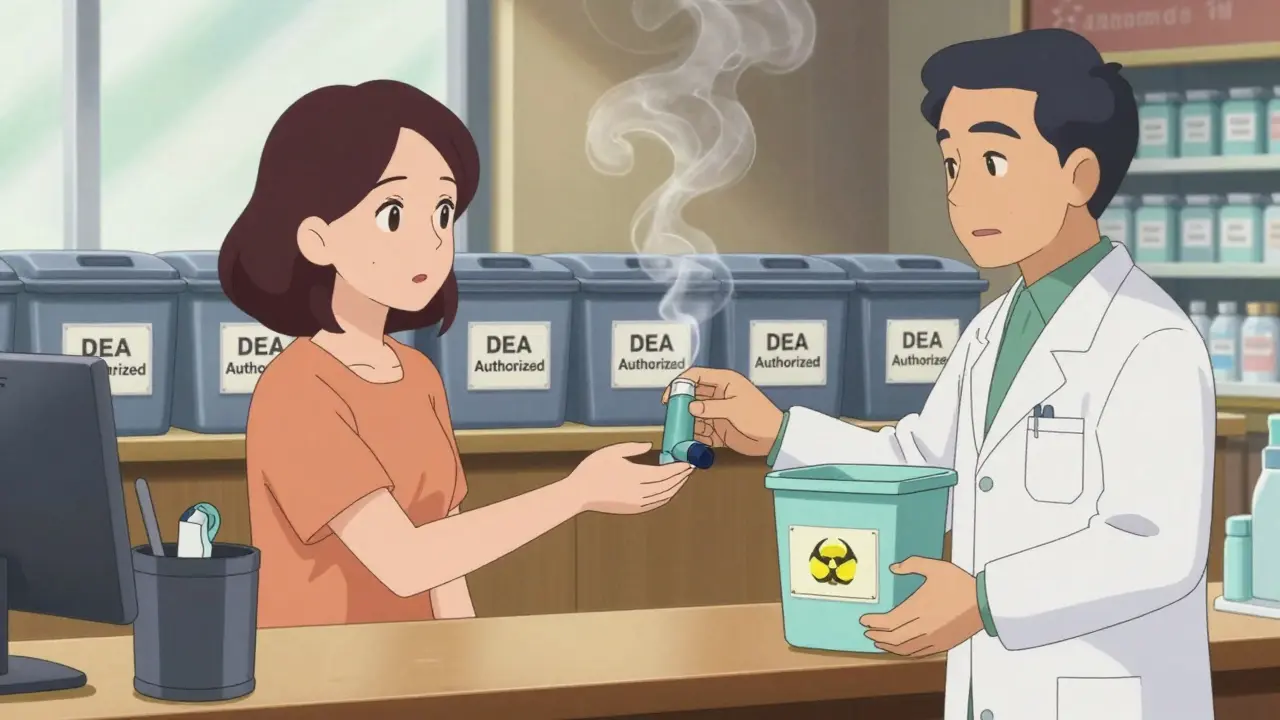
If you can’t get to a medical site, look for a DEA-authorized drug take-back location. These are often at police stations, hospitals, or participating pharmacies. Use the DEA’s Take Back Day locator to find the nearest drop-off point. You can also check safeneedledisposal.org for state-specific options.
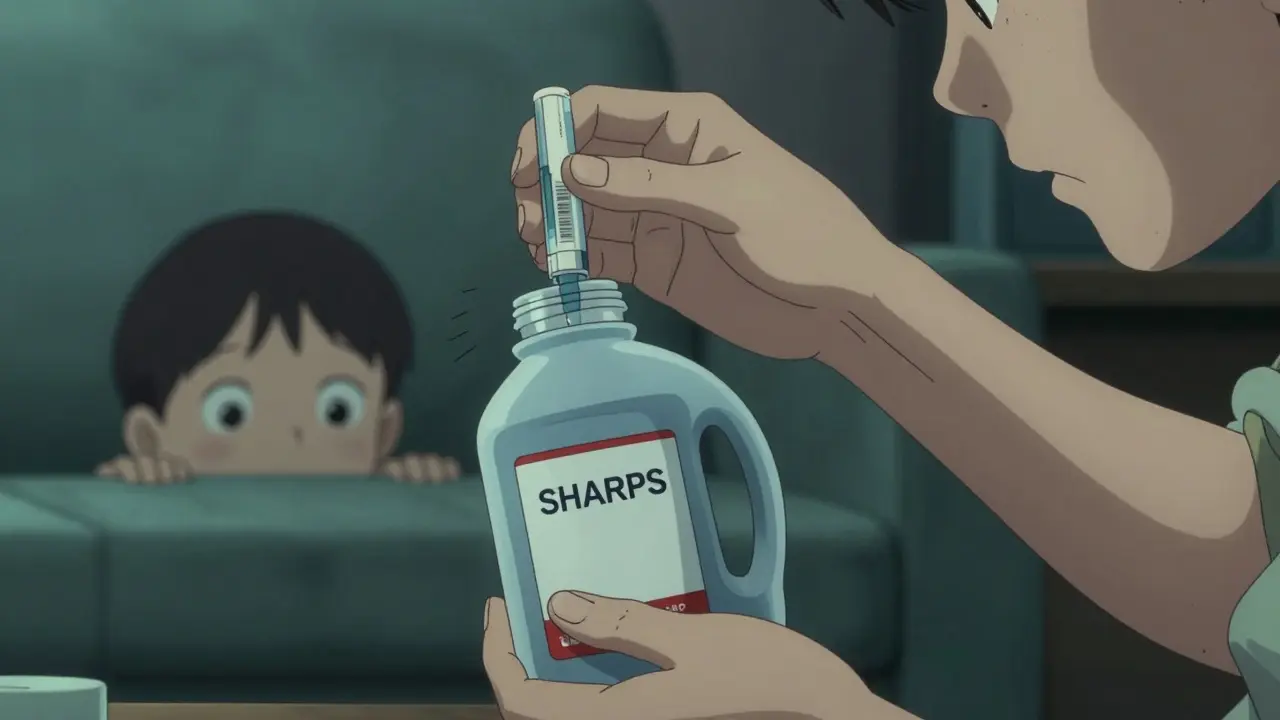
Never try to remove the needle or break open the device. That’s dangerous and illegal in many places. If you must store it at home before disposal, put it in a rigid, puncture-proof container-a plastic laundry detergent bottle works. Label it clearly: “SHARPS,” “BIOHAZARD,” and “DO NOT RECYCLE.” Keep it out of reach of kids and pets.
State rules vary. In California, you must use a certified sharps collection program or mail-back service. In Texas, you can throw it in the trash if it’s properly contained and labeled. Always check your state’s health department website for local rules.
What to Do with Old Inhalers
Inhalers are tricky because they’re pressurized. Throwing one in the trash or recycling bin can cause it to explode if crushed or exposed to heat. Burning it releases greenhouse gases from the propellant. The American College of Allergy, Asthma, and Immunology says around 300 million inhalers are thrown away each year in the U.S.-and most end up in landfills.
The best option? Return it to a pharmacy that accepts inhalers. Walgreens and CVS have pilot programs in some states, but availability is spotty. Only about 47% of Walgreens locations take them, according to a 2022 survey. Call your local store before you go.
If your pharmacy doesn’t accept them, contact your city’s household hazardous waste program. Big cities like New York, Chicago, and Seattle have special drop-off sites for aerosols. Some counties even offer mail-back kits. Check your local government’s waste management site for details.
Never puncture, burn, or throw an inhaler into a fire. Even if it feels empty, there’s still pressure inside. If you’re stuck, remove the metal canister from the plastic mouthpiece. The plastic part can go in recycling (if your program accepts #1 or #2 plastic). The metal canister? Take it to a hazardous waste site. Don’t recycle it with cans or bottles.
Disposing of Medicated Patches
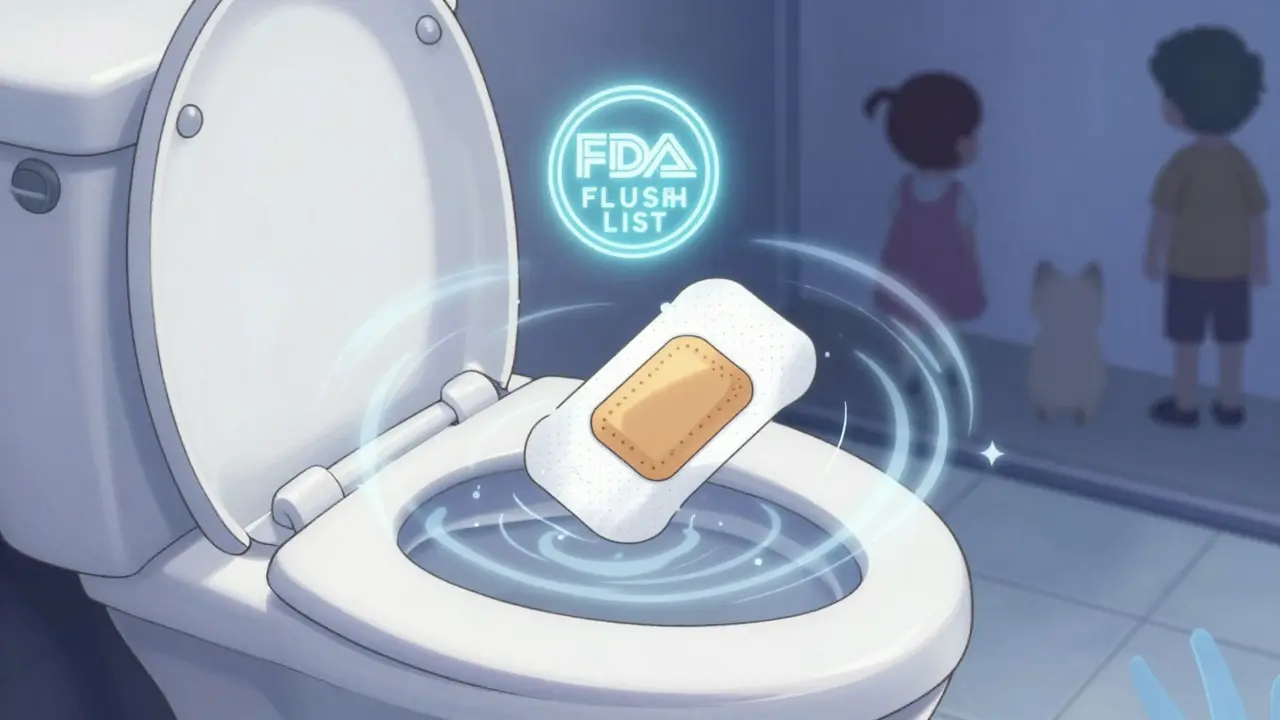
Patches are among the most dangerous if not disposed of correctly. Fentanyl, nicotine, and other strong drugs can still be absorbed through skin-even after use. The FDA has a specific “flush list” of medications that should be flushed down the toilet immediately to prevent accidental exposure. Fentanyl patches are on that list. So are certain opioids.
If your patch is on the flush list, fold it in half with the sticky sides together, then flush it. That’s the safest way to stop someone else from getting exposed. Nationwide Children’s Hospital recommends this for all high-risk patches.
If your patch isn’t on the flush list, fold it in half (sticky sides together) and put it in a sealed container. Mix it with coffee grounds, cat litter, or dirt to make it unappealing. Then throw it in the trash. Don’t just toss it in the open bin. Kids and pets might dig through it.
There’s a product called DisposeRx® that turns pills and liquids into a gel when mixed with water. But CVS says it doesn’t work well with patches-the adhesive doesn’t break down properly. So stick with folding and flushing (if approved) or folding and trashing with a bad-smelling mix.
Use Drug Take-Back Days
Every April and October, the DEA runs National Prescription Drug Take Back Day. Over 5,800 locations across the country-police stations, fire departments, hospitals-accept all kinds of expired or unwanted medications, including EpiPens, inhalers, and patches. In October 2022, they collected nearly a million pounds of drugs.
You don’t need a receipt or ID. You can drop off anything: full bottles, empty containers, patches, even syringes (if properly contained). It’s free and anonymous. If you miss the event, many locations keep drop boxes year-round. Check the DEA website for permanent collection sites near you.
These events are growing. In 2010, they collected 121 tons of drugs. In 2022, it was 493 tons. More people are learning how to do this right.
What Not to Do
Here are the most common mistakes:
- Don’t flush everything. Only flush what’s on the FDA’s official flush list. Most medications should not go down the toilet.
- Don’t recycle EpiPens or inhalers. Even if they look like plastic, they’re not. They contain chemicals and pressurized parts.
- Don’t throw loose needles or patches in the trash. Always contain them. A loose needle can poke someone.
- Don’t rely on pharmacies unless you confirm. Many only take pills. Always call first.
- Don’t wait until you have a full box. Dispose of expired items as soon as you notice they’re past the date. Don’t let them sit in a drawer.
How to Stay Prepared
Check your medicine cabinet every month. Set a reminder on your phone: “Check EpiPen and inhaler dates.” Most EpiPens expire after 12-18 months. Inhalers often last 1 year after opening. Patches vary by brand.
Keep a small sharps container in your bag or car if you carry an EpiPen. Some pharmacies sell them for $5-$15. When it’s full, drop it off at a take-back site. You can also order mail-back kits online-some states offer them for free.
If you’re unsure where to go, call 211. It’s a free national helpline that connects people to local health and safety services. They can tell you about drop-off locations, mail-back programs, or even mobile collection events in your area.
What’s Changing
More states are making disposal easier. California passed a law in 2024 requiring drug makers to pay for disposal programs. That means more drop boxes at pharmacies, more mail-back kits, and better labeling on packaging. Mylan, the maker of EpiPens, started putting QR codes on their devices that link directly to disposal instructions.
The EPA is also working on new rules to cut pharmaceutical pollution in waterways. In the next few years, you’ll see more clear instructions on boxes and more accessible take-back options-especially in rural areas where access has been limited.
For now, the best thing you can do is act now. Don’t wait for the system to get better. Use the tools that exist today: take-back programs, sealed containers, and flush-only items when the FDA says so. Your family, your community, and the environment will thank you.
Trevor Davis
January 13, 2026 AT 11:18Just disposed of my kid’s expired EpiPen last week. Took it to the pharmacy like they said - no hassle, no questions asked. They even gave me a free sticker for being responsible. Small win for safety.
Also, I started keeping a small sharps container in my glovebox now. Best habit I’ve picked up this year.
John Tran
January 14, 2026 AT 11:21You know, humanity’s relationship with medicine is a tragic paradox - we create life-saving tools, then treat them like trash because we’re too lazy to think about consequences. EpiPens aren’t just plastic and metal, they’re the last line of defense against death, and yet we toss them like empty soda cans.
And the system? It’s broken. Corporations profit off the fear of anaphylaxis, then shift the burden of disposal onto the individual while offering zero real infrastructure. We’re not just disposing of drugs - we’re disposing of our moral responsibility.
And don’t get me started on how the FDA flush list is a patchwork of bureaucratic whim. One day fentanyl patches are sacred, the next they’re ‘not recommended’ unless you live in a zip code with a drop box. It’s chaos dressed as policy.
Maybe we need a new religion. Worship the needle. Bow before the inhaler. Let the earth be cleansed by proper containment. I’m starting a cult. First ritual: folding your patch like a origami crane while whispering ‘I am not a hazard.’
Join me. We’ll call it The Church of Safe Disposal. Offerings accepted in sealed containers only.
mike swinchoski
January 15, 2026 AT 13:18You people are ridiculous. Just flush it. Everyone does. Who cares if a few fish get sick? You think your little patch is gonna kill the ocean? Get real.
And don’t waste your time calling pharmacies. They don’t care. They just want you to buy a new one.
My cousin’s kid swallowed a whole inhaler once. He’s fine. Kids are tough. Stop coddling them.
Also, why do you even have expired stuff? Buy less. Be smarter. Simple.
Trevor Whipple
January 17, 2026 AT 07:58Wait, so you’re telling me I can’t just toss my inhaler in the recycle bin? I’ve been doing that for years. My mom says it’s fine. She’s 72 and still uses a typewriter, so I trust her.
Also, I tried that DEA locator and it said the nearest drop-off was 47 miles away. That’s a full tank of gas. No thanks.
And why do they even make patches that stick so good? I peel mine off and it still sticks to my fingers. That’s not medicine, that’s glue with benefits.
Also, ‘fold sticky sides together’? Bro, I tried that and it stuck to my pants. Now I have a fentanyl patch on my jeans. That’s a whole new level of awkward.
Lethabo Phalafala
January 17, 2026 AT 09:11Oh my god, I just read this and I’m crying. Not because it’s sad - because it’s so *right*. I’m from South Africa, and here, people just throw meds in the river or burn them in the yard. No one knows better. I wish we had this kind of education.
I’ve been telling my neighbors to save their old patches in old coffee tins. One woman asked me, ‘Why not just throw it?’ I said, ‘Because your grandson might find it, and then you’ll have to explain why his little hands are shaking.’ She didn’t say anything after that.
We need more of this. Not just in the US. Everywhere. This isn’t just about rules - it’s about love. Love for the ones who can’t speak for themselves. The kids. The dogs. The water. The future.
Thank you for writing this. I’m sharing it with my entire township tomorrow.
Lance Nickie
January 18, 2026 AT 07:10Flush everything. Problem solved. Stop overthinking.
Milla Masliy
January 19, 2026 AT 14:37I love how this article says ‘don’t rely on pharmacies unless you confirm.’ Like, yeah, because who *would* trust a place that literally sells medicine? I mean, they’re just there to upsell you Advil and hand you a coupon for more EpiPens.
Also, I tried to return my inhaler and the pharmacist said, ‘We don’t take those.’ I asked, ‘Then why does your website say you do?’ She shrugged and handed me a free sample of nasal spray. That’s the American dream right there.
Meanwhile, my cat is staring at the old patch I left on the counter. I think he’s planning a heist.
Damario Brown
January 20, 2026 AT 06:48Let’s break this down statistically. 12% of pediatric poisonings from improper disposal? That’s 0.0004% of total pediatric ER visits in the US. The real threat is opioid overdoses from *active* prescriptions, not expired ones. You’re fearmongering with cherry-picked stats.
Also, pharmaceuticals in 80% of waterways? So what? The concentration is in parts per trillion. You’d have to drink 20,000 liters of tap water to get a therapeutic dose of ibuprofen.
And the ‘flush list’? It’s a marketing tool. The FDA doesn’t want you flushing meds because they’re worried about sewage systems - they want you to buy their new mail-back kits, which cost $15 and are funded by Big Pharma.
Bottom line: You’re being manipulated. Stop being a compliance sheep.
sam abas
January 22, 2026 AT 00:41I read the entire thing. Took me 22 minutes. I’m not even mad. I’m just… tired.
Why does everything have to be this complicated? I used to just throw stuff in the trash. Life was simpler. I didn’t need QR codes, DEA databases, or folding instructions for patches.
Also, I looked up ‘Take Back Day’ and it’s in April and October. That’s like… 6 months apart. What if I get an expired inhaler in July? Do I just keep it under my bed until next spring? Am I supposed to become a hoarder of dangerous medical waste?
And why is the EPA involved? They’re supposed to be about pollution, not my expired nicotine patch.
I think we need a new system. Maybe an app. ‘MediTrash’ - scan your pill bottle, it tells you how to dispose of it, then schedules a pickup. Like Uber, but for your old medicine.
Until then, I’m just gonna keep it in the drawer. My cat’s already used it as a pillow.
John Pope
January 22, 2026 AT 11:06Let’s be real - this entire system is performative activism dressed as public health.
You know what’s *actually* dangerous? The fact that we’re told to ‘fold patches in half’ like we’re wrapping a burrito. What if the adhesive fails? What if the kid just rips it open? The real solution isn’t folding - it’s eliminating the damn patch entirely.
And why are we still using propellant inhalers in 2024? We have dry powder inhalers. They’re cleaner. Quieter. No greenhouse gas. But no one pushes them because they’re 30% more expensive and Big Pharma doesn’t profit from ‘eco-friendly’ asthma.
Also, ‘take-back day’? That’s a PR stunt. They collect 500 tons of meds and then incinerate them. So we’re just moving the pollution from waterways to the air. Congrats, we solved one problem by creating another.
Real change? Ban single-use epinephrine pens. Mandate refillable auto-injectors. Make inhalers refillable. Tax pharmaceutical waste. Stop pretending this is about safety - it’s about profit.
Clay .Haeber
January 23, 2026 AT 16:52Wow. You wrote a novel about how to throw away a pen. I’m impressed. Did you also write a 10,000-word treatise on how to dispose of a Band-Aid? Because I’m sure the EPA is just waiting for that one.
Also, ‘fold sticky sides together’? That’s the most poetic thing I’ve read all year. Next you’ll be telling us to whisper a lullaby to the inhaler before tossing it into the hazardous waste bin.
Meanwhile, I just put mine in a Ziploc and called it a day. My trash can doesn’t care. Neither does my dog. He ate a whole box of expired gummy vitamins last week. He’s fine. He’s also a genius.
Priyanka Kumari
January 25, 2026 AT 03:54This is beautiful. I’m from India, and here, most people don’t even know what ‘expired medicine’ means - they just keep taking it. I showed this to my sister, and she cried because she’d been keeping her dad’s old patches for ‘just in case.’
I’m starting a small project in my neighborhood: we collect expired meds once a month and drop them at the nearest pharmacy. We even make little flyers in Hindi and English. One old man gave me his grandson’s EpiPen - said, ‘I don’t want my boy to be scared like I was.’
Thank you for reminding us that care doesn’t have to be complicated. Just consistent. Just kind.
Trevor Davis
January 26, 2026 AT 12:25Just got a reply from my local pharmacy - they’re adding a drop box next month. No more 47-mile drives. I’m so glad I didn’t just give up.
Also, my kid asked me why we don’t throw the EpiPen in the trash. I told him, ‘Because someone else might find it, and it could hurt them.’ He hugged me and said, ‘Then we’re superheroes.’
Best comment I’ve ever received.