
Measuring Your Medication Adherence: A Practical Checklist for Better Health
 Jan, 3 2026
Why Medication Adherence Matters More Than You Think
If you’re taking medication for high blood pressure, diabetes, or cholesterol, skipping doses isn’t just a small mistake-it’s a health risk. More than half of people with chronic conditions don’t take their meds as prescribed. That’s not laziness. It’s forgetfulness, cost, side effects, or confusion. But here’s the real problem: medication adherence isn’t something you can guess. You need to measure it. Without numbers, you’re flying blind.
When you miss pills, your condition can worsen. Blood pressure spikes. Blood sugar goes wild. Cholesterol builds up. You might end up in the hospital. In the U.S. alone, poor adherence costs the system $100-$300 billion a year in avoidable care. That’s not just a statistic-it’s your life on the line.
What Does ‘Adherence’ Really Mean?
Adherence isn’t just about taking your pills. It’s three things: initiation, implementation, and persistence. Initiation means you started the medication. Implementation means you’re taking it the right way-right dose, right time, right frequency. Persistence means you didn’t quit early.
Most people think if they picked up the prescription, they’re doing fine. But that’s not true. You could fill your meds every month and still throw them in the drawer. Or take half the dose because you’re scared of side effects. Or skip pills on weekends because you’re ‘too busy.’
Health systems use tools like PDC-Proportion of Days Covered-to measure this. It’s simple: if you had enough pills to cover 80% or more of the days you were supposed to take them, you’re considered adherent. That’s the gold standard for chronic meds. But you don’t need fancy software to track this. You can do it yourself.
Your 7-Step Medication Adherence Checklist
Here’s a practical, no-tech, low-cost way to track your adherence. Use this every week. It works whether you’re on one pill or five.
- Write down every medication-name, dose, time of day, why you take it. Keep this list on your phone or in your wallet. Don’t rely on memory.
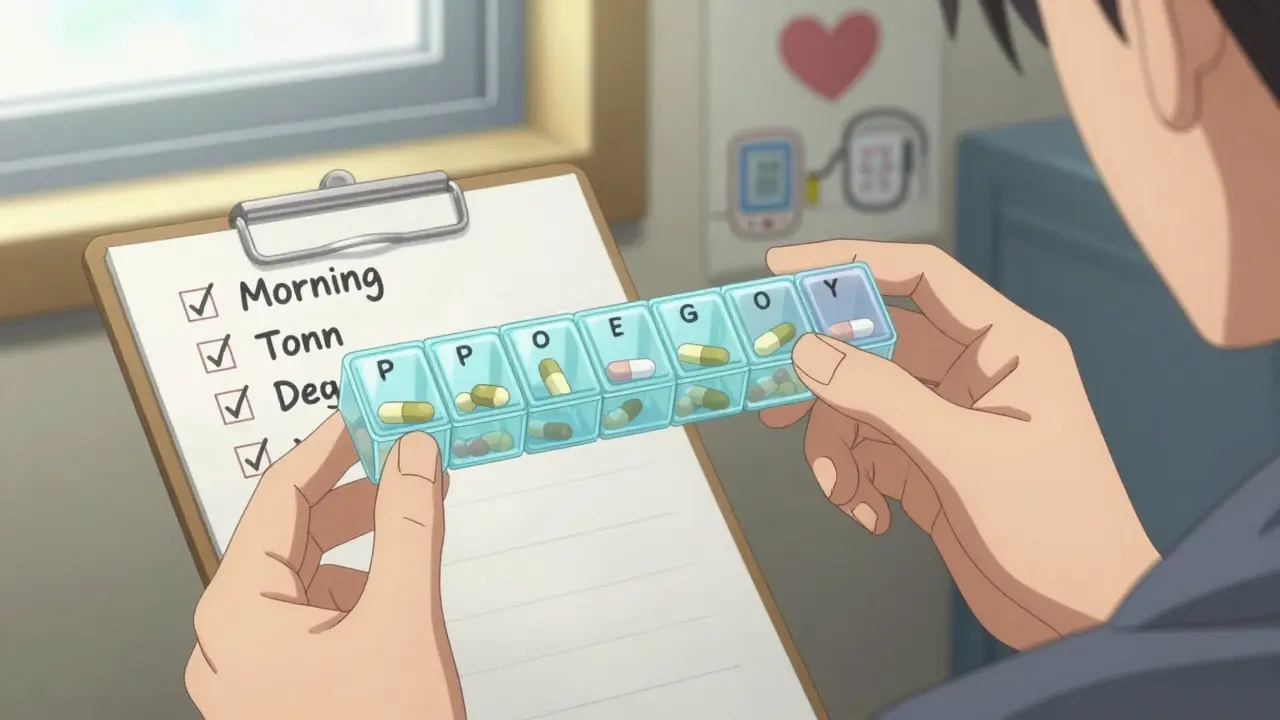
- Use a pill organizer-a simple seven-day box with morning/afternoon/evening slots. Buy one for under $10. Fill it every Sunday.
- Check off each dose-as soon as you take it. Use a calendar, a notebook, or a free app like Medisafe or MyTherapy. If you don’t check it, you didn’t take it.
- Track refills-write down when you fill each prescription. Note the date and how many pills you got. If your supply runs out before the next refill, you missed doses.
- Calculate your PDC score monthly-Add up the total days you were supposed to take your meds in the last 30 days. Then count how many days you actually took them. Divide the days taken by the days needed. Multiply by 100. If it’s 80% or higher, you’re doing well. Below 80%, you need a plan.
- Ask yourself: Why did I miss a dose? Was it cost? Side effects? Too many pills? Forgetting? Write it down. Patterns matter.
- Talk to your pharmacist or doctor-every visit. Say: ‘I’m trying to stick to my meds. Here’s what’s working and what’s not.’ They can help adjust doses, switch to once-daily pills, or find financial help.

What Your Doctor Isn’t Telling You About Adherence Tools
Doctors don’t have time to check your pill count every visit. They rely on what you say. And guess what? Most people overreport how well they take their meds. A study found electronic monitors caught 58% of non-adherent patients. Self-reports caught only 32%. That’s a huge gap.
That’s why tools like the Medication Adherence Report Scale (MARS) exist. It’s a five-question quiz you can take in under two minutes:
- How often do you forget to take your medicine? (Never to Very Often)
- Do you ever stop taking it when you feel better?
- Do you ever cut the dose to save money?
- Do you ever skip it because you’re worried about side effects?
- Do you ever take someone else’s medicine instead?
Score it: 1 = very often, 5 = never. Add them up. 20-25 = good adherence. Below 18? You’re at risk.
And here’s the truth: your doctor won’t know unless you tell them. Don’t wait for them to ask. Bring your checklist. Bring your score. Make it part of the conversation.
Why Your Pharmacy Might Be Hiding Your Real Adherence
Pharmacies track your refills. They calculate your MPR-Medication Possession Ratio. But here’s the catch: MPR can say you’re 120% adherent because you refilled early. That doesn’t mean you took the pills. You might have bought them, then sold them. Or stored them. Or taken them once and stopped.
PDC is better. It only counts days you actually had pills in hand. But even PDC has limits. If you use three different pharmacies, your data is split. Medicare patients use an average of 3.2 pharmacies a year. That means your adherence score could be wrong by 20% or more.
Solution? Stick to one pharmacy. Or ask your doctor to link your records through a health information exchange. If you’re on Medicare, your plan already tracks this. Call them. Ask: ‘What’s my PDC score for my blood pressure pill?’ They’re required to tell you.
What to Do If You’re Struggling
Missing doses isn’t a failure. It’s a signal. Here’s what to try:
- Too many pills? Ask if you can switch to combination pills. Some diabetes meds now come in one pill that does two jobs.
- Cost is a problem? Ask your pharmacist about generic versions or patient assistance programs. Many drug makers give free meds to low-income patients.
- Side effects? Don’t stop cold. Call your doctor. There might be a different drug or a lower dose.
- Forgetful? Set phone alarms. Link pill-taking to daily habits-like brushing your teeth or eating breakfast.
- Overwhelmed? Ask for a medication review. Many pharmacies offer free 15-minute consultations with a pharmacist.

The Bigger Picture: Why This Isn’t Just Your Problem
Medication adherence isn’t just personal. It’s systemic. Health plans get paid bonuses if their members stay adherent. Medicare gives up to $1,200 per person per year for good adherence on key meds. Pharmacies and tech companies are building smart bottles that beep when you miss a dose. AI tools are learning to predict who’s at risk-before they end up in the ER.
But none of that matters if you don’t know where you stand. You can’t fix what you don’t measure. And you can’t improve what you don’t track.
Start Today. No Tools Needed.
Grab a pen. Write down your meds. Count how many you took last week. Calculate your PDC. If it’s below 80%, pick one thing to fix this week. Maybe it’s switching to a pill box. Maybe it’s calling your pharmacist about cost. Maybe it’s telling your doctor you’ve been skipping pills on weekends.
Small changes add up. One missed pill here. One skipped dose there. Over months, that’s a health crisis. But one consistent habit? That’s a life saved.
How do I know if I’m truly adherent to my medication?
You’re adherent if you’ve taken your medication as prescribed for at least 80% of the days you were supposed to. Use the Proportion of Days Covered (PDC) method: add up the days you had your meds available, divide by the total days you should have taken them, then multiply by 100. If the result is 80% or higher, you’re on track. For a quick check, use the 7-step checklist to track daily intake.
Can I trust my pharmacy’s refill records to show if I’m taking my meds?
No. Refill records only show you picked up the prescription, not that you took it. Many people fill prescriptions but don’t take the pills-due to cost, side effects, or forgetfulness. PDC is more accurate because it measures actual days covered by supply, but even that can be skewed if you use multiple pharmacies. Always track your own intake with a daily log.
What’s the difference between MPR and PDC?
MPR (Medication Possession Ratio) calculates total days of medication received divided by days in the period. It can go over 100% if you refill early. PDC (Proportion of Days Covered) only counts days you had medication, with a maximum of 100%. PDC is the preferred method because it doesn’t overestimate adherence and better reflects actual use.
Is there a free tool I can use to track my medication adherence?
Yes. Use a simple pill organizer and a notebook or free app like Medisafe or MyTherapy. Both let you set reminders, check off doses, and generate monthly reports. No cost, no subscription. You can also use your phone’s calendar to mark each dose taken. The key is consistency-not the tool.
Why do I keep forgetting to take my pills even though I want to?
Forgetting is common, especially with complex regimens. It’s not laziness-it’s cognitive overload. Link pill-taking to daily habits like brushing your teeth or eating breakfast. Use alarms. Put your pill box where you’ll see it-next to your toothbrush or coffee maker. If you still struggle, ask your doctor about once-daily options or combination pills.
Can my doctor tell if I’m not taking my meds?
Sometimes. If your blood pressure stays high or your A1C rises despite treatment, your doctor may suspect non-adherence. But they won’t know for sure unless you tell them. Don’t wait for them to guess. Bring your adherence checklist to appointments. Be honest. Your doctor’s job is to help-not to judge.
What should I do if I can’t afford my medication?
Don’t skip doses or split pills without talking to your doctor. Ask your pharmacist about generic versions or patient assistance programs. Many drug manufacturers offer free or low-cost meds to people with low income. You can also call your insurance plan-they may have cost-sharing programs. Some pharmacies offer $4 generic lists for common chronic meds.
Are there new technologies that help with medication adherence?
Yes. Smart pill bottles like AdhereTech beep and send alerts if you miss a dose. Some apps use AI to predict who’s at risk of non-adherence based on refill patterns and lifestyle data. But these aren’t necessary for most people. A $10 pill box and a daily check-off list work just as well. Tech helps-but behavior change matters more.
Next Steps: What to Do Right Now
Don’t wait. Pick one thing from this checklist and do it today.
- If you don’t have a pill box-buy one before you leave the pharmacy.
- If you haven’t tracked your doses this week-do it tonight.
- If you’re not sure about your PDC score-calculate it now.
- If you’ve been skipping doses-tell your doctor next time you see them.
Your health isn’t a guess. It’s a number. And you’re the only one who can measure it.
Palesa Makuru
January 4, 2026 AT 07:25Hank Pannell
January 6, 2026 AT 07:02Ian Ring
January 7, 2026 AT 18:44erica yabut
January 9, 2026 AT 14:54Tru Vista
January 9, 2026 AT 17:36Vincent Sunio
January 11, 2026 AT 16:06Haley Parizo
January 12, 2026 AT 07:15Angela Fisher
January 12, 2026 AT 13:03Neela Sharma
January 14, 2026 AT 02:17