
Metabolic Acidosis in CKD: How Bicarbonate Therapy Slows Kidney Decline
 Dec, 17 2025
When your kidneys start to fail, they don’t just stop filtering waste-they also lose their ability to keep your blood’s acid levels in check. This leads to metabolic acidosis, a quiet but dangerous condition that speeds up kidney damage, breaks down muscle, and weakens bones. In people with chronic kidney disease (CKD), especially stages 3 to 5, metabolic acidosis isn’t rare-it’s common. About 42% of those with stage 5 CKD have it. And yet, many never get treated.
What Is Metabolic Acidosis?
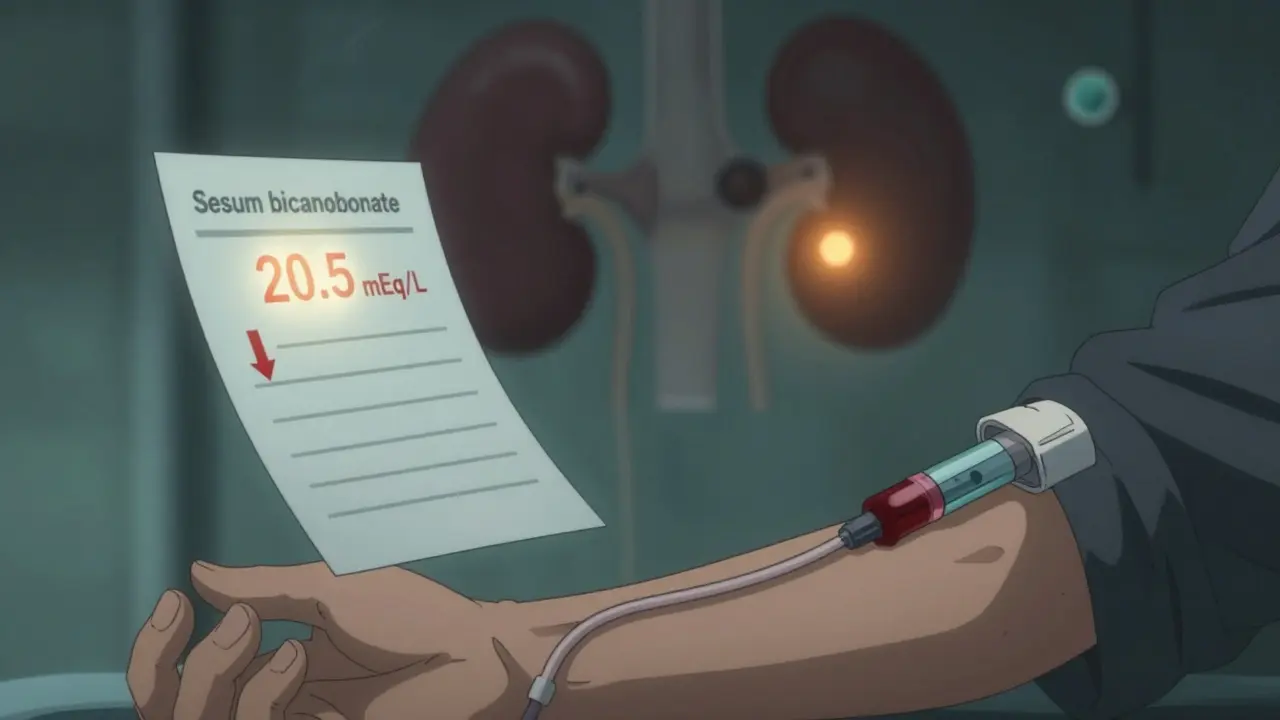
Metabolic acidosis happens when your blood becomes too acidic because your kidneys can’t remove enough acid or make enough bicarbonate to balance it. Normal blood bicarbonate levels sit between 22 and 29 mEq/L. When they drop below 22, you’re in metabolic acidosis. This isn’t just a lab number-it’s a signal that your body is under stress.The kidneys normally get rid of acid through urine and rebuild bicarbonate to neutralize it. But when kidney function drops below 30%, this system starts to fail. Acid builds up. And over time, that acid eats away at your muscles, bones, and even your heart.
Why Bicarbonate Matters in CKD
Bicarbonate isn’t just a buffer-it’s a lifeline. When you take sodium bicarbonate (baking soda), it enters your bloodstream and neutralizes the excess acid. This simple act slows the decline of your kidney function.A major 3-year study published in the Journal of the American Society of Nephrology showed that CKD patients taking oral sodium bicarbonate had a 5.9 mL/min/1.73m² slower decline in eGFR compared to those who didn’t. That’s like adding two years of healthy kidney function over three years. Other studies found that keeping bicarbonate above 22 mEq/L cuts the risk of needing dialysis by 23%.
The KDIGO guidelines now recommend starting bicarbonate therapy when levels fall below 22 mEq/L. Many doctors wait until it’s below 20. But evidence shows that even a small drop below 22 starts causing harm. The goal isn’t to push bicarbonate to 30-it’s to hold it between 23 and 29 mEq/L. Too high, and you risk complications. Too low, and your kidneys keep deteriorating.
The Sodium Problem
Here’s the catch: sodium bicarbonate comes with sodium. One 650mg tablet contains 7.6 mEq of bicarbonate-and 160mg of sodium. A full daily dose can mean over 1,000mg of sodium. For someone with high blood pressure or heart failure, that’s dangerous.One study found that CKD patients with hypertension who took sodium bicarbonate had a 32% higher chance of being hospitalized for heart failure. That’s why many nephrologists avoid it in patients with fluid retention, swelling, or poor heart function. It’s a trade-off: protect your kidneys, but risk your heart.
That’s why alternatives exist.

Alternatives to Sodium Bicarbonate
Sodium citrate (Shohl’s solution) is a liquid form that’s easier to dose. But it tastes awful-many patients mix it with orange juice, adding sugar they shouldn’t have. One Reddit user said it felt like drinking battery acid.Potassium citrate sounds ideal-it adds potassium instead of sodium. But in CKD, potassium builds up easily. About 18% of patients on potassium citrate develop dangerous hyperkalemia (potassium over 5.0 mEq/L). The National Kidney Foundation advises against it in stage 3b-5 CKD unless potassium is already low.
Calcium citrate is another option. It avoids sodium and potassium. But it can raise blood calcium levels and increase kidney stones. One study found a 27% higher rate of calcium stones in patients on long-term calcium supplements. And if you’re already taking vitamin D or calcium for bone health, you might be overdoing it.
There’s also veverimer, a pill that binds acid in the gut without being absorbed. It showed promise in early trials-raising bicarbonate by 4.3 mEq/L in 12 weeks. But its phase 3 trial failed in 2021. It didn’t meet the target for long-term bicarbonate improvement. The FDA didn’t approve it. Tricida Inc. is trying again with new data in 2024, but for now, it’s not an option.
Diet Can Help-If You Stick With It
Food plays a huge role. Some foods produce acid when broken down. Meat, cheese, and processed grains are acid-forming. Fruits and vegetables? They’re base-forming.Here’s what the numbers say:
- Beef: +9.5 mEq acid per 100g
- Cheddar cheese: +8.0 mEq per 100g
- Apples: -2.2 mEq per 100g
- Broccoli: -2.8 mEq per 100g
Switching from a standard Western diet to one rich in fruits and vegetables can reduce your daily acid load by 40-60 mEq. That’s like taking a full tablet of bicarbonate every day-without the sodium.
A patient at Cleveland Clinic raised their bicarbonate by 3.5 mEq/L in six months just by replacing meat dinners with lentil bowls and leafy greens. But it’s hard. Most people don’t know which foods are acid-producing. And few have access to a renal dietitian.
Only 35% of CKD patients hit the target of a neutral or negative Potential Renal Acid Load (PRAL) score-even after counseling. Adherence is the biggest barrier.
What Patients Actually Experience
Real people don’t live by guidelines. They live with side effects, pill burdens, and bad tastes.One patient on an online forum said: “I was taking six calcium citrate pills a day. My legs cramped. I couldn’t sleep.” Another said: “The baking soda powder made me bloated. I stopped after two weeks.”
A 2022 survey of 457 CKD patients found:
- 68% struggled with pill burden (average 4.2 tablets daily)
- 41% hated the taste of liquid alkali
- 29% had nausea or bloating
These aren’t just inconveniences-they’re reasons people stop treatment. And when they stop, their kidneys decline faster.
Who Gets Treated? Who Doesn’t?
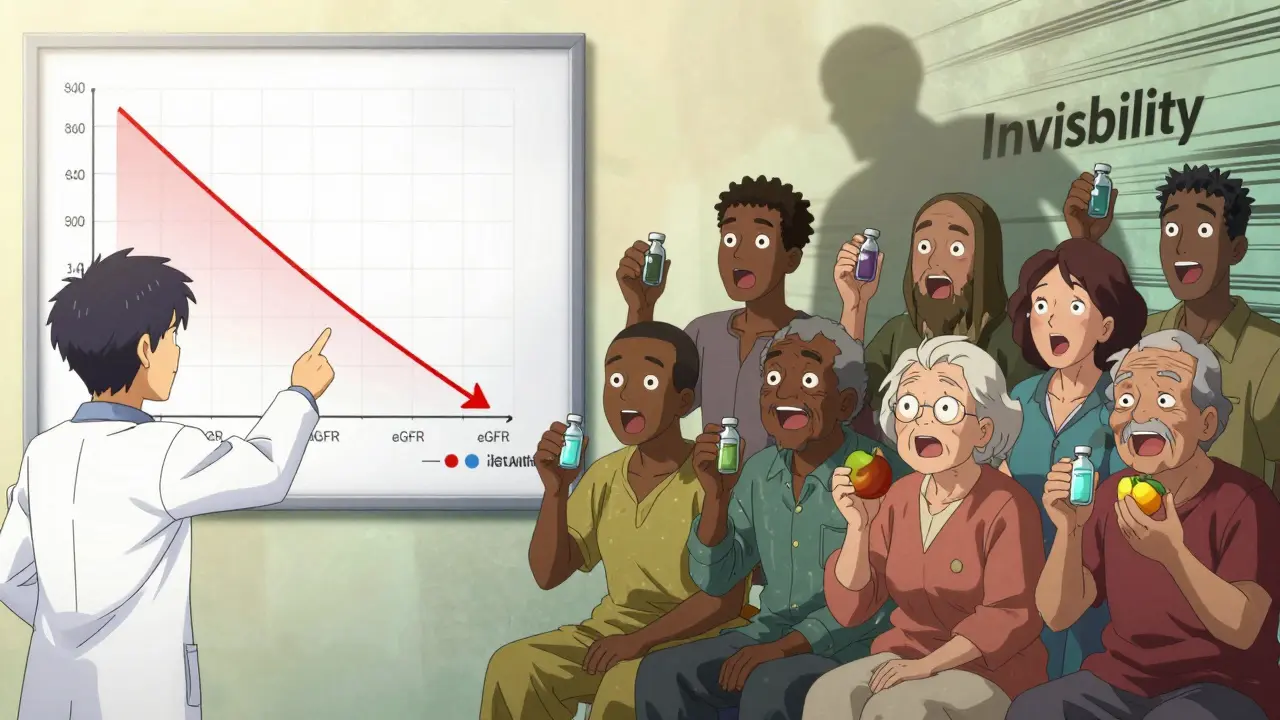
Despite strong evidence, only 43% of CKD patients with metabolic acidosis get alkali therapy. And there’s a clear gap:- Black patients: 38% treated
- White patients: 47% treated
- Rural patients: 35% treated
- Urban patients: 49% treated
This isn’t about access to care-it’s about awareness. Many primary care doctors don’t check bicarbonate levels. They check creatinine and eGFR. But bicarbonate? That’s a nephrologist’s test. And if you’re not seeing a kidney specialist, you might never know you’re in acidosis.
What Should You Do?
If you have CKD, here’s what to ask for:- Ask for your serum bicarbonate level at your next blood test.
- If it’s below 22 mEq/L, ask if alkali therapy is right for you.
- Discuss your blood pressure, heart health, and potassium levels before choosing a treatment.
- Ask for a referral to a renal dietitian. Even one session can change your food choices.
- Track your symptoms: swelling, fatigue, muscle cramps, nausea.
Start simple. Add two servings of vegetables to your lunch. Swap one meat meal for beans or tofu. See how you feel. Then talk to your doctor about whether a low-dose bicarbonate tablet might help.
The Future Is Personalized
The KDIGO 2024 draft guidelines are changing. Instead of one target for everyone, they’re moving toward personalized goals:- 24-26 mEq/L for patients with heart failure
- 22-24 mEq/L for elderly or malnourished patients
- 23-29 mEq/L for most others
And new drugs are coming. A new citrate-free alkali supplement (TRC001) is in trials. Early results show it raises bicarbonate just as well as sodium citrate-but with half the stomach upset.
The goal isn’t to cure CKD. It’s to slow it down. And correcting metabolic acidosis might be one of the simplest, cheapest, and most effective ways to do it.
Right now, 28,000 cases of kidney failure each year in the U.S. could be prevented if everyone with low bicarbonate got treatment. But that only happens if patients know to ask-and doctors know to listen.
What is metabolic acidosis in chronic kidney disease?
Metabolic acidosis in CKD happens when the kidneys can’t remove enough acid or make enough bicarbonate, causing blood pH to drop below 7.35 and serum bicarbonate to fall below 22 mEq/L. It’s common in stages 3-5 CKD and accelerates kidney damage, muscle loss, and bone weakening.
Is sodium bicarbonate safe for CKD patients?
Sodium bicarbonate is effective at raising bicarbonate levels and slowing kidney decline, but it’s not safe for everyone. It contains sodium, which can worsen high blood pressure, heart failure, or swelling. Patients with these conditions should avoid it or use lower doses under close monitoring.
Can diet alone treat metabolic acidosis in CKD?
Diet can help significantly. Eating more fruits and vegetables (5-9 servings daily) and cutting back on meat and cheese reduces acid load by 40-60 mEq per day. But most people can’t reach target bicarbonate levels with diet alone. It’s best used alongside medication, not instead of it.
Why is potassium citrate risky for CKD patients?
Potassium citrate can raise blood potassium levels, which is dangerous for CKD patients because their kidneys can’t clear potassium well. About 18% develop hyperkalemia (potassium >5.0 mEq/L), which can cause heart rhythm problems. It’s only recommended if potassium is already low and closely monitored.
What’s the best target for bicarbonate in CKD?
The KDIGO 2024 draft recommends a range of 22-29 mEq/L, but the ideal level depends on your health. For most, aim for 23-26 mEq/L. For heart failure or elderly patients, 22-24 mEq/L may be safer. Levels above 26 mEq/L may increase mortality risk in some older adults.
Why aren’t more CKD patients treated for metabolic acidosis?
Many doctors don’t test bicarbonate levels regularly. Patients often don’t know to ask. Pill burden, bad taste, and side effects lead to poor adherence. And disparities exist-Black and rural patients are less likely to receive treatment, even when they have the condition.
Is there a new drug coming for metabolic acidosis in CKD?
Veverimer was tested but failed its phase 3 trial in 2021 and isn’t approved. A new citrate-free alkali supplement called TRC001 is in trials and shows promise with fewer side effects. Results are expected in 2025. For now, sodium bicarbonate, calcium citrate, and dietary changes remain the main options.
William Liu
December 17, 2025 AT 18:36Just had my bicarbonate checked last week-21.8. Doctor said ‘keep an eye on it.’ I’m starting with two servings of broccoli a day and a half tablet of baking soda. No side effects yet. If this buys me even a year of not needing dialysis, it’s worth it.
Frank Drewery
December 17, 2025 AT 22:09I’ve been on sodium bicarbonate for 18 months. My eGFR dropped 1.2 last year-last year it was 4.1. I know it’s not a cure, but it’s the only thing that’s slowed the bleed. The bloating? Yeah, it’s rough. I take it with meals now and drink extra water. Small wins.
Erica Vest
December 18, 2025 AT 16:06There’s a critical flaw in the common narrative: bicarbonate therapy isn’t a standalone intervention. It’s a bridge. The real benefit comes from combining it with dietary acid load reduction. A 2023 meta-analysis in Clinical Journal of the American Society of Nephrology showed that patients who combined alkali therapy with a PRAL-negative diet had 47% slower eGFR decline than those on alkali alone. The diet isn’t optional-it’s the multiplier.
Also, the 23–29 mEq/L target range isn’t arbitrary. Below 22, you activate the renin-angiotensin system and muscle proteolysis. Above 29, you risk intracellular alkalosis and hypocalcemia. Precision matters.
And yes, sodium is a problem-but the alternative isn’t doing nothing. Calcium citrate at 600mg twice daily with meals is a viable option for hypertensive patients. Just monitor serum calcium every 3 months. Don’t ignore it.
Finally, veverimer’s failure wasn’t due to lack of efficacy-it was due to poor patient adherence. The pill burden was 6 tablets daily. TRC001’s single daily dose may finally crack this.
Kinnaird Lynsey
December 20, 2025 AT 01:03So let me get this straight-you’re telling me the solution to kidney failure is… baking soda? And we’ve been ignoring this for decades because doctors are too busy chasing fancy drugs? Funny how the cheapest, simplest fix is always the one nobody wants to talk about.
Also, ‘diet can help’? Try telling that to someone on food stamps who lives 30 miles from the nearest grocery store with fresh produce. This isn’t a medical issue-it’s a poverty issue.
Andrew Kelly
December 21, 2025 AT 01:25Let’s be real. The entire bicarbonate narrative is a pharmaceutical shill. Who funds the JASN study? Big Pharma. Who markets sodium citrate? Big Pharma. Who pushed veverimer until it failed? Big Pharma. They don’t want you to know that eating kale and avoiding processed meat is cheaper than a monthly prescription. They want you dependent. The FDA approves everything that makes money. That’s not medicine-that’s capitalism.
And don’t even get me started on ‘renal dietitians.’ They’re just glorified sales reps for overpriced supplements. I’ve been eating whole foods for 10 years. My creatinine is stable. No pills. No nonsense.
Connie Zehner
December 21, 2025 AT 02:11OMG I just found out my bicarb was 20.5 😭 I’ve been taking baking soda for 3 weeks and I feel SO MUCH BETTER!! 🤗 I even cried when I stopped getting leg cramps!! I switched to potassium citrate because I thought sodium was bad but now I’m scared 😭 is it safe?? I’m also eating 10 bananas a day now because I heard they’re alkaline?? 🍌🍌🍌 I need help!!
Jedidiah Massey
December 22, 2025 AT 22:24Metabolic acidosis in CKD is a classic example of homeostatic dysregulation secondary to diminished nephron mass and impaired ammoniagenesis. The resultant negative bicarbonate balance initiates a catabolic cascade mediated by NF-κB and ubiquitin-proteasome pathways, accelerating muscle wasting. Alkali therapy, particularly with sodium bicarbonate, exerts a pH-buffering effect that downregulates these pathways, thereby preserving lean body mass and glomerular filtration rate. The KDIGO 2024 stratification reflects a paradigm shift toward phenotypic tailoring-akin to precision oncology in oncology. The failure of veverimer was attributable to suboptimal pharmacokinetic exposure, not target engagement. TRC001, with its novel non-citrate, non-sodium buffering moiety, represents the next evolutionary step in renal acid-base pharmacotherapy.
Alex Curran
December 24, 2025 AT 16:14I’ve been on calcium citrate for 2 years. My bicarb is stable at 24.5. No stones. No swelling. I eat a ton of spinach and mushrooms. I don’t take sodium bicarbonate because my BP is 145/92. I don’t think diet alone fixes it but it helps a lot. My doc never mentioned PRAL scores until I asked. You gotta ask. And don’t trust the lab’s ‘normal’ range-22 is the floor, not the goal.
Lynsey Tyson
December 24, 2025 AT 18:43I just started eating more veggies and I swear I have more energy. No magic pill, just better food. My nephrologist said I’m doing great. Still taking my half tablet though. I don’t want to be the person who stopped because it tasted weird and then ended up on dialysis. Not worth it.