
Migraine Medications: Triptan Interactions and Limitations
 Jan, 15 2026
Triptan Effectiveness Calculator
How Effective Will Triptans Be For You?
Answer a few questions about your migraine patterns and health to see if triptans might work for you.
Enter your information to see your triptan effectiveness likelihood.
When a migraine hits, time matters. The sooner you treat it, the better your chances of stopping it cold. That’s why triptans became the gold standard for acute migraine treatment. But they’re not magic pills. For every person who gets instant relief, another finds them useless-or even risky. Understanding how triptans work, who they’re safe for, and what they can’t do is the difference between relief and a bad reaction.
How Triptans Actually Work
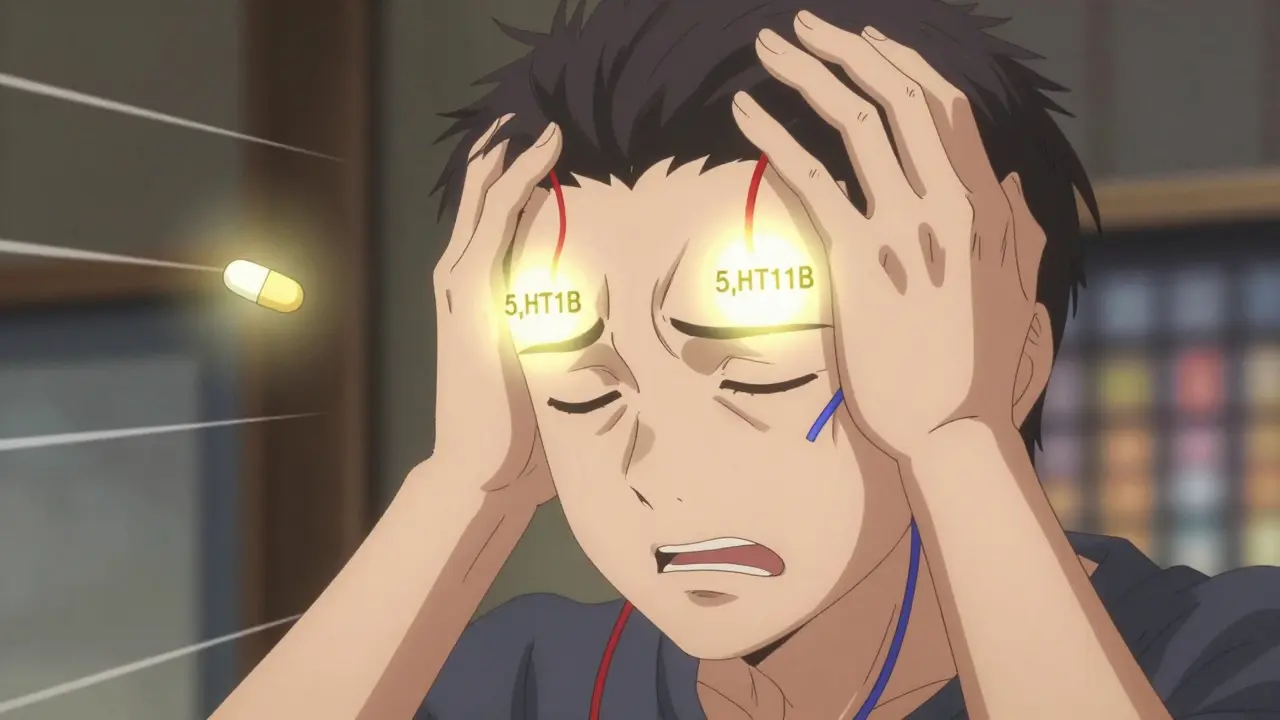
Triptans aren’t just painkillers. They’re targeted drugs that lock onto specific serotonin receptors in your brain and blood vessels. The two main targets are 5-HT1B and 5-HT1D receptors. When activated, 5-HT1B causes the swollen blood vessels around your brain to tighten back down. At the same time, 5-HT1D shuts off the release of pain-signaling chemicals like CGRP and substance P from nerves around your trigeminal system. It’s like flipping a switch that turns off both the swelling and the noise.
This dual action is why triptans work better than ibuprofen or acetaminophen for moderate to severe migraines. Studies show that within two hours, 42% to 76% of people get significant headache relief. About 18% to 50% feel completely pain-free. That’s a big jump from over-the-counter meds, which often fail at this stage.
There are seven FDA-approved triptans: sumatriptan, rizatriptan, zolmitriptan, naratriptan, frovatriptan, almotriptan, and eletriptan. They all end in “-triptan,” but they’re not the same. Rizatriptan and zolmitriptan are absorbed faster and hit peak levels quicker than sumatriptan. Frovatriptan lasts longer-up to 26 hours-which helps prevent rebound headaches. Eletriptan has the highest two-hour success rate at 75%, while frovatriptan is the slowest to kick in at 42%.
When Triptans Don’t Work (And Why)
It’s not just about picking the wrong pill. Sometimes, the migraine itself is too far gone. Triptans work best when taken at the very first sign of head pain-not during aura, not when your vision is blurry, not when your neck is stiff. By then, the blood vessels are already dilated and the chemicals are flooding your system. If you wait too long, even the strongest triptan won’t reverse it.
Another big reason triptans fail? Cutaneous allodynia. That’s when your skin becomes painfully sensitive-brushing your hair, wearing glasses, or even a light touch on your forehead feels unbearable. If you have this, triptans drop from 70-80% effective to just 30-40%. That’s because the pain pathway has moved beyond the blood vessels and into the nerves in your skin. At this point, you need something that targets nerves directly, not blood flow.
And then there’s the 20% of migraine sufferers who get zero relief from any triptan. No matter which one they try-oral, nasal spray, or injection-they just don’t respond. Researchers think this has to do with genetic differences in how serotonin receptors are expressed. It’s not a failure of the drug. It’s a mismatch in biology.
The Real Risks: Interactions and Contraindications
Triptans are generally safe for healthy people. But if you have heart problems, they’re dangerous. They cause blood vessels to narrow. That’s fine if your arteries are clear. But if you’ve had a heart attack, have angina, or have uncontrolled high blood pressure, that constriction can trigger a new heart event. The risk is small-about 0.08 cases per 10,000 patient-years with sumatriptan-but it’s real. That’s why doctors screen for cardiovascular disease before prescribing.
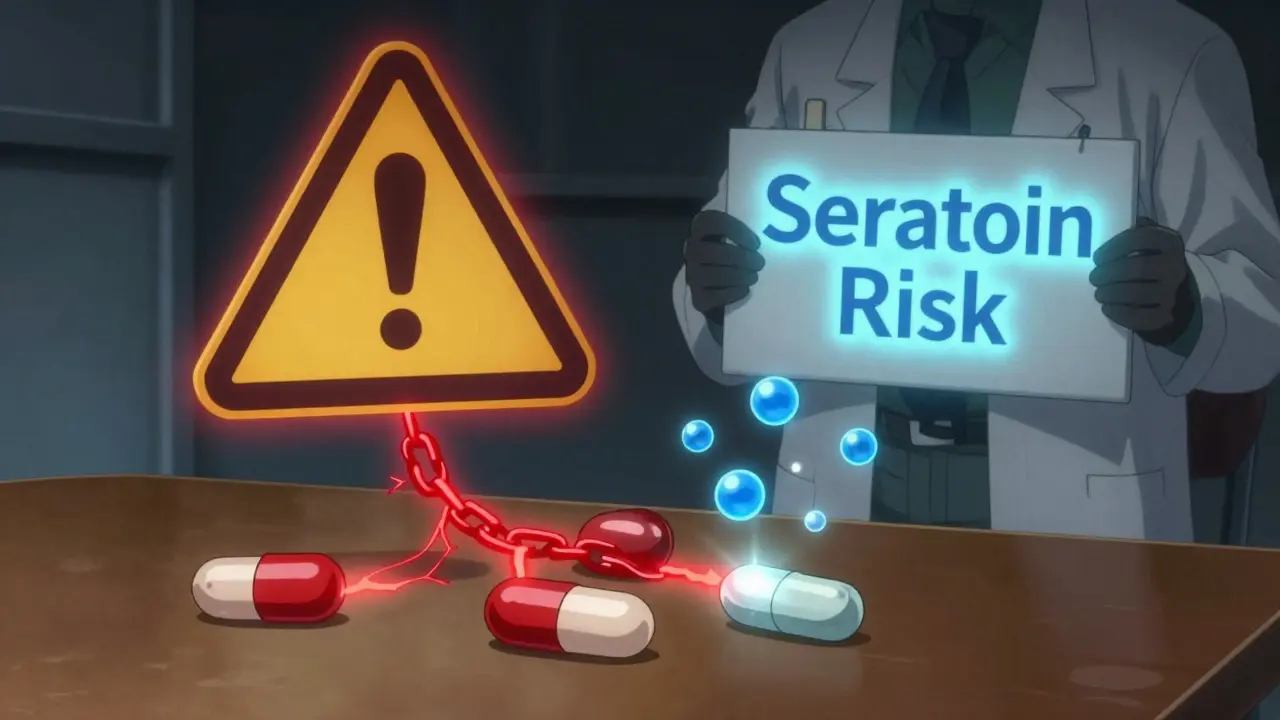
Another hidden danger? Serotonin syndrome. This rare but serious condition happens when too much serotonin builds up in your system. Triptans boost serotonin activity. So do SSRIs and SNRIs-common antidepressants like fluoxetine, sertraline, venlafaxine, and duloxetine. While documented cases are rare, the combination isn’t worth the gamble. If you’re on an antidepressant, your doctor should check for interactions before prescribing a triptan.
Also, don’t mix triptans with ergotamines (like dihydroergotamine) or other vasoconstrictors. The combined effect can cause severe, long-lasting blood vessel narrowing. The same goes for monoamine oxidase inhibitors (MAOIs), which are rarely used today but still prescribed for depression or Parkinson’s. You need at least a 14-day gap between stopping an MAOI and starting a triptan.

How to Use Them Right
Timing is everything. Take your triptan as soon as the headache starts. Don’t wait for it to peak. If you take it during aura, you might make things worse. The blood vessels are already tightening then. Adding a vasoconstrictor can disrupt normal brain function.
Dosing matters too. No more than two doses of any triptan in 24 hours. And you need at least two hours between doses. Exceeding this increases your risk of medication-overuse headache-a cycle where frequent use makes migraines worse and more frequent.
Formulations vary. If you’re nauseous and can’t swallow pills, try a nasal spray (zolmitriptan) or an orally disintegrating tablet (rizatriptan). These get into your system faster. For people with long-lasting migraines, frovatriptan’s 26-hour half-life makes it a good choice for prevention or prolonged attacks.
What Comes After Triptans?
Triptans still make up about 45% of the acute migraine treatment market. But new options are rising. Gepants (like ubrogepant and rimegepant) block CGRP without constricting blood vessels. That makes them safe for people with heart disease. Ditans (like lasmiditan) target 5-HT1F receptors-no vasoconstriction, no heart risk. Both work well for patients who can’t use triptans.
Combination therapy is also gaining ground. Sumatriptan plus naproxen (a common NSAID) works better than either alone. The 2-hour pain-free rate jumps from 18% with sumatriptan to 27% with the combo. It’s a simple fix: one pill with two active ingredients.
Still, triptans remain the most studied, most affordable, and most widely available option. For someone with no heart issues, no antidepressants, and who takes the pill early, they’re still the best shot at stopping a migraine fast.
What If Nothing Works?
If you’ve tried three or four different triptans and nothing helps, it’s not you. It’s the migraine. At this point, talk to a neurologist or headache specialist. You might need preventive treatment-daily pills like topiramate, beta-blockers, or newer CGRP monoclonal antibodies. Or you might benefit from non-drug options: nerve blocks, biofeedback, or neuromodulation devices.
Don’t keep pushing through pain. Migraine is a neurological disorder, not just a bad headache. The right treatment exists. But you need to find the one that fits your body-not just your symptoms.
Can I take a triptan if I’m on an SSRI like sertraline?
It’s possible, but not without caution. Triptans and SSRIs both affect serotonin, and while serious serotonin syndrome is rare, the risk exists. Many doctors will still prescribe a triptan if you’re on an SSRI, but they’ll start with a low dose and monitor you closely. Never combine them without medical supervision. If you notice confusion, rapid heartbeat, high fever, or muscle rigidity after taking both, seek emergency care immediately.
Why do triptans make my chest feel tight?
That tightness or pressure in your chest, throat, or jaw is a common side effect-reported by 5% to 7% of users. It’s not a heart attack. It’s the drug causing blood vessels to narrow, including those in your chest. The sensation usually lasts only 10 to 20 minutes and goes away on its own. If it’s severe, lasts longer, or comes with shortness of breath or dizziness, stop the medication and call your doctor. Never ignore chest pain, even if you think it’s just a side effect.
Can I take two different triptans in one day?
No. You should never combine different triptans in a single day. Each one works the same way, and stacking them increases your risk of dangerous blood vessel narrowing and serotonin syndrome. If one triptan doesn’t work, wait at least two hours and try a second dose of the same one-never switch to another. If that fails, your next step should be an alternative medication, not another triptan.
Are triptans safe during pregnancy?
There isn’t enough data to say triptans are completely safe in pregnancy. Most experts recommend avoiding them unless absolutely necessary, especially in the first trimester. If you’re pregnant and have severe migraines, talk to your OB-GYN and neurologist. Safer options like acetaminophen, rest, and hydration are usually tried first. Some doctors may allow sumatriptan in the second or third trimester if benefits clearly outweigh risks, but only after careful evaluation.
Why do I get migraines again after taking a triptan?
Rebound headaches within 24 hours happen in 15% to 40% of users, depending on the triptan. Short-acting ones like sumatriptan (half-life of 2 hours) are more likely to cause this than long-acting ones like frovatriptan. It’s not that the drug failed-it’s that your migraine cycle wasn’t fully stopped. The best way to prevent it? Take the triptan early, avoid overuse, and consider adding a long-acting NSAID like naproxen. If it keeps happening, you might need preventive treatment instead of just rescue meds.
Next Steps: What to Do If Triptans Aren’t Working
If you’ve tried two or three triptans and still get no relief, don’t blame yourself. Migraine is complex. Your brain’s pain pathways might be wired differently. Talk to a headache specialist. They can check for allodynia, assess your medication use, and rule out other conditions like vestibular migraine or chronic migraine.
Keep a detailed headache diary. Note when the pain starts, how long it lasts, what you took, and whether it worked. This helps your doctor spot patterns-like whether you’re taking the drug too late or whether your migraines are worsening because of overuse.
There are newer treatments now that don’t rely on vasoconstriction. Gepants and ditans are options if you have heart disease or can’t tolerate triptans. Even non-drug tools like Cefaly (a wearable nerve stimulator) or biofeedback can reduce frequency and severity.
Migraine isn’t one-size-fits-all. What works for your neighbor might not work for you. But with the right approach, most people find a solution. It just takes patience, the right information, and the courage to ask for help.
Corey Sawchuk
January 15, 2026 AT 21:21Been using sumatriptan for years and it works like a charm if I take it the second I feel that weird pressure behind my eyes. Wait till the headache hits full force? Yeah good luck with that. I learned the hard way.
Stephen Tulloch
January 16, 2026 AT 10:26Bro triptans are literally magic beans for migraines 🤓 but only if you’re not some heart patient or on SSRIs like a zombie. If you’re taking sertraline and still popping triptans like Skittles you’re one bad day away from serotonin soup. Just sayin’.
Joie Cregin
January 17, 2026 AT 08:28I used to think I was just bad at managing migraines until I found out I had cutaneous allodynia. It’s like my skin was screaming every time my hair brushed against it. Triptans? Useless. Then I tried ubrogepant and it was like someone turned off a fire alarm in my skull. No vasoconstriction, no chest tightness - just peace.
It’s not that triptans don’t work - it’s that your brain might be screaming in a different language. And yeah, it’s frustrating when doctors treat migraines like ‘just a bad headache.’ They’re not. They’re neurological fireworks.
I’m so glad there are new options now. I used to feel broken because nothing worked. Turns out I just needed the right key, not more locks.
Melodie Lesesne
January 17, 2026 AT 22:48My mom’s been on frovatriptan for her long migraines and she swears by it. Says it’s like a slow burn instead of a flashbang. Also, she takes it with naproxen now and it cuts the rebound headaches way down. Just a little combo hack that changed her life.
john Mccoskey
January 19, 2026 AT 13:36Let’s be real - triptans are the pharmaceutical equivalent of putting duct tape on a leaking nuclear reactor. You’re not fixing the problem, you’re just suppressing the symptoms while ignoring the root cause. Migraines are a systemic neurological dysfunction, not a vascular hiccup. The fact that we still treat them like a simple vasoconstriction issue shows how outdated neurology is. Gepants and ditans? Finally. But even those are just band-aids on a broken system. We need to stop treating migraines as if they’re just bad headaches and start treating them as the complex neuroinflammatory disorders they are. Until then, we’re just rearranging deck chairs on the Titanic while the industry profits off our suffering.
vivek kumar
January 21, 2026 AT 13:29Actually, the 20% non-responders likely have polymorphisms in the HTR1B and HTR1D genes. There’s peer-reviewed data from 2021 showing reduced receptor binding affinity in non-responders. It’s not ‘bad luck’ - it’s pharmacogenetics. If your doctor doesn’t mention genetic testing, ask for it.
Riya Katyal
January 23, 2026 AT 12:22Oh wow so triptans don’t work for everyone? Shocking. Next you’ll tell me water isn’t wet or gravity isn’t a suggestion.
waneta rozwan
January 23, 2026 AT 16:35My sister had a stroke after taking sumatriptan while on venlafaxine. She’s 34. She can’t walk properly anymore. So yeah, ‘rare’ doesn’t mean ‘won’t happen to you.’ If your doctor says ‘it’s fine,’ they’re either lazy or lying. Don’t gamble with your brain.
Nicholas Gabriel
January 25, 2026 AT 03:17Always check your meds! Always! Always! Always! Triptans + SSRIs? Maybe. But only with a doctor who actually reads the prescribing info. And don’t forget - you need at least 2 hours between doses. And never, ever, ever combine triptans. Ever. Ever. Ever. And if you feel chest tightness? Stop. Wait. Call. Don’t ignore it. Please. Your life matters.
swarnima singh
January 25, 2026 AT 07:08people just dont wanna admit theyre addicted to painkillers. triptans are just fancy pills for weak people who cant handle life. if you had real discipline youd meditate or do yoga or something. instead you pop pills like candy and blame your biology. sad.
Allen Davidson
January 27, 2026 AT 03:20Hey, if you’re on an SSRI and your doc cleared you for triptans, that’s great - but start low and go slow. I’ve seen patients get relief without side effects when they take half a dose first. No shame in testing the waters. You’re not failing - you’re learning your body.
Samyak Shertok
January 27, 2026 AT 13:57Oh so the ‘gold standard’ is only gold if you’re a healthy white guy with no depression and no heart issues? How convenient. Meanwhile, the rest of us are just ‘non-responders’ - a fancy word for ‘you don’t fit the profile.’ Tell me again why Big Pharma is so invested in triptans? Hint: it’s not because they’re perfect.
Bianca Leonhardt
January 28, 2026 AT 21:58Anyone else notice how the article glosses over the fact that triptans are literally banned in some countries for migraine prevention? They’re not ‘safe’ - they’re tolerated. And the fact that we’re still using 30-year-old drugs because they’re cheap? Pathetic.
Travis Craw
January 29, 2026 AT 20:42triptans make my jaw feel like its clenching on a brick. i thought it was stress. turns out its the drug. now i just use ice packs and sleep it off. no pills no problems.
Cheryl Griffith
January 30, 2026 AT 06:08I used to feel so alone in this. Like I was broken because nothing worked. Then I found a migraine support group and realized so many of us are just trying to survive. It’s not about being ‘strong enough’ or ‘trying harder.’ It’s about finding the right tool. And sometimes that tool isn’t a pill at all - it’s a neurologist who listens.