
Opioid-Induced Hyperalgesia: Recognizing and Managing Paradoxical Pain
 Jul, 31 2026
Imagine taking a medication specifically designed to stop your pain, only to find that the higher you raise the dose, the more sensitive you become to every touch, every movement, and every sensation. It feels like a cruel joke, but for millions of people living with chronic pain, this is not a metaphor-it is a physiological reality known as Opioid-Induced Hyperalgesia, or a state where exposure to opioids causes a paradoxical increase in pain sensitivity rather than relief. This condition, often abbreviated as OIH, turns the fundamental logic of pain management on its head. Instead of providing comfort, the very drugs meant to heal begin to amplify suffering.
If you are a patient who has noticed your pain spreading beyond its original site, or if you are a clinician puzzled by patients whose pain worsens despite escalating doses, understanding OIH is critical. It is a treatable condition, yet it remains one of the most misunderstood phenomena in modern pain medicine. By recognizing the subtle signs early, we can prevent unnecessary suffering and avoid the dangerous cycle of increasing opioid dosages that ultimately makes things worse.
What Exactly Is Opioid-Induced Hyperalgesia?
To grasp OIH, we first need to distinguish it from two other common concepts: disease progression and opioid tolerance. Disease progression means the underlying injury or illness is getting worse. Tolerance means your body has adapted to the drug, so you need more of it to get the same effect. OIH is different. It is a change in how your nervous system processes pain signals.
Opioid-Induced Hyperalgesia was first scientifically documented in 1971 by Eddy et al., who observed that repeated morphine injections made rats more sensitive to pain. Since then, clinical studies have shown that OIH affects approximately 2% to 15% of chronic opioid users. The hallmark sign is a diffuse increase in pain sensitivity. You might start with back pain, but suddenly, a light breeze or the weight of a bedsheet feels painful. This phenomenon, called allodynia, is a red flag that your nervous system is becoming hypersensitive due to the medication itself.
The key difference between tolerance and OIH lies in the response to dose escalation. With tolerance, increasing the dose brings relief, albeit temporarily. With OIH, increasing the dose often intensifies the pain. According to the Palliative Care Network of Wisconsin’s Fast Fact #142, published in September 2024, OIH is characterized by worsening pain despite increasing opioid doses, distinct from both disease progression and pharmacological tolerance.
How OIH Develops: The Biological Mechanisms
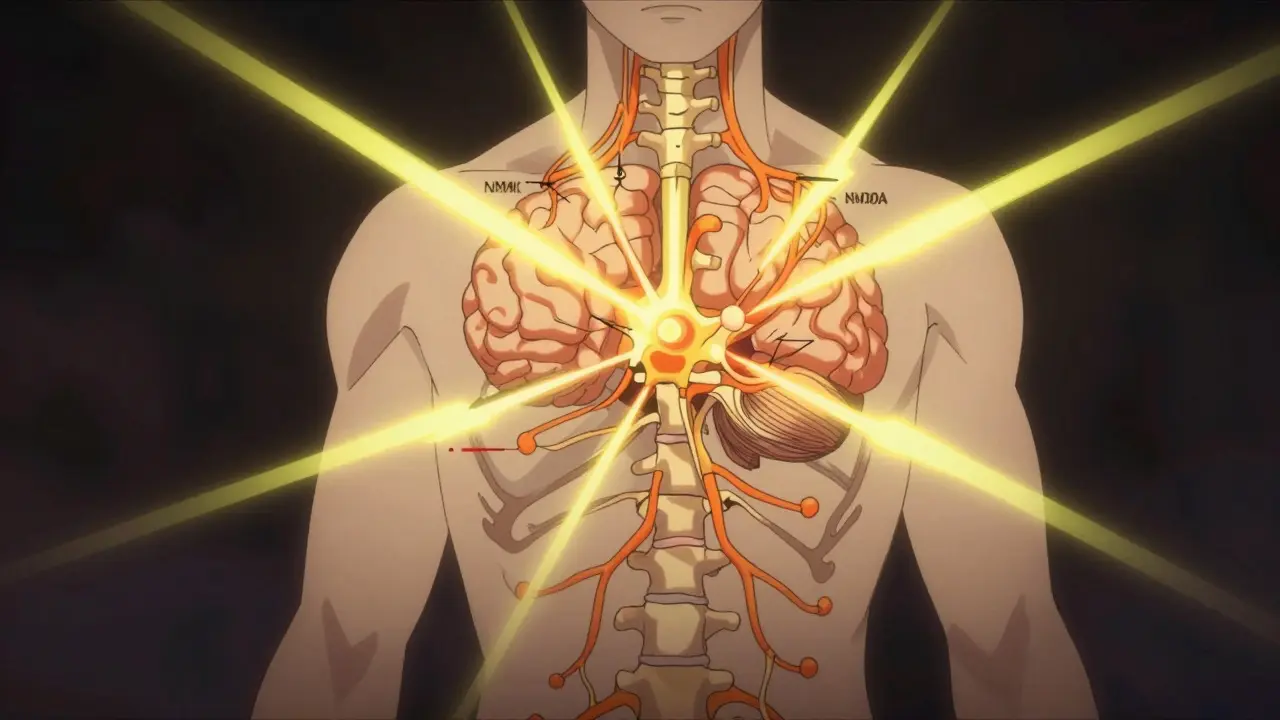
Why does a painkiller cause pain? The answer lies deep within the central nervous system. While scientists are still unraveling every detail, several key mechanisms explain this paradox.
The most widely accepted theory involves the activation of N-methyl-D-aspartate (NMDA) receptors. Normally, these receptors help transmit pain signals. When exposed to high levels of opioids over time, these receptors become overly active, essentially turning up the volume on pain signals throughout the brain and spinal cord. This process is known as central sensitization.
Other contributing factors include:
- Toxic Metabolites: Some opioids, like morphine, break down into substances such as morphine-3-glucuronide. In patients with kidney issues, these metabolites can accumulate and directly irritate nerve cells, increasing pain sensitivity.
- Spinal Dynorphins: Opioids can trigger the release of dynorphin, a neurotransmitter that actually promotes pain signaling in the spinal cord, counteracting the pain-relieving effects of the opioid.
- Genetic Factors: Variations in genes like catechol-O-methyltransferase (COMT) can make some individuals naturally more susceptible to developing OIH when they take opioids.
- Descending Facilitation: The brain’s rostral ventromedial medulla may shift from inhibiting pain to facilitating it, sending more "pain on" signals down the spinal cord.
Understanding these mechanisms is crucial because it points us toward specific treatments. If NMDA receptors are the problem, blocking them becomes part of the solution.
Recognizing the Signs: How to Spot OIH
Diagnosing OIH is challenging because it is a diagnosis of exclusion. This means doctors must rule out other causes first. However, there are specific clinical clues that should raise suspicion.
You should suspect OIH if you notice the following patterns:
- Pain Spreading: Your pain is no longer localized to the original injury site. It has become widespread or diffuse.
- Allodynia: You feel pain from stimuli that shouldn’t hurt, like clothing brushing against your skin or a gentle touch.
- Worsening with Dose Increases: Every time your doctor increases your opioid dosage, your pain gets worse, not better.
- Timeframe: Symptoms typically emerge after 2 to 8 weeks of continuous opioid therapy, though they can occur at any point.
- High Dosage Context: OIH is more common with high parenteral doses, such as more than 300mg of morphine per day, or with potent opioids like hydromorphone.
Clinicians often use tools like the Opioid-Induced Hyperalgesia Questionnaire (OIHQ), which has demonstrated 85% sensitivity in identifying cases. Quantitative sensory testing (QST) can also help by measuring your pain thresholds before and after opioid administration. If your threshold drops significantly, it suggests heightened sensitivity consistent with OIH.
Differentiating OIH from Tolerance and Withdrawal
One of the biggest pitfalls in managing chronic pain is mistaking OIH for tolerance. If a doctor assumes you are just tolerant and keeps raising the dose, they may inadvertently fuel the hyperalgesia, creating a vicious cycle.
| Feature | Opioid-Induced Hyperalgesia (OIH) | Opioid Tolerance | Opioid Withdrawal |
|---|---|---|---|
| Pain Response to Dose Increase | Pain worsens or spreads | Temporary relief, then returns to baseline | Pain may increase due to rebound, but systemic symptoms present |
| Pain Distribution | Diffuse, widespread, allodynia | Localized to original site | Variable, often accompanied by flu-like symptoms |
| Physical Symptoms | Hypersensitivity to touch/light | Few physical symptoms beyond lack of analgesia | Sweating, nausea, diarrhea, anxiety, muscle aches |
| Mechanism | Central sensitization (NMDA activation) | Receptor downregulation/adaptation | Absence of opioid effect on adapted receptors |
Dr. Stephan Schug, a leading pain specialist, emphasizes that OIH should not be the first diagnosis assumed, even in long-term users. A thorough evaluation is necessary to ensure the underlying disease hasn’t progressed. However, ignoring the possibility of OIH can lead to years of unnecessary suffering.

Managing and Treating Opioid-Induced Hyperalgesia
The good news is that OIH is reversible. The cornerstone of treatment is modifying opioid therapy, usually by reducing the dose or switching medications. This approach requires patience and careful monitoring, as initial dose reductions might temporarily increase discomfort before improvement sets in.
Strategies for Management
1. Opioid Rotation or Reduction
Reducing the opioid dose by 10-25% every 2-3 days is a standard protocol. Alternatively, switching to an opioid with a different metabolic profile can help. Methadone is often effective because it acts as an NMDA receptor antagonist, directly counteracting the mechanism driving OIH.
2. NMDA Receptor Modulators
Medications that block NMDA receptors can reverse hyperalgesia. Ketamine, used at sub-anesthetic doses (0.1-0.5 mg/kg/hour), has shown significant efficacy in clinical studies. Other options include memantine, though evidence varies.
3. Adjunctive Medications
Adding non-opioid pain relievers can target different pathways. Alpha-2 agonists like clonidine (0.1-0.3 mg twice daily) and gabapentinoids (gabapentin 300-1800 mg three times daily) help calm central sensitization. These drugs do not rely on opioid receptors, making them valuable allies in breaking the cycle.
4. Non-Pharmacological Approaches
Cognitive behavioral therapy (CBT) and physical therapy play vital roles. CBT helps patients manage the psychological distress associated with chronic pain, while physical therapy gradually desensitizes the nervous system through controlled movement and exercise.
Effective management typically takes 2-4 weeks to show clear improvement, with complete resolution potentially requiring 4-8 weeks. Patient education is crucial here; explaining that reducing the dose is the path to relief, not away from it, helps overcome resistance.
Future Directions and Genetic Testing
As our understanding of OIH grows, so do our tools for prevention. Current research is focusing on genetic markers, particularly variations in the COMT enzyme, which predispose certain individuals to OIH. By 2025, commercial genetic testing panels are expected to launch, allowing clinicians to identify high-risk patients before starting long-term opioid therapy.
The pharmaceutical industry is also responding. Several new compounds targeting NMDA receptors and other sensitization pathways are currently in Phase II/III trials. With the global opioid market valued at $21.8 billion in 2023, investment in safer pain management strategies is accelerating. The FDA’s 2022 requirement for updated labeling on long-acting opioids to include OIH warnings reflects a broader regulatory shift toward transparency and safety.
Despite declining opioid prescriptions in recent years, with usage dropping 44% from 2016 to 2023, OIH remains highly relevant. Over 10 million Americans still receive long-term opioid therapy. For these individuals, recognizing and managing OIH is not just a medical nuance-it is a lifeline to reclaiming quality of life.
How long does it take for Opioid-Induced Hyperalgesia to resolve?
Resolution times vary, but clinical improvements are typically seen within 2 to 4 weeks of adjusting the opioid regimen. Complete resolution may take 4 to 8 weeks. The timeline depends on the duration of opioid use, the specific drug involved, and the individual's neurobiology.
Can OIH happen with low doses of opioids?
Yes, although it is less common. OIH can occur at any dose, but it is more frequently observed with high parenteral doses (e.g., >300mg/day of morphine) or in patients with renal failure where toxic metabolites accumulate. Individual susceptibility, influenced by genetics, also plays a major role.
Is Opioid-Induced Hyperalgesia permanent?
No, OIH is generally reversible. Once the offending opioid is reduced, rotated, or supplemented with NMDA antagonists, the nervous system can reset its pain processing pathways. Early intervention leads to faster recovery.
What is the difference between OIH and opioid tolerance?
In tolerance, the drug loses effectiveness, and increasing the dose provides temporary relief. In OIH, increasing the dose worsens the pain and expands the area of sensitivity. Tolerance is about needing more drug for the same effect; OIH is about the drug causing increased pain sensitivity.
Are there genetic tests available for OIH susceptibility?
As of 2024, genetic testing for COMT polymorphisms linked to OIH is emerging. Commercial tests are expected to become widely available in mid-2025. These tests aim to identify patients at higher risk before initiating long-term opioid therapy, allowing for preemptive alternative strategies.