
Peanut Allergy Prevention: When and How to Introduce Peanuts to Infants
 Dec, 10 2025
For years, parents were told to wait until their child was two or three before giving them peanut butter. It seemed like the safest move-until it wasn’t. Between 1997 and 2010, peanut allergies in U.S. children more than quadrupled, jumping from 0.4% to 2.0%. That spike didn’t stop. By 2015, nearly one in 50 kids had a peanut allergy, and it was becoming the leading cause of food-related anaphylaxis in children. Then came a breakthrough that flipped everything on its head.
Why Waiting Made Things Worse
The old advice-delay peanut exposure-was based on fear, not science. It came from a 1998 American Academy of Pediatrics recommendation that suggested avoiding peanuts in high-risk babies. But the data didn’t match the logic. As more parents avoided peanuts, more kids developed allergies. It was like trying to stop a fire by hiding the matches.
The turning point was the LEAP study, published in 2015. Researchers in London followed 640 high-risk infants-those with severe eczema or egg allergy-from 4 to 11 months old. Half were told to avoid peanuts entirely. The other half were given 2 grams of peanut protein three times a week, mixed into food or diluted peanut butter. By age five, only 1.9% of the group that ate peanuts developed an allergy. In the group that avoided them? 13.7%. That’s a 86% drop in risk.
It wasn’t a fluke. The EAT study, which looked at peanut and other allergens in healthy infants, confirmed it. When peanut was introduced early-before six months-there was a 75% reduction in allergy development. Even more striking: in babies with mild or moderate eczema who stuck to the schedule, the reduction was nearly 100%.
What the Guidelines Say Now
In 2017, the National Institute of Allergy and Infectious Diseases (NIAID) released updated guidelines based on this evidence. They split infants into three risk groups, and each has a clear path:
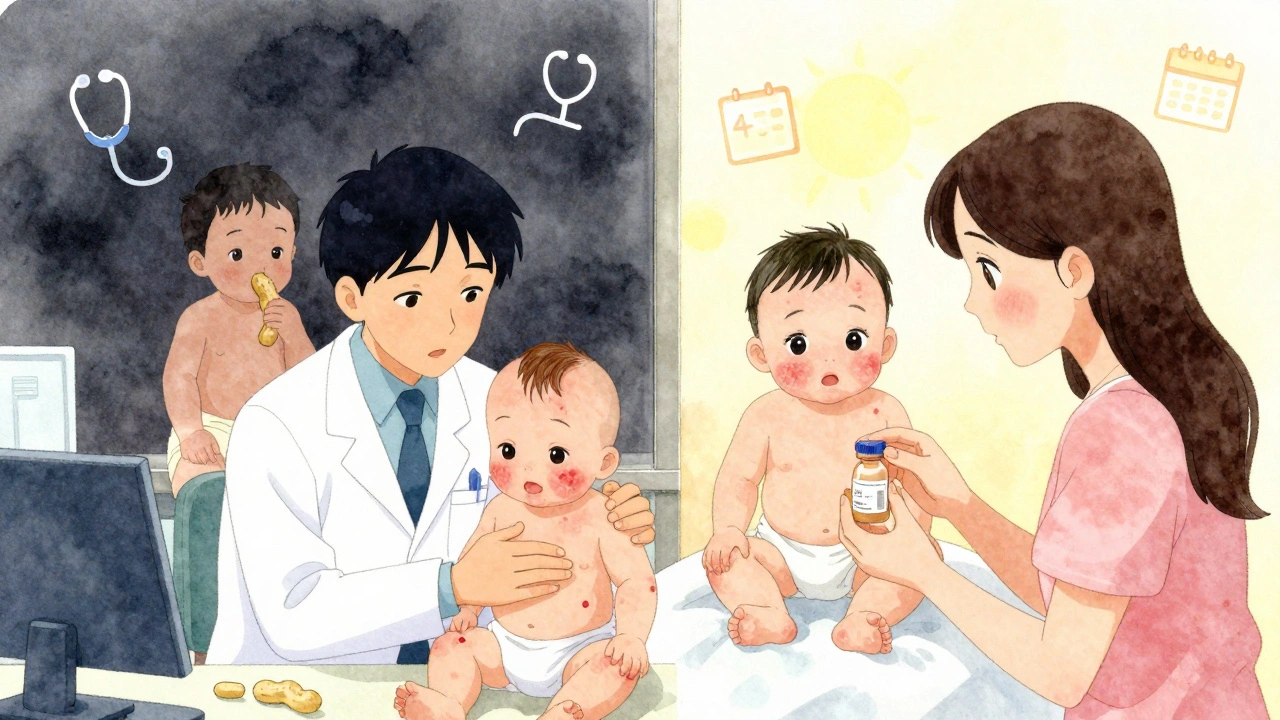
- High-risk infants (severe eczema, egg allergy): Start peanut between 4 and 6 months, but only after seeing a doctor. They may need a skin or blood test first. If the test is negative, begin with a small amount under medical supervision, then continue with 2 grams of peanut protein three times a week.
- Moderate-risk infants (mild to moderate eczema): Introduce peanut around 6 months at home, no testing needed. Use smooth peanut butter mixed with water or breast milk.
- Low-risk infants (no eczema or food allergies): Introduce peanut anytime after starting solids, usually around 6 months. No special steps required.
The key? Don’t wait. The window for prevention is narrow. Waiting until 10 months or later cuts the protective effect in half. The earlier you start-between 4 and 6 months-the better.
How to Safely Introduce Peanut
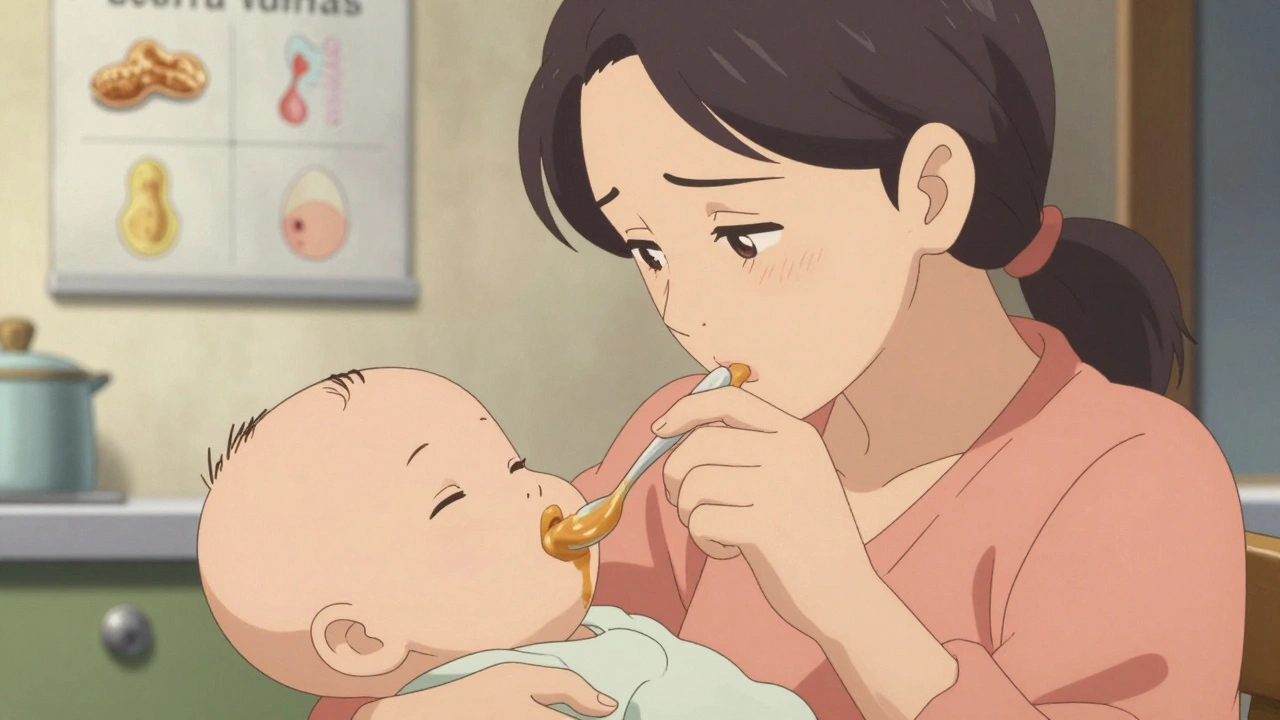
Whole peanuts? Never. Choking hazard. Peanut butter straight from the jar? Too thick. The goal is to give 2 grams of peanut protein, three times a week, in a safe, swallowable form.
Here’s how:
- Use smooth peanut butter-no chunks, no crunchy.
- Mix 2 teaspoons (about 10 grams) of peanut butter with 2-3 tablespoons of warm water, breast milk, or formula until it’s thin and runny.
- Or, stir it into infant cereal, pureed applesauce, or mashed banana.
- Start with a tiny amount-a quarter of a teaspoon-and wait 10 minutes. Watch for swelling, hives, vomiting, or trouble breathing.
- If no reaction, give the rest. Then continue three times a week.
Some parents use products like Bamba (a puffed corn snack with peanut) or pre-made peanut powder designed for infants. These are fine too. Just make sure you’re getting the right amount of peanut protein-about 2 grams per serving. Check the label or use a trusted calculator from a pediatric allergy center.
What About Oral Immunotherapy (OIT)?
People often confuse early introduction with oral immunotherapy (OIT). They’re not the same.
Early introduction is for preventing allergy in babies who don’t yet have it. OIT is for treating kids who already have a confirmed peanut allergy.
OIT involves giving tiny, gradually increasing doses of peanut protein under strict medical supervision. It doesn’t cure the allergy-it builds tolerance. Kids on OIT must keep eating peanut daily for life, or the protection fades. Side effects like stomach pain, itching, or even anaphylaxis are common during treatment. It’s not for everyone. The FDA has approved one OIT product, Palforzia, for kids 4 to 17, but it’s expensive, requires frequent clinic visits, and isn’t a first-line recommendation for prevention.
For parents of babies without allergy, OIT isn’t needed. Early introduction is safer, simpler, and far more effective at stopping the allergy before it starts.
Why So Many Parents Still Wait
Even with clear guidelines, only about 39% of high-risk infants are getting peanut introduced early. Why?
Parents are scared. One 2022 survey found 62% of parents worried about anaphylaxis during the first taste. Doctors are unsure too. A 2023 study showed only 54% of pediatricians could correctly state the current NIAID guidelines.
There’s also confusion over what “safe” peanut looks like. Some parents give peanut flour, others use peanut oil (which doesn’t contain the protein that triggers allergy), and some think a smear on the lip is enough. It’s not. You need to feed it orally, regularly, and consistently.
And then there’s inequality. Black and Hispanic infants are 22% less likely to get early peanut exposure than white infants. That’s not just a gap-it’s a risk gap. Allergy rates remain higher in these communities, partly because prevention isn’t reaching them.
What Works-and What Doesn’t
Let’s clear up the noise. Not every parenting tip helps.
- Works: Early peanut introduction (4-6 months), consistent feeding (3x/week), smooth texture, medical guidance for high-risk babies.
- Doesn’t work: Avoiding peanuts during pregnancy or breastfeeding. No evidence. The Cochrane Review found no benefit.
- Doesn’t work: Probiotics or vitamin D supplements. Multiple studies show no effect on peanut allergy prevention.
- Doesn’t work: Waiting until toddlerhood. That’s the old advice-and it failed.
The science is clear: exposure, not avoidance, builds tolerance. The immune system learns to recognize peanut as safe when it’s introduced early and often.

Long-Term Results
One of the most powerful findings? The protection lasts. The LEAP study followed kids after they stopped eating peanut for a full year. Even after 12 months of avoidance, 80% of the kids who ate peanut early still didn’t have an allergy. That’s not just desensitization-it’s true tolerance. Their immune systems remembered peanut as harmless.
And the numbers are improving. In 2015, 2.2% of U.S. children had peanut allergies. By 2023, that number dropped to 1.6%. That’s about 300,000 fewer children with a life-altering allergy. The CDC says the biggest drop is in high-risk groups, especially those with eczema. In babies with mild eczema, peanut allergy dropped by 85%. In moderate eczema, by 87%.
What’s Next?
Researchers are now looking at combining early peanut introduction with other allergens. The EAT study extension showed that introducing peanut, egg, milk, and fish together before six months didn’t just lower peanut allergy-it lowered the risk of multiple food allergies at once.
The PRESTO trial, funded by the NIAID with $35 million, is testing whether even earlier exposure-starting at 3 months-works better for the highest-risk babies. Results are expected in 2026.
Industry is catching up too. Peanut powder blends, spoonable pouches, and infant-specific peanut products are booming. Sales grew 27% a year from 2018 to 2023. More parents are buying them. More doctors are recommending them.
But the biggest challenge isn’t the science. It’s the rollout. We have the tools. We have the data. What we need now is consistent messaging, better provider training, and equitable access.
What Parents Should Do Today
If your baby is 4 to 6 months old and has severe eczema or egg allergy: Talk to your pediatrician. Ask about allergy testing. If it’s negative, start peanut at home or under supervision.
If your baby has mild eczema: Start peanut at 6 months. No test needed. Mix smooth peanut butter with water or formula. Give it three times a week.
If your baby has no eczema or food allergies: Just introduce peanut like any other solid food. No special rules.
Don’t wait. Don’t overthink it. The evidence is strong, simple, and life-changing.
Can I give my baby peanut butter straight from the jar?
No. Thick peanut butter is a choking hazard. Always thin it with water, breast milk, or formula until it’s runny. Use smooth peanut butter-no chunks. A good rule: if it drips off a spoon, it’s safe.
Is it safe to introduce peanut at home?
For low- and moderate-risk babies, yes. For high-risk babies (severe eczema or egg allergy), the first dose should be given under medical supervision. After that, you can continue at home. Always watch for signs of reaction: hives, swelling, vomiting, wheezing. If any appear, stop and call your doctor.
How often should I give peanut to my baby?
Three times a week. Consistency matters more than the exact amount. Aim for 2 grams of peanut protein per serving-about 2 teaspoons of smooth peanut butter. Don’t skip weeks. Regular exposure is what builds tolerance.
What if my baby has a reaction the first time?
If you see mild symptoms like a rash or lip swelling, stop feeding and contact your pediatrician. If there’s trouble breathing, swelling of the throat, or loss of consciousness, call emergency services immediately. A reaction doesn’t mean you should avoid peanut forever-it means you need medical guidance. Many kids with mild reactions can still safely consume peanut under supervision.
Does breastfeeding prevent peanut allergy?
No. Studies show no link between breastfeeding and reduced peanut allergy risk. Avoiding peanut in your diet while breastfeeding also doesn’t help. The only proven strategy is introducing peanut to the baby directly, between 4 and 6 months.
Are there peanut products made just for babies?
Yes. Products like Bamba (puffed corn with peanut), peanut powder blends, and spoonable pouches are designed for infants. They’re pre-measured for safety and easier to digest. Check the label to make sure each serving contains about 2 grams of peanut protein. These are great options if you’re unsure how to prepare peanut at home.
Jack Appleby
December 12, 2025 AT 00:02Let’s be clear: this isn’t just science-it’s a paradigm shift in immunology. The LEAP study didn’t just challenge dogma; it obliterated it. The notion that avoidance = safety was never evidence-based; it was fear masquerading as medical advice. And now we know: early, sustained exposure trains the immune system to recognize peanut as benign, not as a battlefield. This isn’t parenting-it’s preemptive immunotherapy. The fact that we’re still debating this in 2025 is a testament to how slowly medicine adapts to data.
Raj Rsvpraj
December 13, 2025 AT 19:41Finally! Someone in the West admits that Indian mothers have been feeding peanut paste to babies since the 1980s-and we didn’t need a $10M clinical trial to figure it out! You people waited until 2015 to learn what our grandmas knew? We gave jaggery + groundnut chutney to infants at 5 months, and guess what? No allergies. Just strong kids. Why do you need a doctor to tell you what tradition already solved? Your science is late, but your arrogance is timeless.
Rebecca Dong
December 15, 2025 AT 11:02Wait-so you’re telling me the government, Big Pharma, and the AAP all lied to us for 20 years? And now they’re selling peanut powder pouches for $12 a jar? This is a money grab disguised as science. Who funded the LEAP study? Who profits from Palforzia? I’ve read the studies-they cherry-picked high-risk infants and ignored the placebo effect. My cousin’s kid ate peanut butter at 4 months and broke out in hives. Now he’s on a $500/month OIT regimen. This isn’t prevention-it’s a pharmaceutical trap.
Sarah Clifford
December 17, 2025 AT 03:44I tried giving my 5-month-old peanut butter mixed with applesauce and she spit it out like it was poison. Then I tried Bamba and she devoured it. So I just keep giving her a little every other day. No big deal. No tests. No drama. If your kid gags, try a different texture. Done. Why is this so complicated??
Regan Mears
December 18, 2025 AT 21:54To Rebecca: I hear your fear, and it’s valid-but let’s not confuse suspicion with skepticism. The LEAP and EAT studies were double-blind, randomized, and peer-reviewed across multiple institutions. Palforzia’s side effects are documented, yes, but so are its benefits. The real tragedy isn’t the cost-it’s the kids who still aren’t getting exposure because their parents are scared by misinformation. I’ve seen parents lose sleep over this. Let’s meet fear with facts, not conspiracy. You’re not alone. We’re all just trying to do right by our kids.
Ben Greening
December 19, 2025 AT 18:21Interesting. The drop in allergy rates from 2.2% to 1.6% over eight years aligns closely with the adoption curve of early introduction guidelines. Correlation isn’t causation, but when paired with mechanistic immunological data-particularly the persistence of tolerance after a year of avoidance-it becomes highly persuasive. The biological plausibility is strong: dendritic cells in the gut, regulatory T-cell induction, and oral tolerance induction are well-documented pathways. This isn’t anecdotal. It’s translational medicine at its best.
Queenie Chan
December 20, 2025 AT 06:11What fascinates me isn’t just the peanut data-it’s the ripple effect. If early exposure to one allergen reprograms immune tolerance, what about the others? Egg, milk, wheat? The EAT study’s extension suggests a domino effect: introduce multiple allergens early, and you don’t just prevent peanut allergy-you lower the odds of developing *any* food allergy. Imagine a world where kids aren’t allergic to anything because they were fed the whole food pyramid before their first birthday. That’s not just prevention-it’s a public health revolution. And yet, we’re still arguing over whether to thin the peanut butter.
Stephanie Maillet
December 20, 2025 AT 09:41There’s a quiet, profound truth here: we’ve been treating children’s immune systems like fragile porcelain-wrapped in cotton, shielded from dirt, and terrified of the outside world. But the immune system isn’t a child’s toy. It’s a warrior forged in chaos. It doesn’t need protection-it needs practice. Early peanut exposure isn’t about introducing a food; it’s about inviting the body into a conversation with the world. We stopped listening. Now we’re trying to whisper back. And maybe, just maybe, if we keep speaking gently and consistently, it will learn to trust us again.
David Palmer
December 21, 2025 AT 18:48My kid ate peanut butter at 6 months and got a rash. Now I’m scared to give him anything. What if it’s not just peanuts? What if it’s eggs next? Or milk? Or air? I’m just trying to survive parenthood, not run a clinical trial. Why does everything have to be so complicated?