
Photosensitivity from Medications: Sun Safety and Skin Protection Guide
 Feb, 27 2026
Photosensitivity Medication Sun Safety Calculator
This tool estimates your sun sensitivity risk based on your medication, current UV index, and skin type. Results are based on FDA and Skin Cancer Foundation guidelines.
Your Risk Level
Important Safety Notes
Never skip sun protection when taking photosensitizing medications. Even brief exposure can cause severe burns. UV rays penetrate clouds and windows. If you experience any redness or irritation after sun exposure, contact your healthcare provider immediately.
When you take a pill for an infection, high blood pressure, or acne, you probably don’t think about the sun. But for many people, stepping outside on a bright day after starting a new medication can lead to more than just a tan-it can mean painful burns, blisters, or long-term skin damage. This isn’t rare. Around 1,000 medications can make your skin dangerously sensitive to sunlight. And most people have no idea they’re at risk until it’s too late.
What Exactly Is Medication-Induced Photosensitivity?
Photosensitivity from medications isn’t just a bad sunburn. It’s a chemical reaction between the drug in your body and ultraviolet (UV) light-mostly UVA rays, the kind that penetrate deep into your skin, even through clouds and windows. There are two main types: phototoxicity and photoallergy.
Phototoxic reactions are far more common-about 95% of cases. They happen fast. Within 30 minutes to two hours after sun exposure, your skin turns red, swells, and burns like you’ve been lying out too long. You might even get blisters. It doesn’t matter who you are-if you’ve taken enough of the drug and got enough sun, you’ll react. Common culprits? Doxycycline (used for acne and infections), NSAIDs like ketoprofen, ciprofloxacin, and amiodarone. Amiodarone, a heart medication, can cause photosensitivity in up to 75% of people who take it long-term-and the effect can last for years after stopping it.
Photoallergic reactions are rarer-only about 5% of cases-but trickier. They act like an allergic reaction. Your immune system gets involved. UV light changes the drug into something your body sees as a threat. Symptoms show up 24 to 72 hours later: itchy, patchy rashes that spread beyond sun-exposed areas. Common triggers? Sulfonamide antibiotics, some antidepressants like phenothiazines, and even ingredients in sunscreen like oxybenzone. Women are twice as likely to have these reactions, likely because they use more topical products.
Why Most People Don’t Realize They’re at Risk
Doctors don’t always warn patients. A 2022 survey of over 1,200 people with medication-related sun sensitivity found that 68% were never told about the risk when they started their prescription. One Reddit user, a pharmacist, shared how she got severe burns just walking her dog for 15 minutes after starting doxycycline. No warning. No advice. Just pain.
Even when warnings exist, they’re often buried in fine print. Many people assume sunscreen alone is enough. But standard SPF 30 sunscreens? They block UVB rays well-the ones that cause sunburn-but often fall short on UVA protection. A 2022 study found that only 35% of SPF 50+ sunscreens actually provide enough UVA defense. That’s why so many people still get burned.
The Real Danger: More Than Just a Burn
Yes, the immediate reaction is painful. But the long-term risk is even scarier. The Skin Cancer Foundation says people on photosensitizing drugs have up to a 60% higher chance of developing non-melanoma skin cancers like squamous cell carcinoma. That’s not theoretical. It’s based on tracking thousands of patients over time.
Some drugs cause lasting damage. Amiodarone can leave deep, dark spots on the skin that last decades. Others trigger pseudoporphyria-blistering that looks like a rare genetic disease. Some even cause nail separation (photo-onycholysis) or lichenoid rashes that mimic autoimmune conditions. These aren’t just cosmetic. They can be disabling.
What Actually Works: Sun Protection That’s Not Just a Myth
Here’s the truth: most advice you’ve heard about sun safety is incomplete. SPF 30? Not enough. Reapplying once a day? Not enough. Wearing a hat? Helpful-but not enough alone.
Based on guidelines from the FDA, Mayo Clinic, and the Skin Cancer Foundation, here’s what actually protects you:
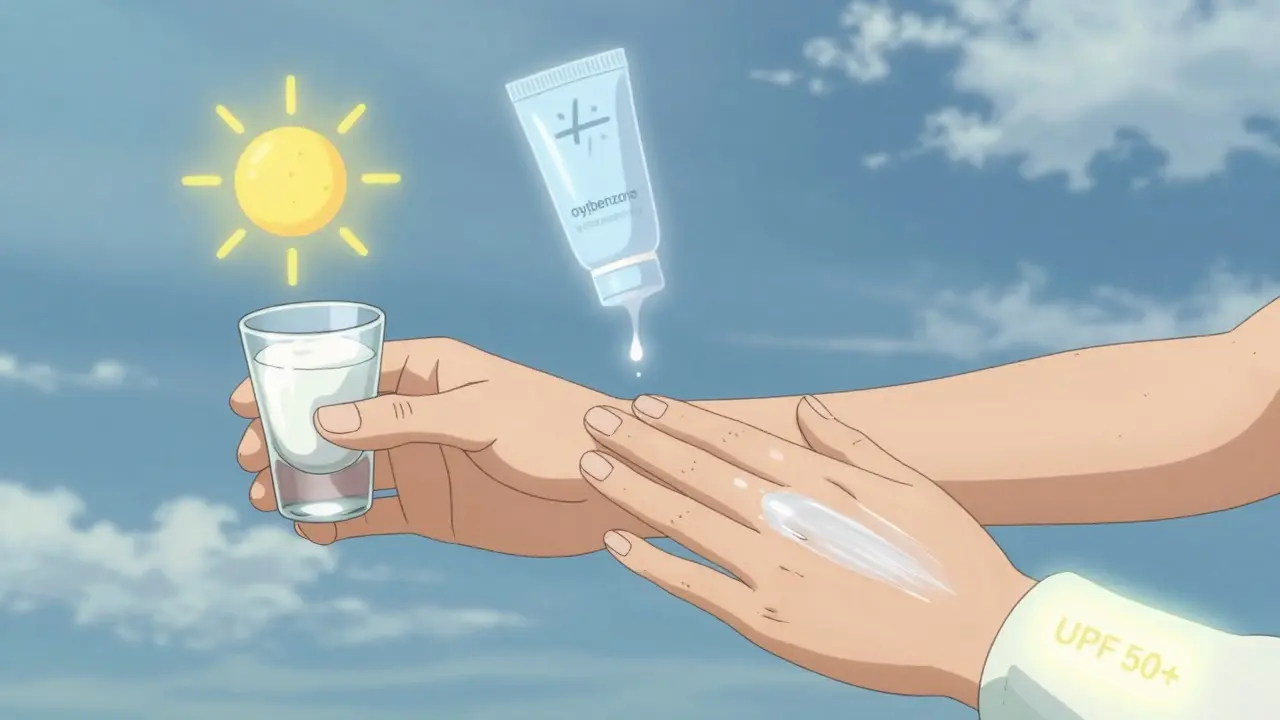
- Use zinc oxide or titanium dioxide sunscreens with SPF 50+-these mineral blockers reflect UVA and UVB. Look for at least 15% zinc oxide. Avoid chemical filters like oxybenzone if you’re sensitive.
- Apply 1 ounce (a shot glass full) for your whole body. Most people use only a quarter of that. That’s why it fails.
- Reapply every 2 hours, even if you’re not sweating. UVA rays penetrate windows and clouds.
- Wear UPF 50+ clothing. Regular cotton blocks only 3-20% of UV. UPF 50+ fabric blocks 98%. Brands like Solbari and Coolibar have been independently tested and proven. One user reported a 90% drop in symptoms after switching to sun-protective clothing.
- Check the UV index daily. If it’s above 3, take extra precautions. Apps like UVLens give real-time alerts based on your location.
- Avoid sun between 10 a.m. and 4 p.m. That’s when UVA is strongest, even on cloudy days.
And don’t forget: sunglasses with UVA/UVB protection protect your eyes, too. Some medications can cause light sensitivity in the eyes as well.
Who’s Most at Risk-and Why It’s Not Just You
It’s not just people on antibiotics. The biggest groups at risk:
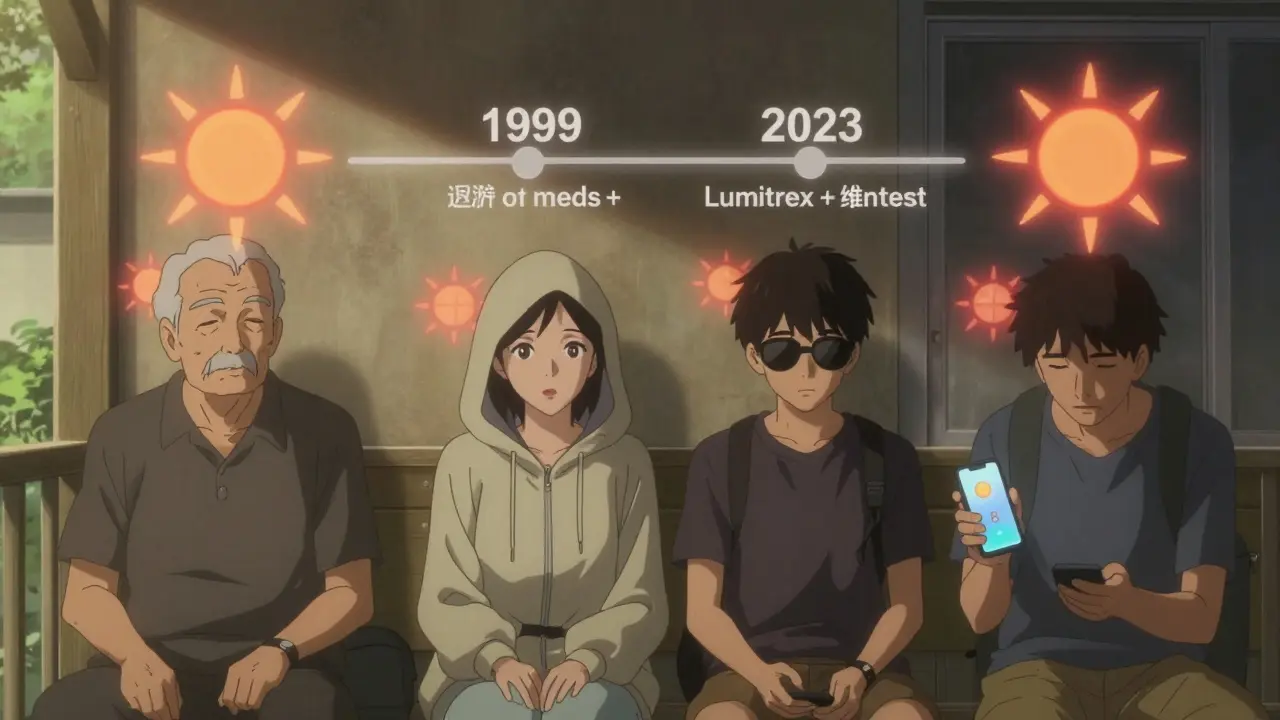
- Older adults: Since 1999, prescription use in adults over 65 has jumped 300%. Many take multiple photosensitizing drugs-statins, blood pressure meds, diuretics.
- People with chronic conditions: Those on long-term doxycycline for acne, amiodarone for heart rhythm, or NSAIDs for arthritis are at high risk.
- Women: Higher use of topical meds and cosmetics increases photoallergy risk.
- People in high-UV areas: Like Durban, South Africa, where UV levels are among the highest in the world.
And here’s the kicker: dermatologists estimate that 70% of photosensitivity cases are misdiagnosed. Doctors think it’s eczema, sun allergy, or a rash from something else. That means people keep taking the drug and keep getting burned.
What’s Changing: New Tools and Better Protection
Thankfully, things are improving. In 2022, the FDA required photosensitivity warnings on over 200 high-risk medications. That’s a big step. Companies like Kaiser Permanente now use automated alerts in their electronic health records to flag patients on dangerous drugs.
New products are emerging too. In 2023, the FDA approved the first targeted photoprotective drug, Lumitrex, which cuts UV-induced skin damage by 70%. Meanwhile, companies are testing “smart” sunscreens that change color when UV levels rise-so you know when to get out of the sun.
Even genetic testing is entering the scene. 23andMe now offers a photosensitivity risk panel that checks for gene variants linked to higher sensitivity. It’s not perfect-but it gives people a heads-up before they even start a risky medication.
What to Do If You’re Already Reacting
If you’ve already gotten burned or developed a rash after sun exposure while on medication:
- Stop the sun exposure immediately. Even brief exposure can make it worse.
- Call your doctor. Don’t assume it’s just a sunburn. They may need to switch your medication.
- Don’t self-diagnose. A photopatch test can confirm if it’s photoallergy-but it’s only positive in 30-40% of cases. Your medication history matters more.
- Use cool compresses and hydrocortisone cream for relief, but avoid topical anesthetics like benzocaine-they can make photoallergy worse.
And if you’re starting a new drug? Ask: “Can this make my skin sensitive to the sun?” If they hesitate or say “probably not,” ask for the FDA’s Sun Safety Medication Database. It’s free, updated quarterly, and lists every known photosensitizer.
Final Thought: Sun Safety Isn’t Optional-It’s Medical
For people on these medications, sunscreen isn’t about looking good. It’s about staying healthy. It’s not a luxury. It’s as essential as taking the pill itself. And if your doctor doesn’t mention it, you have to ask. Because in a world where UV levels are rising and prescriptions are piling up, ignorance isn’t bliss-it’s a risk you can’t afford to take.
Full Scale Webmaster
March 1, 2026 AT 03:20Let me tell you something nobody else will admit: this whole photosensitivity thing is a pharmaceutical industry scam wrapped in a medical advisory.
They make you think you need $80 sunscreens and $200 UPF clothing because they're terrified you'll realize how many drugs they push that are basically chemical landmines.
I've been on doxycycline for five years for acne, and yeah, I got burned once-but it was because I was dumb enough to think SPF 30 was enough.
Turns out, the FDA only started forcing warnings after lawsuits piled up, not because they cared about patients.
Amiodarone? That's a drug that should've been pulled off the market decades ago.
And don't get me started on oxybenzone in sunscreen-it's literally a hormone disruptor, and now they're telling us to use it because 'mineral sunscreens are too expensive'? Bullshit.
Big Pharma doesn't want you to know that sunlight is a natural detoxifier.
They want you scared, dependent, and buying their next product.
Meanwhile, people in Nigeria, India, and Kenya have been living under 12-hour sun days for centuries without turning into walking third-degree burns.
It's not the sun, it's the cocktail of drugs we're being pumped full of.
And guess what? No one's testing the interaction between statins, diuretics, and UV exposure in real-world populations.
They're too busy marketing their next 'smart sunscreen' that changes color like a mood ring.
Wake up. This isn't science. It's profit-driven fear.
And if your doctor didn't warn you? That's not negligence-it's complicity.
Brandie Bradshaw
March 2, 2026 AT 17:00There is a profound, systemic failure in how we communicate risk in pharmacology.
Patients are not merely passive recipients of prescriptions; they are active agents in their own health, yet are routinely excluded from the risk-assessment dialogue.
The assumption that 'sunscreen is sufficient' reflects a gross misunderstanding of photobiology.
UVA penetration-particularly through glass and cloud cover-is not mitigated by standard SPF ratings, which are calibrated primarily for UVB-induced erythema.
Furthermore, the FDA's 2022 directive, while a step forward, remains reactive rather than proactive.
Why are photosensitizing agents not flagged during e-prescribing? Why is there no mandatory patient counseling protocol?
And why is the burden of vigilance placed entirely on the individual, rather than on the prescriber, the pharmacy, and the regulatory body?
This is not a personal responsibility issue-it is a structural failure of the healthcare delivery system.
Until we institutionalize photoprotection as a standard-of-care component, we are complicit in iatrogenic harm.
It is not enough to 'ask your doctor.' We must demand a change in protocol, not merely awareness.
Katherine Farmer
March 3, 2026 AT 19:03Oh please. Another 'guide' that treats patients like toddlers who can't read the fine print.
Let me guess-you're the type who thinks UPF 50+ clothing is a lifestyle choice, not a medical necessity?
And you actually believe the FDA's '200 high-risk medications' list is comprehensive?
Have you seen the list of OTC drugs that cause photosensitivity? Antihistamines, NSAIDs, even some herbal supplements like St. John’s Wort-none of those are regulated the same way.
Also, 'women are twice as likely'? That’s not because they use more topicals-it’s because they’re more likely to be prescribed SSRIs and oral contraceptives, which are both high-risk.
And don’t even get me started on how 'smart sunscreens' are just another Silicon Valley scam.
They don’t change color based on UV-they change color based on how much money you spent on them.
This isn’t education.
This is fear marketing dressed up as public health.
Angel Wolfe
March 4, 2026 AT 06:06They want you scared of the sun so you'll take more pills.
Big Pharma and the FDA are the same thing.
Stop listening to doctors.
Go outside.
Live.
They're lying to you.
Sophia Rafiq
March 6, 2026 AT 03:24Just wanna say I’ve been on doxycycline for 3 years for acne and never knew this.
Started using zinc oxide SPF 50+ and UPF shirt-no more burning.
Also, UV index app is a game changer.
Simple fix.
Why didn’t anyone tell me?
Martin Halpin
March 7, 2026 AT 17:39Let me tell you something you didn’t ask for but desperately need to hear.
Did you know that in Ireland, where the sun barely exists, people are still getting photosensitivity reactions?
Not because they're sunbathing.
Because they're driving to work.
Because they're sitting by the window at their desk.
Because their doctor gave them a prescription and didn't say a word.
I had a patient last month-68-year-old man on amiodarone, took a 10-minute walk to the mailbox, ended up with second-degree burns on his neck.
He thought it was 'just a rash.'
He didn’t even know the drug he'd been on for 7 years could do this.
And now? He’s suing his GP.
Because no one told him.
And here’s the kicker: the same drug is prescribed to 300,000 people in the UK alone.
How many are walking around with invisible burns?
How many are being misdiagnosed as eczema?
It’s not a matter of 'being careful.'
It’s a matter of systemic neglect.
And if your doctor didn’t warn you?
They failed you.
And you deserve better.
Eimear Gilroy
March 8, 2026 AT 02:09I’m curious-how do you determine which medications are included in the FDA’s photosensitivity list?
Is it based on clinical trials, post-marketing surveillance, or case reports?
And is there any data on how many people develop long-term pigmentation changes or skin cancer after years of undiagnosed exposure?
I ask because I’ve seen patients with lichenoid rashes that were misdiagnosed for over a decade-only to find out they were on a photosensitizing drug the whole time.
It makes me wonder if we’re underestimating the cumulative burden.
Also, are there any studies comparing photoprotection outcomes between patients who received counseling vs. those who didn’t?
Just trying to understand the evidence base behind these recommendations.
Ajay Krishna
March 8, 2026 AT 14:57Thank you for this. As someone from India where sunlight is unavoidable, I’ve seen too many elderly patients get burned from routine meds.
My grandmother was on amlodipine and got blistered legs after gardening-doctors called it 'old age rash.'
Now I carry mineral sunscreen and UPF hats for my family.
One thing I’d add: in rural areas, people don’t have access to zinc oxide sunscreens.
They use coconut oil or aloe vera, which gives zero protection.
Maybe we need low-cost, locally available photoprotective solutions-like shaded clothing or timed outdoor activity guidelines.
Education matters, but so does accessibility.
Thank you for highlighting this.
It’s not just a Western problem.
Noah Cline
March 9, 2026 AT 04:07Let’s cut through the noise.
Phototoxicity is a dose-dependent, predictable reaction.
Photoallergy is T-cell mediated, delayed-type hypersensitivity.
UVA-1 (340–400 nm) is the primary culprit, not UVB.
SPF measures UVB protection-hence the disconnect.
Broad-spectrum = UVA-PF ≥ 1/3 of labeled SPF.
Most sunscreens fail this.
Mineral filters (ZnO, TiO2) are superior because they scatter and reflect-not absorb.
And yes, oxybenzone is a known endocrine disruptor.
But here’s the clinical reality: 95% of reactions are phototoxic, and they resolve upon discontinuation of the agent.
So why are we overcomplicating this?
Check your meds.
Use zinc oxide.
Reapply.
Wear UPF.
It’s not rocket science.
It’s pharmacology 101.
Lisa Fremder
March 9, 2026 AT 08:10You take a pill, you can’t go outside? What’s next? You can’t breathe air because of chemicals?
My brother takes doxycycline and he’s outside all day-no problem.
Stop scaring people.
They’re just trying to sell sunscreen.
Real Americans don’t hide from the sun.
Justin Ransburg
March 11, 2026 AT 04:21I want to commend the author for a truly comprehensive and well-researched piece.
This is exactly the kind of public health information that needs to be more widely disseminated.
It’s rare to see such clarity on a topic that is so often misunderstood.
The statistics cited are compelling, the recommendations are evidence-based, and the tone is both urgent and compassionate.
As a healthcare professional, I wish every patient received this level of education before starting a new medication.
Thank you for taking the time to compile this.
It is both informative and lifesaving.
Sumit Mohan Saxena
March 13, 2026 AT 04:04With due respect, the recommendations presented are scientifically sound, yet implementation remains a challenge in low-resource settings.
For instance, in rural India, UPF 50+ garments are cost-prohibitive, and zinc oxide sunscreens are often unavailable outside urban pharmacies.
Moreover, public health infrastructure lacks the capacity for patient counseling on photosensitivity.
Alternative strategies such as community-based education, integration with primary care visits, and subsidized photoprotective materials may yield greater impact.
Additionally, leveraging mobile health platforms to send SMS alerts about UV index and medication risks could bridge the information gap.
While the guidelines are optimal, equity in access must be prioritized alongside efficacy.
Brandon Vasquez
March 13, 2026 AT 16:01I’ve been reading this whole thing and I just want to say-thank you.
I didn’t know any of this.
I’ve been on a statin and a blood pressure med for years, and I never thought about the sun.
Now I’m buying zinc sunscreen and a UPF shirt.
And I’m going to ask my doctor next time I see them.
You made me feel like I can take care of myself.
That means a lot.
Full Scale Webmaster
March 14, 2026 AT 23:18Oh wow, look who’s here-the 'I asked my doctor' crowd.
Let me guess, you’re the same person who thinks 'sunscreen is enough' because your dermatologist said so.
Here’s the truth: 68% of patients aren’t warned.
And when they are? It’s usually in a 10-page PDF buried in the portal.
Meanwhile, the guy who wrote this? He’s got a sponsored link to Coolibar.
And now you’re all buying $120 hats because someone told you to.
Who profits?
Not you.
And don’t even get me started on that 'smart sunscreen' nonsense.
It’s a $40 gimmick that changes color when you sweat.
It doesn’t tell you if you’re getting UVA damage.
It tells you you spent too much money.
And the genetic test? 23andMe’s photosensitivity panel? It’s based on one gene variant that explains 3% of cases.
It’s not science.
It’s a marketing funnel.
And you’re all falling for it.
Wake up.
They’re selling fear.
Not protection.