
Spotting Counterfeit Pills: How to Prevent Overdose from Fentanyl-Laced Meds
 Sep, 1 2026
You think you’re taking a standard dose of Xanax or Percocet. You swallow it, wait for the effect, and maybe feel a bit off. But that "off" feeling isn’t just your imagination-it could be the last thing you notice before losing consciousness. The illicit drug market has shifted dramatically since 2019, with counterfeit pills becoming a primary driver of overdose deaths. These aren’t just bad-quality meds; they are often pressed tablets containing lethal doses of illicitly manufactured fentanyls (IMFs), designed to look exactly like legitimate prescription drugs.
The danger is invisible. You cannot see, smell, or taste fentanyl. A lethal dose is roughly two milligrams-about the size of a few grains of salt. If you are using pills bought outside a pharmacy, you are playing Russian roulette with your life. Here is how you can spot the red flags, test what you have, and stay alive.
Why Visual Inspection Alone Is Not Enough
Your first instinct might be to look at the pill. Does it have the right imprint? Is the color correct? While these checks help, they are no longer reliable indicators of safety. Counterfeiters are sophisticated. They use high-pressure presses to mimic the texture, weight, and markings of real medications. However, there are subtle physical cues that might give them away.
- Inconsistent Imprints: Look closely at the letters or numbers on the pill. Are they crisp and centered, or do they look blurry, faded, or misaligned? Legitimate pharmaceutical manufacturing uses strict quality control; counterfeits often lack this precision.
- Color Variations: If you usually take a specific brand of medication, note its exact shade. Counterfeit batches may vary slightly in hue. A pill that looks "too bright" or "too pale" compared to your usual supply is suspicious.
- Packaging Clues: Check the bottle or blister pack. Are the labels printed clearly, or do they look like cheap photocopies? Look for spelling errors, missing lot numbers, or expiration dates that seem inconsistent with the manufacturer’s standards.
Remember, though, that visual inspection is a weak shield. A counterfeit pill can look perfect but contain ten times the intended dose of a dangerous substance. This is why relying solely on your eyes is a gamble.
Fentanyl Test Strips: Your Best Line of Defense
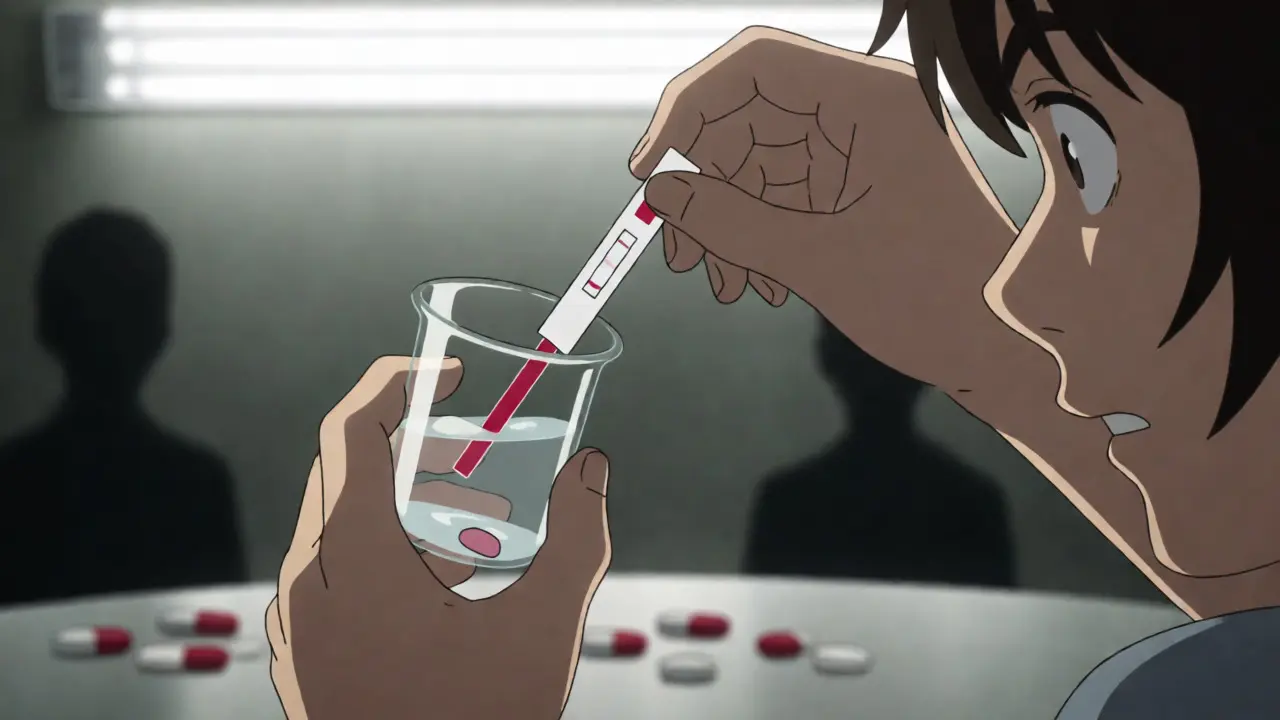
If you must use substances obtained illicitly, fentanyl test strips (FTS) are the most accessible tool for detecting the presence of fentanyl in drugs. These small paper strips work similarly to pregnancy tests. You dissolve a tiny sample of the crushed pill in water, dip the strip, and wait for the result. If the line appears, fentanyl is present.
But here is the catch: a negative result does not mean the pill is safe. Fentanyl is not distributed evenly throughout a batch of pills. One pill might contain none, while the next one contains a lethal amount. Furthermore, standard test strips may not detect newer analogs like carfentanil, which is even more potent than fentanyl. Treat a negative test as a warning, not a guarantee.
| Method | Reliability | Limitations | Best For |
|---|---|---|---|
| Visual Inspection | Low | Cannot detect potency or chemical composition; counterfeits look identical. | Catching obvious packaging errors. |
| Fentanyl Test Strips | Moderate | False negatives common due to uneven distribution; misses some analogs. | Rapid screening of illicit powders or crushed pills. |
| Laboratory Testing | High | Takes time (days/weeks); not immediate for users. | Public health monitoring and post-overdose analysis. |
Recognizing the Signs of an Opioid Overdose
Because counterfeit pills often contain unpredictable amounts of opioids, recognizing an overdose quickly can save a life. The classic signs of opioid poisoning are distinct. If someone takes a pill and suddenly becomes unresponsive, check for the "triad" of symptoms identified by the DEA:
- Pinpoint Pupils: Their pupils become extremely small, regardless of lighting conditions.
- Respiratory Depression: Breathing becomes slow, shallow, or stops entirely. You might hear gurgling or snoring sounds.
- Unconsciousness: The person cannot be woken up by shouting or shaking.
Other physical signs include cold, clammy skin and blue or purple lips and fingernails, indicating a lack of oxygen. If you see these signs, act immediately. Do not assume they are just sleeping it off. In the context of counterfeit pills, this reaction can happen within minutes.

The Hidden Danger of Illicit Benzodiazepines
It’s not just opioids. Many pills sold as Xanax (alprazolam) actually contain bromazolam, etizolam, or other illicit benzodiazepines. These substances are not approved for human consumption in many countries and have varying potencies. Some are significantly stronger than standard Xanax, leading to unexpected sedation and respiratory depression, especially when mixed with alcohol or opioids.
Users often report feeling "weird" or excessively tired after taking what they thought was a standard dose. This unpredictability makes counterfeit benzos particularly risky for those who mix substances. If you are using pills for anxiety or sleep, know that the chemical inside might be far more powerful than expected.
Harm Reduction: Naloxone and Safe Practices
Given the risks, harm reduction strategies are essential. The most critical step is carrying naloxone, an opioid overdose reversal medication. Naloxone works by binding to opioid receptors and blocking the effects of fentanyl and other opioids. It is safe to administer if you suspect an overdose, even if you aren't sure it's an opioid involved.
Experts recommend three key rules for anyone using non-prescribed medications:
- Never Use Alone: Have someone with you who can call for help or administer naloxone if you pass out.
- Start Low, Go Slow: Assume the pill is much stronger than labeled. Take half a pill first and wait to see the effect.
- Avoid Mixing: Combining unknown pills with alcohol or other depressants exponentially increases the risk of respiratory failure.
Also, be wary of social media sources. The DEA notes that dealers increasingly target young adults through platforms like Snapchat and Instagram, selling pills that look authentic but carry deadly secrets. Trusting a seller based on their online profile is a high-stakes bet.
Can I tell if a pill contains fentanyl by looking at it?
No. Fentanyl is odorless, colorless, and tasteless. Counterfeit pills are specifically manufactured to mimic the appearance of legitimate drugs like oxycodone or alprazolam. Visual inspection alone cannot determine the chemical content or potency of a pill.
Are fentanyl test strips 100% accurate?
No, they are not 100% accurate. While they can detect common fentanyl types, false negatives occur because fentanyl may not be evenly distributed throughout a batch of pills. Additionally, some newer fentanyl analogs may not trigger a positive result on standard strips. Always treat a negative result with caution.
What should I do if someone overdoses on a counterfeit pill?
Call emergency services immediately. Administer naloxone if available. Perform rescue breathing if the person is not breathing normally. Stay with the person until help arrives, as fentanyl overdoses can require multiple doses of naloxone due to its high potency.
Why are counterfeit pills so dangerous now?
Since around 2019, illicit manufacturers have increasingly used fentanyl in counterfeit pills because it is cheap and highly potent. Unlike heroin or cocaine, where users might tolerate higher doses, a slight variation in fentanyl content can turn a recreational dose into a lethal one. The lack of regulation means dosages vary wildly between pills.
Do all counterfeit pills contain fentanyl?
Not all, but many do. Others may contain methamphetamine, illicit benzodiazepines like bromazolam, or other synthetic cannabinoids. The danger lies in the uncertainty; you never know exactly what substance or combination of substances you are ingesting, leading to unpredictable interactions and overdose risks.
hareesh kumar
September 3, 2026 AT 00:21you think its just bad quality meds but its actually the gov testing new sedatives on us without consent and they press these pills to look like xanax so we dont panic while they experiment with our nervous systems which is why you feel off because its not fentanyl its something worse that they havent named yet
Venkatesan V.K.
September 3, 2026 AT 20:35The article provides a decent overview of the visual cues, though it fails to address the socioeconomic factors driving this crisis. It is emotionally draining to read about people dying from ignorance when the solution is simply better education and access to clean supplies.
Marc-David Mayer
September 4, 2026 AT 17:01This is such important info! 🌟 Please everyone, keep your naloxone handy and don't hesitate to use it. You are stronger than you think, and taking that first half pill is a brave step towards staying safe. 💪❤️ Stay hydrated and stay alert!
Kimberly Thomas
September 5, 2026 AT 20:33Your analysis is superficial at best. You list symptoms like pinpoint pupils as if they are unique identifiers for opioid overdose when any clinician knows that hypoglycemia or pontine hemorrhages present similarly. By simplifying the diagnostic triad, you risk encouraging laypeople to make fatal misjudgments in critical moments where seconds matter. The reliance on test strips is equally flawed given the uneven distribution issue you barely touched upon. This isn't helpful advice; it's dangerous oversimplification that ignores the complex pharmacokinetics involved in IMF toxicity.
Morgan Law
September 6, 2026 AT 11:18Hey everyone 👋 Just wanted to jump in here. I think the main takeaway should be community support rather than fear. If you see someone looking off, check on them. We've all been there, trying to navigate this weird market. Let's look out for each other instead of judging. Safe travels!
Anderson Miller
September 7, 2026 AT 00:47Oh wow... truly groundbreaking insight here... telling people that invisible poison kills them... shocker... really... next you'll tell me water is wet... and that breathing helps... thanks for the obvious truths wrapped in academic fluff...
Marshall Stephens
September 8, 2026 AT 14:54I appreciate the balanced perspective. While the risks are high, harm reduction seems to be the most pragmatic approach available right now. It’s good to see practical steps outlined clearly.
Aaron Gragg
September 8, 2026 AT 20:19From a public health standpoint, the efficacy of fentanyl test strips (FTS) remains a subject of intense debate within the epidemiological community. While the sensitivity of lateral flow immunoassays is generally high for primary fentanyl analogs, the heterogeneity of illicit pill manufacturing introduces significant variance in analyte concentration per unit dose. Consequently, the negative predictive value drops substantially in batches with non-uniform distribution profiles. Furthermore, the emergence of novel synthetic opioids necessitates continuous updating of antibody targets to maintain detection specificity, which current commercial kits often fail to achieve promptly. Thus, relying solely on FTS without corroborating clinical vigilance presents a non-trivial margin of error.
Harry Falk
September 10, 2026 AT 18:46Good summary. Naloxone saves lives.
Curtis Surpless
September 11, 2026 AT 19:33contrarian take: maybe the problem isnt the pills but the prohibitionist framework that creates the black market where no one checks the goods before selling them to desperate people
Adam Cox
September 12, 2026 AT 18:17You're missing the point entirely. People aren't buying these pills because they want to gamble; they buy them because legal prescriptions are inaccessible or too expensive. Blaming the user for not having a lab in their pocket is absurd. The system failed them long before they swallowed the pill.