
Continuing Education for Doctors: Staying Current on Generic Medications
 Mar, 5 2026
Every year, over 90% of prescriptions in the U.S. are filled with generic drugs. Yet, many doctors still hesitate to prescribe them-not because they doubt their safety, but because they’re not sure what’s changed since last year. The truth is, generics aren’t static. New ones hit the market constantly. Bioequivalence standards evolve. And the stakes? Higher than ever. With patients struggling to afford brand-name drugs, doctors who understand generics aren’t just prescribing medication-they’re removing barriers to care.
Why Generics Matter More Than Ever
Generic drugs aren’t cheaper because they’re inferior. They’re cheaper because they don’t carry the cost of research, marketing, or patent protection. The FDA requires them to deliver the same active ingredient, dosage, and effect as the brand-name version. But here’s what most doctors don’t realize: in 2023 alone, the FDA approved over 1,000 new generic drugs. That’s one every 12 hours. If you’re not updating your knowledge regularly, you’re prescribing based on data from five years ago.
Studies show that when patients are prescribed generics, adherence improves by nearly 24%. That’s not a small win. It means fewer hospital visits, fewer complications, and less long-term cost. The American College of Physicians says prescribing generics should be standard practice-not a last resort. And yet, surveys show that 42% of physicians still feel uncertain about when to switch from brand to generic. That’s not a knowledge gap. It’s a continuing education gap.
What’s Required? The Patchwork of CME Rules
There’s no single national rule for continuing medical education (CME) on generics. Instead, you’ve got 50 different systems. In California, doctors need 50 hours of Category 1 CME every two years. That sounds heavy-but there’s no specific requirement for generics. In Georgia, you need 40 hours, with 10 of them focused on controlled substances. In Nevada, all 40 hours must be Category 1. And in 10 states? No CME is required at all.
But here’s the twist: even where there’s no explicit generics requirement, pharmacology is usually bundled in. The National Board of Medical Examiners found that 68% of state boards require some form of pharmacology education-and 42 of them include drug naming (brand vs. generic) as part of the test. So even if your state doesn’t say "generics," it’s likely hiding in plain sight.
Then there’s the MATE Act. Since June 2023, every doctor with a DEA number-yes, even psychiatrists and pain specialists-must complete eight hours of training on substance use disorders. That includes learning about generic alternatives to opioids and other controlled substances. If you haven’t done this yet, you’re at risk of losing your prescribing privileges by June 2025.
What Should You Actually Learn?
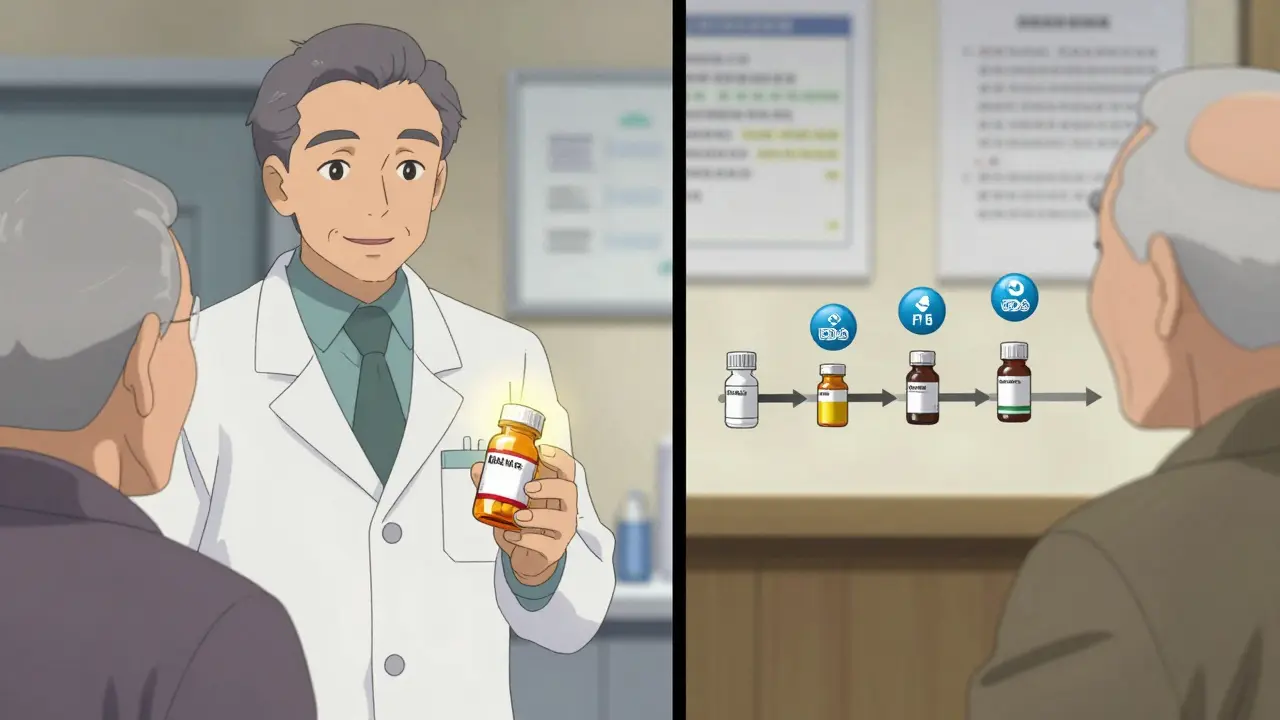
It’s not enough to know that "generic = cheaper." You need to know when they’re not interchangeable. For drugs with a narrow therapeutic index-like warfarin, levothyroxine, or phenytoin-even tiny differences in absorption can cause real harm. That’s why the FDA’s Orange Book matters. It doesn’t just list generics. It rates them: AB (therapeutically equivalent), B (not equivalent), and sometimes, no rating at all.
Here’s what you need to master:
- How to read the Orange Book’s therapeutic equivalence codes
- Which generic manufacturers have consistent quality records (and which don’t)
- How biosimilars differ from traditional generics (especially after California’s 2024 update requiring 2 hours on biosimilars)
- How to explain bioequivalence to patients who say, "I’ve always taken the brand-I’m scared to switch"
Dr. Susan Berry from Johns Hopkins put it simply: "A 24% increase in adherence isn’t magic. It’s the result of a doctor who can confidently say, ‘This generic is just as safe and effective.’"
How to Actually Get the Education You Need
Most CME platforms are bloated. You sign up for a 10-hour pharmacology course, and half of it is about drugs you never prescribe. The good news? You don’t need to sit through all of it.
Start with accredited providers that let you pick topics. UpToDate, Medscape, and WebMD all offer modular courses. You can do 1 hour on opioid generics. Another hour on insulin biosimilars. Another on drug interactions specific to generics. No one’s forcing you to sit through 12 hours of cardiology if you’re a dermatologist.
Here’s a smarter way: integrate CME into your workflow. UpToDate now gives you 0.5 CME credits just for reading a drug monograph during a patient visit. That means every time you check a generic’s equivalence before prescribing, you’re ticking off your requirement. It’s not extra work-it’s work you’re already doing.
And don’t overlook free resources. The FDA’s "Orange Book Primers" are updated quarterly. The American Society of Health-System Pharmacists offers free online modules. Both are concise, evidence-based, and updated within weeks of new approvals.
The Real Problem: One-Size-Fits-All CME
Not all doctors feel the same pressure. A radiologist in Florida told Sermo: "I prescribe contrast agents. My CME on opioids? Irrelevant." And he’s right. The current system treats every physician like a primary care provider. That’s why 42% of doctors say CME is "somewhat to not at all useful."
But here’s the shift happening: by 2027, AI-driven CME platforms will analyze your prescribing patterns and auto-suggest modules. If you rarely prescribe generics? You’ll get a 3-hour crash course. If you prescribe 15 generics a day? You’ll get updates on new biosimilars. This isn’t science fiction-it’s already being piloted in 12 states.
Until then, take control. Skip the generic pharmacology modules if they’re not relevant. Find ones tailored to your specialty. Ask your hospital’s pharmacy department for a 15-minute briefing on the top 5 generics you’re likely to encounter. Talk to your colleagues. The best education isn’t in a course-it’s in a conversation.
What’s Next? The Future of Generics Education
The FDA’s GDUFA III program is accelerating generic approvals. More drugs. More complexity. More need for education. By 2030, the number of new generics entering the market will grow by over 7% every year. That means your knowledge will expire faster than ever.
And it’s not just about new drugs. It’s about new patients. More people are on Medicaid. More are uninsured. More are choosing generics because they have to. If you’re not keeping up, you’re not just falling behind-you’re failing your patients.
There’s no magic bullet. No single course will make you an expert. But if you spend 30 minutes a month reading a new generic update-whether it’s from the FDA, UpToDate, or your hospital pharmacy-you’ll stay ahead of 80% of your peers. And that’s not just good practice. It’s ethical care.
Do all generic drugs work the same as brand-name drugs?
For the vast majority of drugs, yes. The FDA requires generics to have the same active ingredient, strength, dosage form, and route of administration as the brand. They must also prove bioequivalence-meaning they deliver the same amount of drug into the bloodstream at the same rate. But for drugs with a narrow therapeutic index-like warfarin, levothyroxine, or seizure medications-even small differences can matter. That’s why doctors need to check the FDA’s Orange Book before switching patients.
Is continuing education on generics mandatory for all doctors?
No-not directly. But 42 states require some form of pharmacology education that includes generic vs. brand identification. And since June 2023, all DEA-registered doctors must complete 8 hours of training on substance use disorders, which includes education on generic alternatives to controlled substances. So while there’s no "generics-only" mandate, the requirement is baked into other rules.
How can I find quality CME courses on generics?
Look for ACCME-accredited providers like UpToDate, Medscape, and WebMD. Choose modules that are labeled "pharmacology" or "therapeutic equivalence." The FDA’s free "Orange Book Primers" and the American Society of Health-System Pharmacists’ online modules are also reliable. Avoid courses that don’t specify their content focus-many are generic (pun intended) and cover too broad a range.
Why do some patients refuse generic drugs?
Many believe generics are "inferior" because they look different or cost less. Some have had bad experiences with early generic versions decades ago. The best way to address this is to explain bioequivalence clearly: "This generic has the same active ingredient and works the same way in your body. The only difference is the color or shape of the pill-and the price." Studies show that when doctors explain this, patient concerns drop by 40%.
What’s the difference between generics and biosimilars?
Generics are chemically identical copies of small-molecule drugs. Biosimilars are copies of complex biological drugs (like insulin or cancer treatments). Because biologics are made from living cells, biosimilars can’t be exact copies-only "similar." That’s why they require more testing and why new CME requirements (like California’s 2024 mandate) now include specific training on biosimilars.
Every time you prescribe a generic, you’re making a choice-not just about cost, but about access, equity, and trust. Keeping up isn’t about checking a box. It’s about being the kind of doctor your patients can count on.