
Special Populations in Bioequivalence: Age and Sex Considerations
 Mar, 6 2026
When you take a generic pill, you expect it to work just like the brand-name version. But what if the people who tested that generic drug were all young men? What if women, older adults, or people with different body types never even got a chance to be in the study? That’s not just a gap in science-it’s a gap in safety.
Bioequivalence (BE) studies are the backbone of generic drug approval. They measure how fast and how much of a drug enters your bloodstream. If two versions-brand and generic-deliver the same amount at the same rate, they’re considered bioequivalent. Simple, right? Not quite. For decades, these studies were done almost entirely on healthy young men. Why? Because it was easier. Fewer variables. Lower risk. But this approach ignored real-world differences in how men and women, young and old, absorb and process drugs.
Why Age and Sex Matter in Bioequivalence
Your body doesn’t treat every drug the same way. Hormones, liver enzymes, body fat, kidney function-all change with age and sex. For example, women often have slower gastric emptying and higher body fat percentages than men. These differences affect how quickly a drug is absorbed. Older adults, especially those over 60, tend to have reduced kidney and liver function. That means a drug that’s perfectly safe for a 25-year-old might build up to dangerous levels in a 70-year-old.
Take levothyroxine, a thyroid hormone replacement. Over 60% of users are women. Yet, in many bioequivalence studies, women made up less than 25% of participants. What happens when a generic version is approved based on data from mostly male volunteers? It might not work the same way in women. And that’s not hypothetical. Studies have shown women report more side effects and dose adjustments than men for the same generic drug. That’s not because women are “sensitive”-it’s because the testing didn’t reflect them.
How Regulatory Agencies Differ
Not all drug regulators think the same way. The FDA is the U.S. Food and Drug Administration, which regulates drug safety and approval in the United States has taken the strongest stance. In its May 2023 draft guidance, the FDA says clearly: if a drug is meant for both men and women, your bioequivalence study must include similar numbers of each. No exceptions unless you can prove otherwise.
The EMA is the European Medicines Agency, responsible for evaluating and supervising medicinal products in the European Union is more relaxed. Their 2010 guideline says subjects “could belong to either sex.” That’s it. No requirement for balance. No minimum percentage. This has led to studies where 80% of participants are male-even for drugs used mostly by women.
ANVISA is Brazil’s National Health Surveillance Agency, which sets health regulations and standards for pharmaceuticals in Brazil has its own rules. They require a strict 18-50 age range, non-smokers, and equal male-female splits. No wiggle room. That’s why some generic manufacturers run separate studies in Brazil versus the U.S.-the rules are just different.

What the Numbers Really Show
Let’s look at real data. Between 2015 and 2020, the FDA reviewed over 1,200 generic drug applications. Only 38% of those studies had female participants between 40% and 60%. The median? Just 32%. That’s not balanced. That’s underrepresentation.
And it’s not just about numbers. Small studies-say, only 12 or 14 people-are especially risky. If one woman in a group of 14 has unusually slow absorption, it can look like the generic doesn’t work. But if you double the group size to 36, that outlier gets averaged out. That’s why experts now say: small studies can’t detect sex-based differences. You need enough people to see the real pattern.
One 2018 study compared two versions of a drug. In a small trial (n=14), the generic looked 20% less effective in men. But in a larger trial (n=36), the difference vanished. Turns out, it wasn’t the drug-it was the small sample. That’s why regulators now push for studies with at least 24-36 participants. Enough to catch real differences, not statistical noise.
Challenges in Recruitment
So why aren’t all studies balanced? Because it’s harder-and more expensive.
Recruiting women for BE studies is tough. Many are caregivers, work multiple jobs, or can’t take time off. Pregnancy and breastfeeding rules also limit participation. A woman of childbearing age must use two forms of contraception during the study. That’s a barrier. Some sites report it takes 40% longer to recruit a gender-balanced group.
Costs go up too. Studies with balanced sex representation can cost 20-30% more. That’s why some sponsors still try to get away with mostly male participants. But the FDA is watching. If you don’t justify why you’re excluding women or older adults, your application gets flagged. And that delays approval.
What’s Changing-and What’s Next
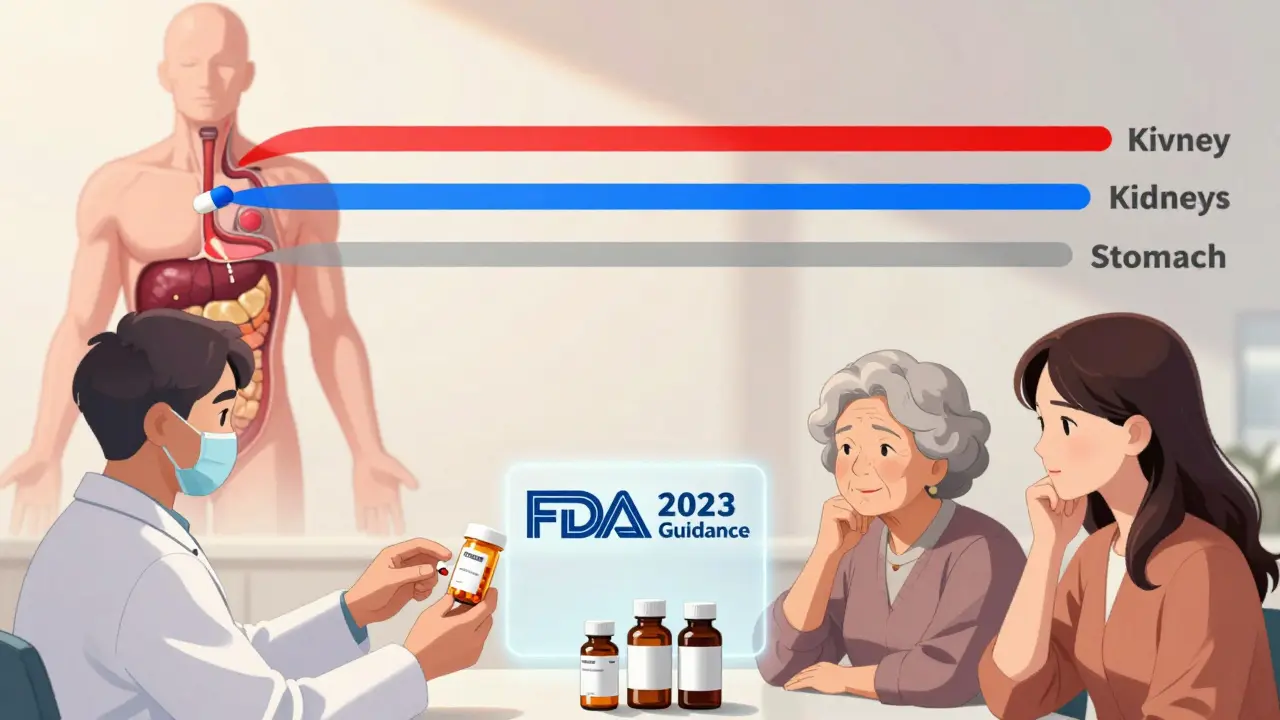
The tide is turning. The FDA’s 2023 draft guidance isn’t a suggestion-it’s a signal. They’re no longer okay with “mostly men.” They want studies that mirror the real patient population. That means if 70% of users are women, your study should be close to 70% women too.
Industry is slowly catching up. In 2022, 68% of contract research organizations (CROs) started actively recruiting women. But only 29% track sex-specific pharmacokinetic data. That’s a problem. You can’t fix what you don’t measure.
Future studies will likely include:
- Stratified randomization by sex and age group
- Pre-specified subgroup analyses in statistical plans
- Sex-specific bioequivalence thresholds for narrow therapeutic index drugs (like warfarin or levothyroxine)
- More data from older adults and people with mild chronic conditions
Researchers at the University of Toronto found that 37% of commonly tested drugs are cleared 15-22% faster in men than in women. That’s not a small difference. That’s a clinical one. If we keep ignoring this, we’re not just being inefficient-we’re putting patients at risk.
What This Means for You
If you’re a patient: know that the generic you take might not have been tested on people like you. Ask your pharmacist or doctor if the drug was studied in women or older adults. If it wasn’t, there’s a chance the dose might need adjusting.
If you’re in the industry: stop treating sex and age as optional. They’re not. The FDA isn’t going to soften its stance. The next review could be yours. Start planning balanced studies now. Track your data by sex. Don’t just collect it-analyze it.
Bioequivalence isn’t about math alone. It’s about people. And people aren’t all young, healthy men. If we want generics to be safe and effective for everyone, we have to test them on everyone.
Why were bioequivalence studies historically done only on young men?
Early BE studies used young, healthy men because they had fewer variables-no hormonal fluctuations, no chronic conditions, and lower risk of pregnancy. It made data cleaner and recruitment easier. But this approach ignored how drugs behave differently in women and older adults, leading to gaps in safety and effectiveness for real patients.
Does the FDA require equal numbers of men and women in BE studies?
Yes, if the drug is intended for both sexes. The FDA’s 2023 draft guidance requires similar proportions of males and females unless there’s a strong scientific reason not to. This is a shift from earlier non-binding recommendations to a clear expectation.
What’s the minimum number of participants needed in a BE study?
The EMA requires at least 12 evaluable subjects, but most studies enroll 24-36 people. Smaller studies (under 20) are prone to false results, especially when looking at sex-based differences. Larger groups help average out outliers and give more reliable data.
Can older adults be included in bioequivalence studies?
Yes, and increasingly, they should be. The FDA recommends including subjects aged 60+ if the drug is meant for older patients. Some agencies, like ANVISA, limit age to 50, but the trend is moving toward including elderly populations to reflect real-world use.
Why do women have lower participation rates in BE studies?
Women face more barriers: childcare responsibilities, work schedules, stricter pregnancy and contraception rules, and lower willingness to participate in drug trials. Some sites report recruitment takes 40% longer for women, which increases costs and delays studies.
Ferdinand Aton
March 7, 2026 AT 17:26William Minks
March 9, 2026 AT 03:54Jeff Mirisola
March 10, 2026 AT 13:39Susan Purney Mark
March 10, 2026 AT 17:48Ian Kiplagat
March 11, 2026 AT 09:59Amina Aminkhuslen
March 12, 2026 AT 07:12amber carrillo
March 12, 2026 AT 20:11Andrew Poulin
March 13, 2026 AT 18:24