
Tyramine-Rich Foods and MAO Inhibitors: What You Must Avoid to Prevent Hypertensive Crisis
 Jan, 4 2026
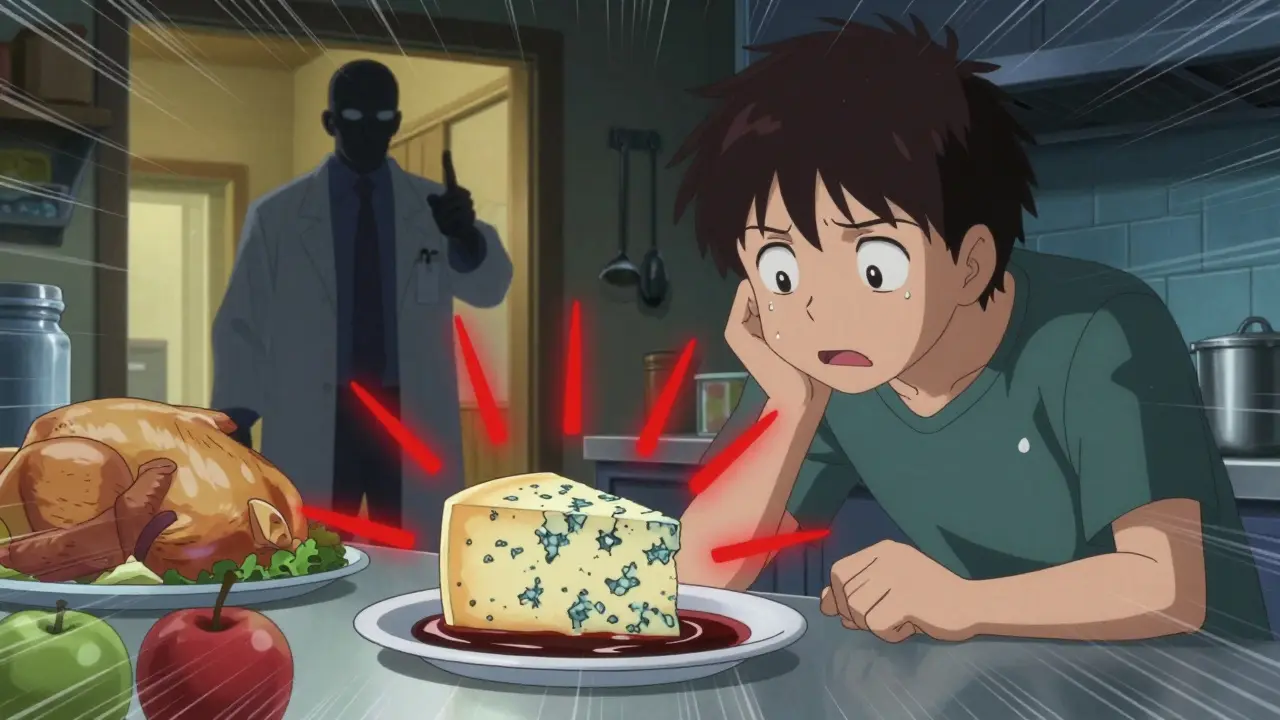
When you’re taking an MAO inhibitor for depression, your food choices aren’t just about taste or nutrition-they can be a matter of life or death. A single bite of aged cheese, a splash of soy sauce, or a glass of red wine could send your blood pressure skyrocketing in minutes. This isn’t a myth. It’s a real, documented risk called a hypertensive crisis, and it happens because of how your body handles tyramine when MAOIs are in your system.
Why Tyramine Turns Dangerous with MAOIs
Your body normally breaks down tyramine-a naturally occurring compound in certain foods-using an enzyme called monoamine oxidase-A (MAO-A). This enzyme works in your gut and liver to keep tyramine from entering your bloodstream in large amounts. But when you take a traditional MAO inhibitor like phenelzine (Nardil) or tranylcypromine (Parnate), that enzyme gets blocked. Tyramine builds up, and instead of being safely processed, it floods your system and triggers a massive release of norepinephrine. That’s the chemical that makes your heart race and your blood vessels tighten. The result? A sudden, dangerous spike in blood pressure-sometimes over 30-50 mmHg in under half an hour.The scary part? You don’t need to eat a huge amount. As little as 5-10 mg of tyramine can cause a noticeable rise in blood pressure. At 10-25 mg, you’re in hypertensive crisis territory. And some foods pack way more than that. Blue cheese? Up to 41 mg per 100 grams. Pickled herring? Between 110 and 230 mg per 100 grams. Soy sauce? 20-70 mg per 100 ml. One tablespoon of soy sauce could easily hit 15 mg. That’s enough to trigger symptoms in many people.
Foods to Avoid-Exactly
General advice like “avoid aged foods” isn’t enough. You need specifics. Here’s what’s risky:- Aged cheeses: Blue cheese, cheddar, Swiss, parmesan, brie, camembert. Fresh mozzarella, cream cheese, and cottage cheese are safe.
- Cured or fermented meats: Salami, pepperoni, liverwurst, corned beef, pickled herring. Hot dogs and fresh chicken or beef are fine.
- Fermented soy products: Soy sauce, teriyaki sauce, miso, tempeh. Tamari and fresh tofu are okay.
- Tap beer and red wine: Especially Chianti, sherry, and port. Bottled or canned beer and white wine are lower risk, but still check labels.
- Overripe or spoiled foods: Bananas with brown spots, aged yogurt, leftover meals stored over 48 hours. Tyramine builds as food ages or spoils-even if it doesn’t look bad.
- Certain supplements: Yohimbine, L-tryptophan, and some herbal extracts can also interact. Always check with your doctor before taking anything new.
Here’s the good news: most fresh, unprocessed foods are safe. A grilled chicken breast, steamed broccoli, rice, apples, and plain yogurt won’t hurt you. The danger comes from aging, fermentation, or spoilage. That’s why a slice of leftover pizza from last night could be riskier than a fresh one.
Not All MAOIs Are the Same
The rules change depending on which MAOI you’re taking. There are three main types, and your dietary restrictions vary accordingly:| MAOI Type | Examples | Tyramine Limit | Dietary Restrictions |
|---|---|---|---|
| Irreversible, non-selective | Phenelzine (Nardil), Tranylcypromine (Parnate), Isocarboxazid (Marplan) | <15 mg/day | Strict avoidance of all high-tyramine foods |
| Reversible MAO-A inhibitor (RIMA) | Moclobemide | Up to 100 mg tolerated | Minimal restrictions; no crisis reported at normal dietary levels |
| Transdermal selegiline (Emsam) | Emsam patch (6 mg/24h) | No limit at lowest dose | No restrictions at 6 mg dose. Avoid foods with >100 mg tyramine at 9 mg and 12 mg doses. |
If you’re on the lowest dose of the Emsam patch (6 mg), you can eat normally. That’s why it’s becoming the go-to option for many doctors. Moclobemide, used widely in Europe and Canada, is also much safer-but it’s not available in the U.S. That means most Americans on MAOIs are still on the older, stricter versions.
What Happens During a Hypertensive Crisis?
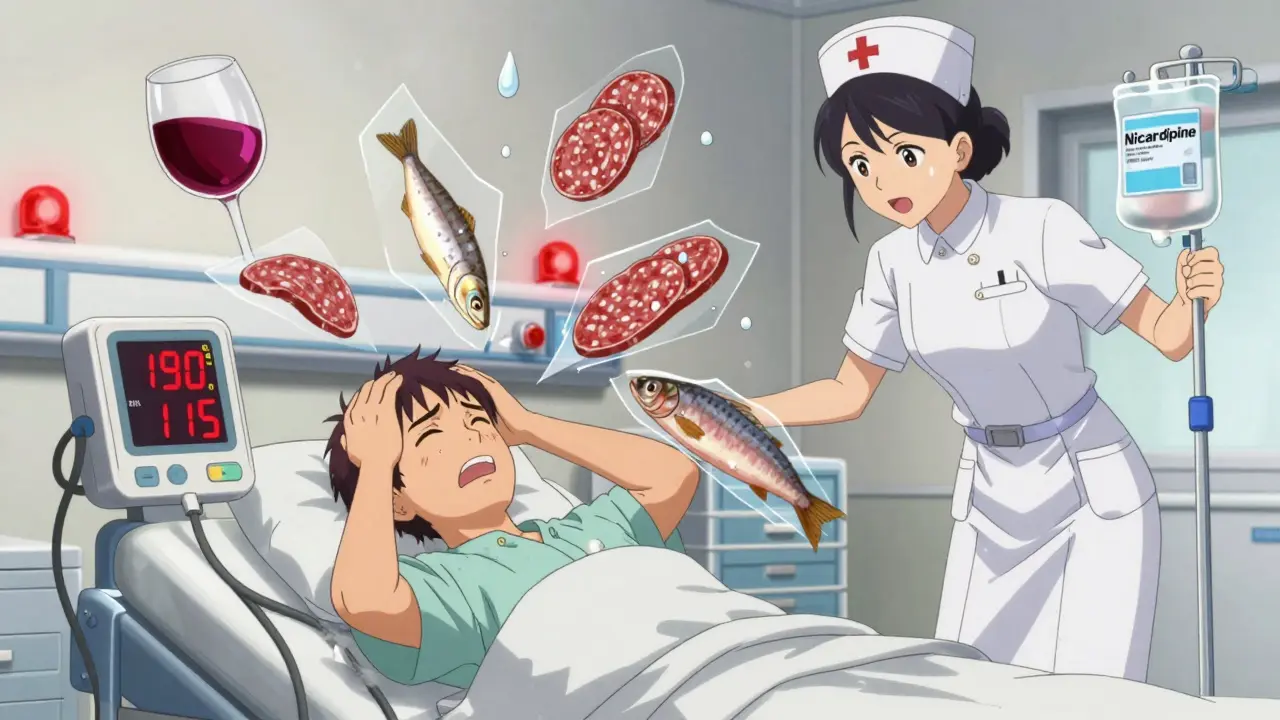
You won’t always feel it coming. But if your blood pressure spikes suddenly, you might notice:- Severe headache, especially at the back of your head (occipital headache)
- Heart palpitations or chest tightness
- Sweating, nausea, or blurred vision
- Confusion or anxiety
Your systolic blood pressure may jump above 180 mmHg. This isn’t just “high blood pressure”-this is an emergency. If you experience these symptoms after eating something questionable, check your blood pressure immediately. If it’s above 180/110, call 911 or go to the ER. Delaying care can lead to stroke, heart attack, or organ damage.
Doctors now treat this with nicardipine, a fast-acting IV medication that gently lowers pressure without crashing your brain’s blood flow. Older treatments like nitroprusside are avoided because they can be too aggressive.
Real People, Real Struggles
Many people stop taking MAOIs-not because they don’t work, but because the diet is too hard. A 2022 survey of over 300 people on online mental health forums found that 68% quit because of dietary restrictions. Social events became stressful. Dining out felt impossible. One woman said she stopped going to restaurants for two years because she couldn’t trust the kitchen to know what was safe.But for others, the trade-off was worth it. A 2022 study in the Journal of Affective Disorders found that 61% of long-term MAOI users (those on it for two or more years) called their improvement “life-changing.” Many had tried five or more other antidepressants with no success. For them, the diet was a small price to pay for feeling normal again.
How to Stay Safe-Practical Tips
You don’t have to live in fear. Here’s how to manage it:- Check labels. Look for “aged,” “fermented,” or “cured.” If it’s not clear, avoid it.
- Use portion control. A small piece of aged cheese (under 1 ounce) is often safe. A whole wedge? Not worth the risk.
- Keep a food diary. Write down everything you eat for a week. You might be surprised what triggers symptoms.
- Buy fresh and cook at home. You control the ingredients. Avoid pre-packaged or deli meats unless labeled “fresh.”
- Get a home blood pressure monitor. The American Psychiatric Nurses Association recommends one for all MAOI users. Log your readings daily. If you see a sudden jump, contact your doctor.
- Ask your pharmacist. They can check if a medication or supplement contains hidden tyramine triggers.
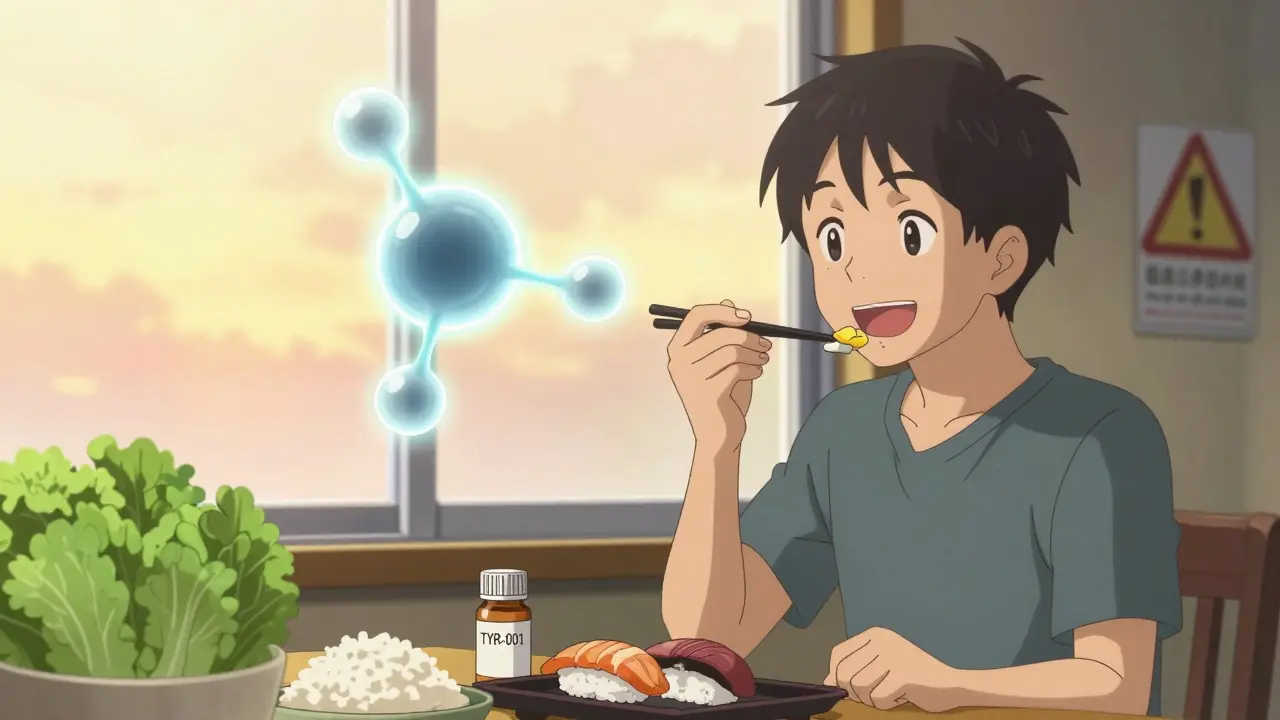
There’s also new hope on the horizon. In March 2024, the FDA gave breakthrough status to a new enzyme supplement called TYR-001. Early trials showed people could eat high-tyramine foods without risk while still taking their MAOI. If it gets approved, it could change everything.
Final Thoughts
MAOIs aren’t the first choice for depression anymore. But for people who’ve tried everything else and still feel stuck, they can be a lifeline. The dietary restrictions are real. They’re strict. And yes, they’re inconvenient. But they’re not impossible. With clear information, careful planning, and the right tools, you can stay safe and still live a full life. You don’t have to give up food entirely-just learn what’s worth avoiding. And if you’re ever unsure, when in doubt, skip it. Your blood pressure will thank you.Can I drink alcohol while on MAOIs?
Some alcohol is risky, some isn’t. Tap beer, red wine, sherry, and port contain high tyramine levels and should be avoided. Bottled or canned beer, white wine, and clear spirits like vodka or gin are lower risk-but still check with your doctor. Even low-risk alcohol can raise blood pressure on its own, so moderation is key.
Are there any safe cheeses on MAOIs?
Yes. Fresh cheeses like mozzarella, ricotta, cottage cheese, cream cheese, and goat cheese are safe. Avoid anything labeled “aged,” “blue,” “sharp,” or “mature.” If it’s been sitting in the fridge for weeks, skip it-even if it looks fine.
What if I accidentally eat something high in tyramine?
Don’t panic. Most people won’t have a crisis from one small slip. But check your blood pressure right away. If it’s under 160/100 and you feel fine, monitor yourself for the next few hours. If your pressure spikes above 180/110, or you get a severe headache, palpitations, or sweating, seek emergency care immediately. Keep your doctor’s number handy.
Is moclobemide available in the United States?
No. Moclobemide is approved in Europe, Canada, and Australia but has never been approved by the FDA. In the U.S., the only MAOIs available are the older, irreversible types like phenelzine and tranylcypromine, or the transdermal selegiline patch.
Can I take over-the-counter cold medicine with MAOIs?
No. Many decongestants like pseudoephedrine and phenylephrine can cause dangerous interactions with MAOIs, leading to severe high blood pressure. Always check with your pharmacist before taking any OTC medication. Use saline sprays or antihistamines like loratadine instead.
How long do I need to follow the diet?
As long as you’re taking the MAOI. For irreversible MAOIs, you must follow the diet for as long as you’re on the medication. After stopping, wait at least two weeks before eating high-tyramine foods, because the enzyme takes time to recover. For transdermal selegiline, restrictions depend on your dose-follow your doctor’s instructions.
Is tyramine only in food?
No. Tyramine can also be found in some herbal supplements, energy drinks, and even certain protein powders. Always read labels carefully. Avoid anything with “aged yeast extract,” “fermented soy,” or “L-tryptophan.” When in doubt, ask your doctor or pharmacist.
Stephen Craig
January 6, 2026 AT 10:39It's wild how something so simple-like cheese-can be a landmine. I used to think dietary restrictions were just overcautious advice until I saw what happened to my uncle. One bite of blue cheese, and he was in the ER with a headache that felt like his skull was splitting. Now I just avoid the whole category. Easier than guessing.
Charlotte N
January 7, 2026 AT 19:52So wait… if I eat leftover pizza from last night but it’s just pepperoni and mozzarella… is the mozzarella safe if it’s fresh? Or does the aging start the second it leaves the oven? I’m confused. Also, does reheating make it worse? Or better? I need clarity. Like, actual science. Not just vibes.
en Max
January 8, 2026 AT 13:06It is imperative to underscore the clinical significance of tyramine-induced sympathomimetic surge in the context of non-selective, irreversible MAO inhibition. The pharmacokinetic displacement of norepinephrine stores in peripheral sympathetic nerve terminals, precipitated by tyramine accumulation, represents a well-documented catecholamine crisis cascade. The threshold for clinical manifestation is highly variable, but epidemiological data from the 2022 JAD cohort supports a median onset window of 18–42 minutes post-ingestion. Prophylactic home BP monitoring is not merely advisable-it is standard of care.
Doreen Pachificus
January 9, 2026 AT 04:36I’ve been on Emsam 6mg for 8 months. I eat sushi, soy sauce, and red wine like it’s nothing. My BP hasn’t budged. I think a lot of the fear is outdated. My doctor says if you’re on the low patch dose, you’re basically fine. Just don’t chug a bottle of soy sauce.
Chris Cantey
January 9, 2026 AT 04:36People don’t realize how much of modern depression treatment is just fear-mongering dressed up as medicine. MAOIs work because they’re brutal. The diet isn’t a side effect-it’s the point. You’re supposed to feel like you’re walking on eggshells. That’s the price of real change. If you can’t handle it, maybe you weren’t ready to heal anyway.
Ashley Viñas
January 9, 2026 AT 15:09It’s so frustrating when people act like the diet is ‘inconvenient’ like it’s a diet for weight loss. This isn’t about willpower. This is about neurochemistry. If you’re on an MAOI and you’re complaining about cheese, you’re missing the point. People die from this. Not ‘feel a little weird’-die. Like, in the ER, intubated, brain hemorrhage die.
Jack Wernet
January 10, 2026 AT 07:07As a physician practicing in rural America, I have witnessed firsthand the tragic consequences of dietary noncompliance with MAO inhibitors. The cultural disconnect is profound-many patients, particularly those from immigrant backgrounds, are unaware of the risks associated with fermented soy or aged dairy. Education must be culturally tailored, linguistically accessible, and repeated. This is not a niche concern-it is a public health imperative.
josh plum
January 10, 2026 AT 13:13They don’t want you to know this, but the FDA banned moclobemide because Big Pharma doesn’t make enough money off it. The real reason you can’t get it here? Because it’s too safe. Too cheap. Too easy. They’d rather keep you on Nardil so you’re dependent on expensive labs, frequent visits, and fear. Wake up.
Uzoamaka Nwankpa
January 11, 2026 AT 16:39I’ve been on MAOIs for 5 years. I lost my best friend because she ate blue cheese. She didn’t even know. She thought it was just ‘strong cheese.’ Now I don’t go to parties. I don’t eat at restaurants. I don’t trust anyone’s kitchen. I don’t even hug people anymore because I’m scared they’ll accidentally touch my food. This isn’t a diet. It’s a prison.
Abhishek Mondal
January 11, 2026 AT 20:47Let me be the first to say this: the entire MAOI diet paradigm is a colonialist relic. Why should we, as global citizens, be forced to adhere to Western biomedical dogma when cultures across Asia, Africa, and Latin America have consumed fermented foods for millennia without incident? The ‘tyramine crisis’ is a myth manufactured by pharmaceutical gatekeepers to maintain monopoly pricing on outdated antidepressants. Your ‘safe cheeses’ are just cultural erasure with a side of lactose.
John Ross
January 12, 2026 AT 14:04TYR-001 is the future. Phase 2 data showed 97% efficacy in neutralizing dietary tyramine without altering MAOI pharmacodynamics. The FDA’s breakthrough designation isn’t just bureaucratic-it’s a signal. Within 18 months, this could be standard. We’re on the cusp of a paradigm shift in psychiatric pharmacotherapy. The diet? It’s going the way of leeches.
Brendan F. Cochran
January 14, 2026 AT 03:03bro i ate a whole wheel of parmesan last week and i was fine. i think the whole thing is a scam. they just want you scared so you keep going to the shrink and paying $300 a month. i’m not taking their pills anymore. i’m gonna eat all the salami i want. my body’s my business.
Michael Rudge
January 15, 2026 AT 18:42Oh wow, so you’re telling me I can’t have soy sauce… but I can have tofu? That’s like saying you can’t drink wine but you can drink grape juice. This is the kind of nonsense that makes people stop taking meds. It’s not science-it’s arbitrary rules made by people who’ve never eaten a real meal.
Ethan Purser
January 17, 2026 AT 06:11I once ate a whole jar of miso paste because I was depressed and angry. I didn’t have a crisis. I had a moment. A moment where I realized the real poison wasn’t the tyramine-it was the loneliness. The isolation. The fact that I couldn’t share a meal with anyone without checking a list. That’s the real crisis. Not the blood pressure. The silence.
Angie Rehe
January 18, 2026 AT 08:19Everyone’s acting like this is some complicated medical mystery. It’s not. You’re on a drug that blocks your body’s natural detox system. So you don’t eat fermented stuff. It’s basic. If you can’t follow a list of 10 foods to avoid, you shouldn’t be on an MAOI. Stop making it a trauma narrative. Just don’t eat the bad stuff. Done.