
When Your Doctor Might Prescribe Brand-Name Only and Why
 Jan, 31 2026
Most of the time, your doctor prescribes a medication, and the pharmacy gives you the generic version. It’s cheaper, just as effective, and approved by the FDA. But sometimes, you walk away with the brand-name pill instead. And if you’ve ever wondered why, you’re not alone. It’s not about preference. It’s not about doctors being out of touch. It’s about real, measurable differences in how your body reacts to certain drugs.
When Generic Isn’t Enough
Not all medications are created equal-even when they have the same active ingredient. For most drugs, like statins, blood pressure pills, or antibiotics, the generic version works just as well. But for a small group of drugs, even tiny differences in how the body absorbs the medicine can lead to serious problems. These are called narrow therapeutic index (NTI) drugs. That means the difference between a dose that works and one that’s dangerous is very small. Examples include levothyroxine (Synthroid) for thyroid conditions, warfarin (Coumadin) for blood thinning, and levetiracetam (Keppra) for seizures. With these, a 10% change in blood levels can mean the difference between controlling your condition and having a seizure, a stroke, or even thyroid failure. The FDA says generics must be within 80-125% of the brand’s absorption rate. That sounds fine on paper. But for NTI drugs, that 20% swing is too wide. A 2019 study in Epilepsy & Behavior found that 12.7% of patients switched from brand to generic levetiracetam had breakthrough seizures. Only 4.3% of those who stayed on the brand did. That’s not a coincidence.Why Your Doctor Might Say ‘Do Not Substitute’
Doctors don’t write “brand only” lightly. It’s not about profit. It’s about safety. When a patient has already stabilized on a brand-name drug-say, Synthroid-and they’ve been feeling better for months, switching to a generic can undo that progress. The inactive ingredients (fillers, dyes, coatings) vary between manufacturers. One person might handle a generic just fine. Another might get stomach cramps, fatigue, or even depression. On Reddit, one patient wrote: “Switched from Synthroid to generic twice. Both times, I felt like I was sinking into a fog. My depression came back hard.” The American Thyroid Association, the American Academy of Neurology, and the Institute for Safe Medication Practices all agree: for NTI drugs, consistency matters. If you’ve been on Synthroid for five years and it’s working, your doctor may insist you stay on it-not because they’re biased, but because changing could put you at risk.What About the Cost?
The price gap is massive. In 2022, the average brand-name prescription cost $471.67. The generic? Just $13.76. That’s an 85% savings. For many people, that’s the difference between taking their medicine and skipping doses. But when a doctor writes “dispense as written” or “brand medically necessary,” insurance companies step in. They’ll often require prior authorization. That means your doctor has to fill out paperwork, explain why the brand is needed, and wait 72 hours for approval. Even then, approval rates vary. For antiepileptics, insurers approve 89% of requests. For proton pump inhibitors? Only 45%. Some patients end up paying hundreds more out of pocket. A 2021 Kaiser Family Foundation survey found 42% of people who got brand-name prescriptions unnecessarily paid more than they should have. But for those on NTI drugs, the cost is worth it. One woman told me: “I pay $120 a month for Synthroid. My generic was $30. But after two switches, I had to go to the ER. That bill? $4,200. I’d rather pay the $120.”
It’s Not Just About the Drug-It’s About the Delivery
Some brand-name drugs aren’t just about the chemical inside. They’re about how they’re delivered. Take Advair, for example. The inhaler’s design-how the powder is released, how deeply it reaches your lungs-is patented. Generic versions may have the same active ingredients, but if the delivery system doesn’t match, you might not get the full dose. The same goes for certain patches, capsules, or extended-release tablets. If the drug doesn’t release slowly over time, it can cause side effects or fail to control symptoms. Even something as simple as pill shape or color can matter. A 2022 report from the Institute for Safe Medication Practices found that 34% of medication errors happened because patients confused similar-looking generics. That’s why the FDA is now pushing generic makers to match brand-name pill shapes and sizes-to reduce confusion.When Generic Works Just Fine
The good news? For the vast majority of drugs, generics are perfect. A 2020 JAMA meta-analysis looked at 47 studies involving over 112,000 patients. It found no difference in outcomes between brand and generic versions of ACE inhibitors, statins, antidepressants, and diabetes meds. Millions of people take generic lisinopril, metformin, or atorvastatin every day without issue. One man on Consumer Reports’ survey said: “I saved $1,200 a year switching to generic atorvastatin. No side effects. No problems.” If you’re on one of these drugs and your doctor hasn’t flagged any concerns, switching to generic is safe-and smart. You’re not sacrificing quality. You’re just saving money.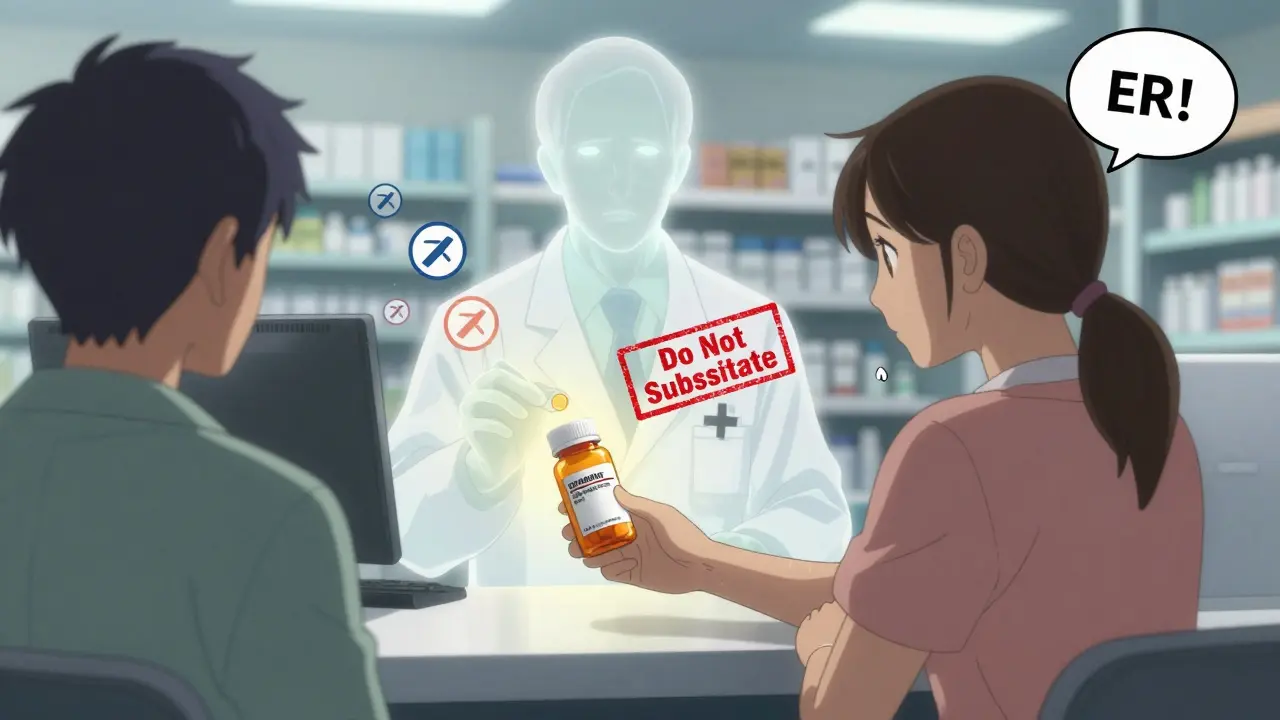
What You Can Do
If your doctor prescribes a brand-name drug and you’re not sure why, ask. Don’t assume it’s about profit. Ask: “Is this because of the type of drug? Or because I had a bad reaction to a generic before?” If you’ve never tried the generic, ask if you can try it under supervision. If you’ve had a bad experience with a generic, tell your doctor exactly what happened-fatigue, nausea, mood changes, seizures. Document it. Check your insurance. If you’re being charged more for a brand-name drug, ask if your plan has a tiered formulary. Sometimes, the brand is on a higher tier just because the manufacturer pays the insurer more-not because it’s better. Use resources like the FDA’s Orange Book to check if a generic is rated as therapeutically equivalent. If your pharmacist switches your drug without your doctor’s permission and you feel worse, speak up. Pharmacists are allowed to substitute unless the doctor says “do not substitute.” You have the right to know why a change was made.The Bigger Picture
About 90% of prescriptions in the U.S. are filled with generics. But they make up only 23% of total drug spending. That means brand-name drugs, though rarely prescribed, cost the system far more. Experts estimate that up to 15-20% of brand-name prescriptions are unnecessary. That’s billions of dollars wasted every year. The problem isn’t just cost. It’s trust. Patients worry that generics are “inferior.” Doctors, under pressure from pharmaceutical reps and patient demands, sometimes prescribe brands out of habit. But the science is clear: for most drugs, generics are just as good. For a small, critical group, they’re not. The goal isn’t to ban brand-name drugs. It’s to make sure they’re used only when they matter. When your life depends on precise dosing, you deserve the right drug. When you’re taking a statin to lower cholesterol, you deserve to save money. The line between the two isn’t always easy to see. But with the right questions, you can make sure you’re getting what you need-not what’s easiest to prescribe.Can my pharmacist substitute a generic if my doctor didn’t say ‘do not substitute’?
Yes. In 49 U.S. states and Washington D.C., pharmacists can legally swap a brand-name drug for a generic unless the doctor writes ‘dispense as written,’ ‘do not substitute,’ or ‘brand medically necessary.’ Only Texas has stricter rules for certain drugs. Always check your prescription label and ask your pharmacist if a substitution was made.
Why do some people have bad reactions to generics?
The active ingredient is the same, but the fillers, dyes, and coatings can differ between manufacturers. For some people, these inactive ingredients cause stomach upset, allergies, or mood changes. This is most common with antibiotics like ciprofloxacin or thyroid meds like levothyroxine. If you notice side effects after switching, report them to your doctor and pharmacist.
Are generic drugs less effective?
For most drugs, no. The FDA requires generics to be bioequivalent to the brand-meaning they work the same way in the body. Large studies, including one from JAMA in 2020 with over 112,000 patients, found no difference in outcomes for statins, blood pressure meds, and antidepressants. The only exceptions are narrow therapeutic index drugs, where even small absorption differences matter.
Can I ask my doctor to switch me to a generic?
Absolutely. If you’re paying more than necessary, ask if a generic version exists and if it’s safe for you. Bring up cost concerns, side effects, or insurance issues. Many doctors will switch you-unless there’s a medical reason not to. You’re not being difficult; you’re being informed.
What’s an ‘authorized generic’?
An authorized generic is made by the same company that makes the brand-name drug, but sold under a different label at a lower price. It’s identical in every way-same ingredients, same factory, same quality. These avoid the variability between different generic manufacturers and are a good middle ground if you’re worried about switching.
Chris & Kara Cutler
February 1, 2026 AT 17:50This hit home so hard 😭 I switched from Synthroid to generic and felt like I was walking through wet cement for months. My doctor said it was 'all in my head.' Turns out? It wasn't. Back on brand now and I can breathe again. Don't let anyone tell you your symptoms aren't real.
Also, $120/month is nothing compared to an ER trip. Worth every penny.
Donna Macaranas
February 2, 2026 AT 07:51I’ve been on generic levetiracetam for years with zero issues. But I also don’t have seizures, so maybe my body just doesn’t care about the 10% swing. Everyone’s different. I think the key is listening to your body-not the hype.
Rachel Liew
February 3, 2026 AT 07:53my doctor just told me to switch to generic and i did without asking and then i got super dizzy and nauseous for weeks. i felt so stupid for not speaking up. now i always ask 'is this one of those drugs where it matters?' and they're always surprised i know to ask. you're not being annoying, you're being smart.
thank you for writing this.
Jamie Allan Brown
February 3, 2026 AT 09:07As someone who’s watched a close friend nearly die from a seizure after a generic switch, I can’t stress this enough: NTI drugs aren’t a gamble. It’s not about being rich or privileged-it’s about biology. The system treats these drugs like they’re interchangeable like soda brands. They’re not. Lives depend on consistency.
And yes, I’ve seen insurance deny prior auth for years. It’s broken.
Lisa Rodriguez
February 3, 2026 AT 09:15My mom takes warfarin and they switched her to generic and her INR went wild. Took three weeks to stabilize. She was terrified. Now she pays $40 a month for brand and we’re fine with it. I used to think generics were always better but now I get it. It’s not about cost, it’s about control.
Also-pharmacists should have to call you before switching. No one should be blindsided like this.
Ed Di Cristofaro
February 3, 2026 AT 12:40People who pay for brand-name meds because they're too lazy to deal with their own health are the reason healthcare costs are insane. If you can't handle a little variability, maybe you shouldn't be taking meds at all. Stop whining and take the generic like the rest of us.
Lilliana Lowe
February 3, 2026 AT 13:32The FDA’s 80–125% bioequivalence standard is statistically inadequate for narrow therapeutic index drugs. This is not anecdotal-it’s pharmacokinetic reality. The 2019 Epilepsy & Behavior study, which you cited, demonstrated a statistically significant increase in seizure recurrence (p < 0.01). Any claim that generics are 'just as good' for NTI drugs is not only misleading-it’s dangerous. Furthermore, the FDA’s recent guidance on pill shape standardization is a long-overdue, scientifically defensible step toward reducing medication errors. I commend the author for citing primary literature rather than relying on corporate-funded meta-analyses.
vivian papadatu
February 4, 2026 AT 23:23My dad is from India and he used to say, 'In my village, we don't have brand names-we have results.' But when he came to the US and got on Synthroid, he realized something: medicine isn't just chemistry. It's trust. It's routine. It's knowing your body won't betray you because the pill looks the same every time.
He switched to an authorized generic last year. Same factory. Same pill. Half the price. No fog. No crashes. He calls it 'the smart middle ground.'
And yes, I cried when he told me that.
Deep Rank
February 6, 2026 AT 21:23Okay but let’s be real-most people who say generics don’t work for them are just lazy or have anxiety about their health. I’ve been on every generic under the sun and I’m fine. Your body adjusts. If you’re getting depressed or fatigued after switching, maybe it’s not the pill-it’s your mindset. Or maybe you’re just not used to saving money. Let me tell you, in India, we don’t even have brand names for most meds, and we don’t have seizures or thyroid crashes because we’re not coddled. You think your body is special? It’s not. You just think you are. Also, $120 a month? That’s a latte. Get a job. Stop being a victim. I’ve seen real poverty. This is not a crisis. It’s a privilege problem.
Also, why do you all keep saying 'my doctor said'? Doctors are just middlemen. The system is rigged. You’re all just pawns. Wake up.
And PS-your 'authorized generic' is still a generic. Don’t fool yourself. You’re just paying extra for branding. Same pill. Same factory. Same placebo effect. You’re not special. You’re just loud.