
Wholesale Economics: How Generic Drug Distribution and Pricing Actually Work
 Jul, 3 2026
Have you ever wondered why a generic pill that costs pennies to manufacture can still seem expensive at the pharmacy counter? The answer isn't just about the medicine itself. It’s about the complex web of middlemen who move those pills from factories to your local shelf. This system, known as pharmaceutical wholesale distribution, is a critical supply chain network that connects manufacturers to pharmacies and healthcare providers, operates on margins so thin they would bankrupt most other industries.
If you think the price tag reflects the cost of ingredients, you’re missing the bigger picture. More than $1 in every $5 spent on prescription drugs goes toward the profits of firms within this distribution system. That number sounds high until you realize how many hands touch a single box of medication before it reaches you. Let’s break down exactly how this machinery works, who controls it, and why the economics of generic drugs are completely different from branded ones.
The Three-Tier System Explained
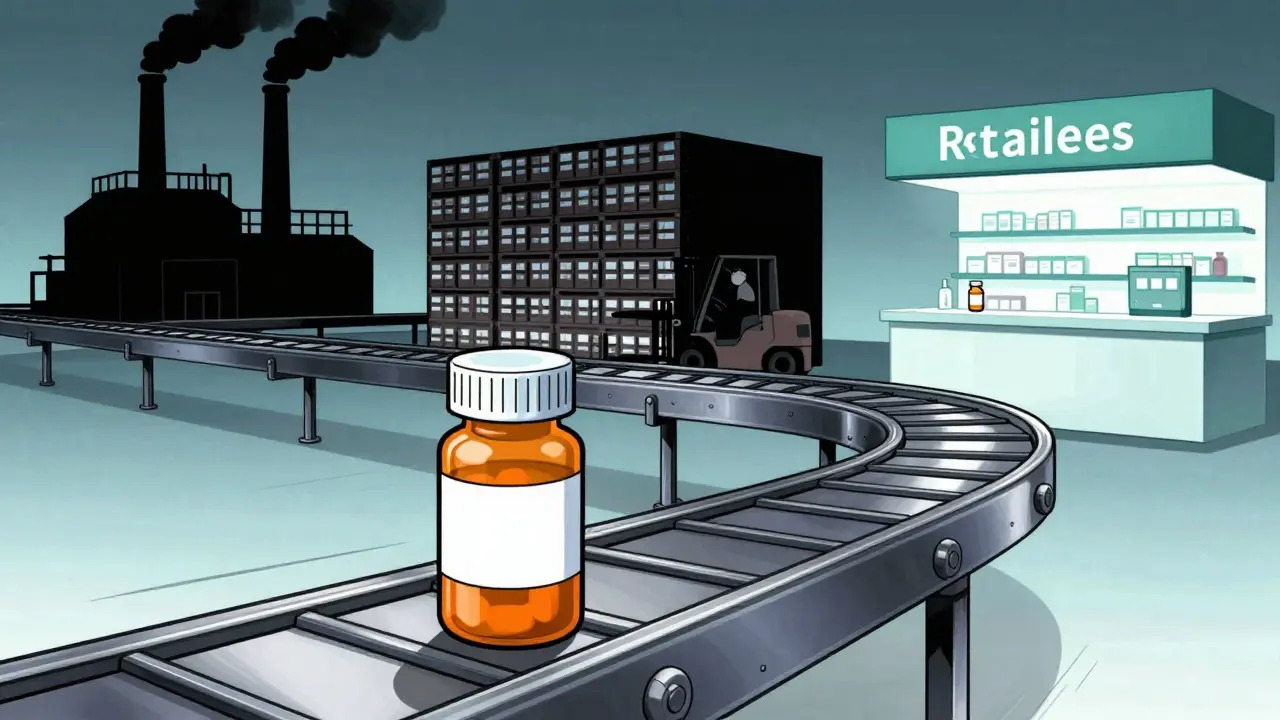
To understand where the money goes, you first need to see how the product moves. Since the Prescription Drug Marketing Act of 1987, the U.S. has relied on a formalized three-tier structure. It’s simple in theory but massive in scale.
- Manufacturers: These companies produce the actual drugs. For generics, their job is volume over margin.
- Wholesalers: The middlemen. They buy in bulk from manufacturers and sell to pharmacies. They handle logistics, inventory, and credit risk.
- Pharmacies: The final retailers. They dispense the medication to patients and bill insurance companies or payers.
This structure wasn’t designed by accident. It was built to ensure efficiency. Manufacturers don’t want to manage thousands of individual pharmacy accounts. Pharmacies don’t want to negotiate with hundreds of tiny factories. Wholesalers fill that gap. But here’s the catch: this convenience comes at a cost. The intermediaries take a cut, and in the case of generic drugs, that cut is surprisingly large relative to the drug’s list price.
Who Controls the Pipeline?
You might imagine a competitive market with dozens of players fighting for business. In reality, the landscape is dominated by an oligopoly. As of 2023, the "Big Three" wholesalers-AmerisourceBergen, Cardinal Health, and McKesson-control approximately 85% of the U.S. pharmaceutical wholesale market. According to the Drug Channels Institute's 2023-24 Economic Report, these giants have immense bargaining power.
Why does this concentration matter to you? Because when only three companies control the flow of goods, they set the terms. They decide which drugs get priority during shortages. They negotiate discounts that determine what pharmacies pay. And they influence the prices that eventually appear on your receipt. This lack of competition means smaller distributors struggle to survive, and manufacturers have fewer places to sell their products.
The Profit Paradox: Why Generics Are King for Wholesalers
Here is the part that confuses most people. Generic drugs are cheap, right? So why do wholesalers love them more than expensive brand-name drugs? The answer lies in the difference between revenue and profit.
| Sector | Generic Gross Margin | Branded Gross Margin |
|---|---|---|
| Manufacturers | 49.8% | 76.3% |
| Pharmacies | 42.7% | Lower |
| Wholesalers | Higher (Volume-driven) | Lower |
Look at the numbers. Manufacturers make much higher gross margins on branded drugs (76.3%) compared to generics (49.8%). However, for wholesalers and pharmacies, the story flips. A 2006 study by the USC Schaeffer Center found that wholesalers make eleven times as much profit on generic drug expenditures compared to brand-name drugs ($32 versus $3 per unit). Pharmacies see a similar trend, making almost twelve times as much on generics.
How is this possible? Volume. Generic drugs represent a massive portion of prescriptions filled. Even if the margin per pill is tiny, the sheer number of pills sold generates enormous total profit. In 2009, generics represented only 9% of wholesaler revenues but contributed 56% of their gross profits. This creates a misaligned incentive: wholesalers are motivated to push generics because they are more profitable for their bottom line, even if the absolute dollar amount per transaction is lower.
Pricing Strategies: How Numbers Are Crunched
Wholesalers don’t just pick a random number off the ceiling. They use specific methodologies to set prices that keep their margins intact while remaining competitive. Here are the four primary strategies used in the industry:
- Cost-Plus Pricing: The simplest method. Add up production costs, shipping, and handling, then add a fixed percentage markup. If the Cost of Goods Sold (COGS) is $10 and shipping is $2, the base cost is $12. A 20% markup results in a $14.40 wholesale price. This guarantees profit but ignores what competitors are charging.
- Market-Based Pricing: Setting prices based on what other wholesalers charge. This keeps you competitive but can lead to race-to-the-bottom scenarios where margins shrink dangerously low.
- Tiered Pricing: Discounts based on volume. This is standard in pharma. You might pay $10 per unit for orders under 100 units, but drop to $8 per unit for orders over 500 units. This encourages pharmacies to buy in bulk, reducing the wholesaler’s logistical burden.
- Value-Based Pricing: Less common for generics, this aligns price with perceived value to the buyer. For specialty drugs, this matters more. For basic generics, it’s mostly about speed and reliability of delivery.
A key factor often overlooked is shipping. As noted by Usetorg’s 2023 analysis, if COGS is $10 but shipping adds $2 per unit, the revised price must absorb that cost. In a high-volume, low-margin game like generics, failing to account for logistics can turn a profitable order into a loss.
The Volatility of Supply: Shortages and Inflation
The economic model described above assumes a steady flow of goods. But what happens when that flow stops? The period from 2021 to 2022 saw deflationary pressures in generic pricing after pandemic-related inflation in 2020. However, 2023 brought a shock: widespread generic drug shortages. Adam J. Fein, President of Drug Channels Institute, noted that these shortages triggered "pockets of inflation" in specific categories.
When supplies dwindle, the leverage shifts. Wholesalers who hold inventory become gatekeepers. Prices spike not because production costs rose, but because scarcity allows sellers to charge more. The Commonwealth Fund’s 2022 analysis highlighted that wholesalers influence the market by setting generic drug prices and affecting drug shortages. This volatility makes budgeting difficult for pharmacies and ultimately increases costs for patients.
Is the System Broken?
Critics argue that the current structure extracts too much value from the healthcare system without adding proportional benefit. Dr. Neeraj Sood of the USC Schaeffer Center concluded that while we can't definitively say profits are "excessive," greater scrutiny and more competition are warranted. The fact that net margins for wholesalers hover around 0.5% suggests they operate on razor-thin edges, relying on massive scale to survive. Yet, their ability to influence prices and access raises questions about fairness.
For consumers, understanding this ecosystem helps explain why drug prices behave the way they do. It’s not just greed; it’s a complex interplay of volume, logistics, and market concentration. As regulatory scrutiny increases and shortages continue to disrupt the market, expect changes in how these giants operate. The goal for policymakers remains clear: reduce spending, ease shortages, and ensure that the economics of distribution serve public health rather than just corporate balance sheets.
Who are the main players in pharmaceutical wholesale?
The market is dominated by the "Big Three": AmerisourceBergen, Cardinal Health, and McKesson. Together, they control approximately 85% of the U.S. pharmaceutical wholesale market, giving them significant power over pricing and distribution.
Why do wholesalers prefer generic drugs over branded ones?
Although generic drugs have lower individual prices, they generate much higher volume. Wholesalers make eleven times more profit on generic expenditures compared to brand-name drugs due to this volume and the lower cost basis, which improves their return on assets.
How does tiered pricing work in wholesale distribution?
Tiered pricing offers discounts based on order size. For example, a pharmacy might pay full price for small orders but receive a 5-15% discount for orders exceeding 100 units, and up to 25% for orders over 500 units. This encourages bulk buying and reduces logistical costs for the wholesaler.
What causes generic drug shortages and price spikes?
Shortages can result from manufacturing issues, raw material scarcity, or supply chain disruptions. When supply drops, wholesalers with existing inventory gain leverage, leading to "pockets of inflation" where prices rise sharply despite the drug being a low-cost generic.
Do wholesalers actually make a lot of money?
While gross profits are significant due to volume, net margins for wholesalers are very thin, often around 0.5%. They rely on massive scale and efficient logistics to remain profitable. However, their aggregate impact on drug spending is substantial, accounting for a large portion of prescription drug costs.